

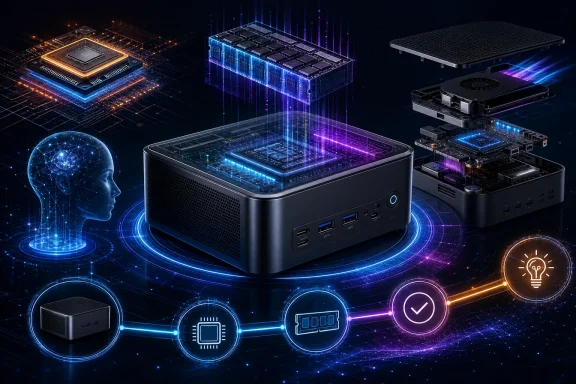
But the key distinction for prospective Windows buyers is between a documented platform specification and a proven finished computer. AMD has published the processor’s specifications, and ACEMAGIC has detailed the F9A’s intended ports and storage. Yet there are no independent reviews of this exact PRO 495 configuration covering gaming, sustained CPU performance, heat, fan noise, eGPU behavior, or local AI throughput. Its price, retail date, regions, and final SKU lineup also remain unannounced as of September 4, 2026.
An IFA showcase, not a retail launch date
ACEMAGIC says it is showing the F9A Mini Workstation at IFA Berlin from September 4 through September 8, 2026, in Hall 6.2, Booth 128. That gives the machine a concrete public debut rather than leaving it as a processor leak or an unverified product listing.
It does not, however, mean the Ryzen AI Max+ PRO 495 model is immediately available to order. A September 10 pre-sale date that has circulated publicly applies to an F9A version using the existing Ryzen AI Max+ 395. ACEMAGIC had not announced pricing or a release schedule for the PRO 495 version at the time of the showcase.
That distinction is consequential. The 395 and PRO 495 machines may share an F9A name and much of the same chassis concept, but the latter’s defining specification is its higher 192 GB memory ceiling. Buyers who specifically need that capacity should not assume that a listing for the 395 configuration represents an order path for the PRO 495 system.
What AMD has confirmed about the Ryzen AI Max+ PRO 495
The Ryzen AI Max+ PRO 495 is an official AMD processor in the Ryzen AI Max PRO 400-series, formerly known by the Gorgon Halo codename. Its published specifications include:
- 16 Zen 5 CPU cores and 32 threads
- A 3.1 GHz base clock and boost clock up to 5.2 GHz
- Support for up to 192 GB of LPDDR5X-8533 memory
- Radeon 8065S integrated graphics with 40 graphics cores running at up to 3.0 GHz
For the F9A, the headline is not merely the core count. It is the relationship between memory and graphics. ACEMAGIC describes the system’s LPDDR5X memory as unified memory, meaning the CPU and integrated graphics draw from the same pool. The company lists up to 192 GB of total memory and a maximum graphics-memory allocation of 160 GB.
For Windows workloads, that could be meaningful for users whose projects are constrained by graphics memory rather than raw CPU cores: large local AI models, data-processing tasks, content workloads, or development environments with several memory-hungry applications open at once. A conventional compact PC with a discrete GPU may have more graphics performance, but its GPU memory capacity is often fixed and separate from system RAM. The F9A’s premise is that one large shared pool can make certain capacity-sensitive jobs possible in a compact system.
Capacity should not be confused with guaranteed speed. How well a particular local model, creative application, game, or compute workload runs depends on its software support, memory bandwidth demands, the F9A’s configured power limits, cooling, and the amount of memory assigned to the graphics processor. None of those system-level results has yet been independently established for the PRO 495 version.
The configuration ACEMAGIC has announced
ACEMAGIC’s published F9A-PRO495 specifications go beyond the APU. The intended platform includes Radeon 8065S graphics, two USB4 ports, OCuLink PCIe 4.0 x4 expansion, Wi-Fi 7, dual 2.5GbE networking, HDMI 2.1, and DisplayPort 2.1.
For a Windows desktop replacement, dual 2.5GbE is particularly practical in a home lab, small office, or NAS-heavy setup. It can support fast wired networking without requiring a USB adapter, assuming the rest of the network also supports 2.5GbE. USB4 provides flexibility for modern docks and fast external storage, while HDMI and DisplayPort give the machine an appropriate display baseline for a workstation-oriented role.
The OCuLink connection is also notable because it brings a direct PCIe 4.0 x4 expansion path to a very small machine. That does not by itself prove any particular external graphics enclosure, device, driver combination, or game will work flawlessly. It does mean an external-expansion test should be high on the review checklist, especially for users considering the F9A as a compact workstation that may later need more graphics horsepower.
Storage reporting around this model needs a correction. The announced F9A does not have a single M.2 2280 PCIe 4.0 x4 SSD slot limited to 4 TB. ACEMAGIC specifies two M.2 2280 PCIe 4.0 x4 NVMe slots, with support for up to 8 TB of total SSD storage. That is a material advantage for Windows users who want to separate the operating system and applications from game libraries, project files, virtual machines, or local model data.
Even so, final retail options are not yet nailed down. It is not established that every region or purchasable configuration will include every listed interface, the 192 GB option, or the full storage choices described in the announcement.
Gaming potential is plausible, but not yet an F9A result
The Radeon 8065S is a 40-compute-unit RDNA 3.5 integrated GPU running at up to 3.0 GHz. Independent GPU reference coverage places it somewhere between GeForce RTX 4060 Laptop and RTX 4070 Laptop performance depending on the game and benchmark. That is an encouraging starting point for an iGPU, but it should not be read as a promise that the F9A itself will match a particular gaming laptop.
Laptop GPUs operate under widely varying power limits, memory configurations, cooling designs, and vendor tuning. The same caution applies to an integrated GPU in a mini PC. System memory speed, the amount of memory reserved for graphics, chassis cooling, and sustained power behavior can all affect real results. Game drivers and individual game engines can matter just as much.
There is also a reason to temper expectations about the 8065S versus AMD’s earlier Radeon 8060S. The documented GPU-clock difference is only 100 MHz: 3.0 GHz for the 8065S versus 2.9 GHz for the 8060S. Independent reference coverage expects very similar graphics performance. The larger differentiator for the PRO 495 platform is therefore likely to be the ability to configure substantially more unified memory, rather than a dramatic graphics-speed leap.
For Windows gamers, the practical conclusion is straightforward: the F9A could be compelling for space-constrained 1080p or carefully tuned higher-resolution gaming, particularly for people who also value CPU capacity and local AI work. It is not yet sensible to treat it as a verified replacement for a gaming desktop with a dedicated graphics card. Independent tests need to establish frame rates, image-quality settings, upscaling behavior, frame-time consistency, temperatures, and acoustics before making that call.
A small refresh in early numbers, not a 10% breakthrough
Pre-launch PassMark figures suggested the PRO 495 scored 4.1% higher in multi-threaded CPU testing and 3.1% higher in single-thread testing than the non-PRO Ryzen AI Max+ 395. Those figures are directionally consistent with a modest refresh, but they are not proof of a meaningful real-world lead.
The report containing those numbers explicitly cautioned that PassMark is not representative of real workloads and that run-to-run variation could explain the difference. It also does not substantiate claims of a 10% advantage over a Ryzen AI Max+ PRO 395.
This restraint is important for buyers choosing between available 395 models and a future PRO 495 model. The documented memory increase from 128 GB to 192 GB is a concrete platform difference. CPU and GPU performance gains, by contrast, should be treated as unverified until the same applications are tested on final systems using comparable power and memory configurations.
The same principle applies to ACEMAGIC’s local-AI messaging. The company has presented a local DeepSeek V4 Flash 284B demonstration, but the model quantization, context length, tokens-per-second measurement, power profile, and software stack have not been independently documented. A claim that a system can load or demonstrate a large model is not enough to determine whether the experience is practically responsive for a particular Windows workflow.
Security history should affect setup decisions
The F9A also arrives with historical baggage that deserves a factual, limited treatment. In February 2024, independent reporting described suspected Bladabindi and Redline malware in reports involving older AceMagic AD08, AD15, and S1-related systems. Windows Defender reportedly identified suspicious files on a recovery partition, and security scanning flagged the files as malicious.
ACEMAGIC later disputed the characterization, saying the affected reports involved altered software and omitted signatures rather than the named malware. The company said the issue was limited to systems manufactured from September through November 2023 and offered returns for affected production dates.
Those are competing accounts of an older incident, not evidence that a new F9A-PRO495 will ship compromised. Equally, they are not an independent verification of the new model’s factory Windows image, recovery media, or firmware. No model-specific audit or independent security validation for the F9A-PRO495 is available in the present information.
For Windows buyers—especially businesses, developers, and anyone who will attach credentials, private code, or sensitive data—the prudent approach is to reduce trust in any factory software image. On arrival, install a fresh Windows image obtained directly from Microsoft, apply current firmware and driver updates from the relevant official vendors, enable Secure Boot and device encryption where appropriate, and scan any bundled recovery media before using it. This is a measured response to a documented prior concern, not an allegation about a product that has not yet been independently evaluated.
The question is execution, not headline specifications
The F9A-PRO495 has the ingredients for one of the more interesting compact Windows workstations of 2026: a 16-core Zen 5 APU, 40-core Radeon integrated graphics, up to 192 GB of shared LPDDR5X memory, dual NVMe storage, fast wired networking, USB4, and OCuLink expansion in a roughly 2-liter chassis.
Its strongest case is likely to be for users who value compact size and unusually high memory capacity more than conventional desktop upgradeability. That includes developers, local-AI experimenters, media users, home-lab operators, and power users who want a small Windows machine with serious CPU resources and storage flexibility.
Yet the reasons to wait are equally concrete. The PRO 495 version has no announced price or sales date, and there is no independent evidence yet on thermal performance, noise, power behavior, gaming, external expansion, or practical AI speed. The right verdict today is not that the F9A-PRO495 is a proven gaming powerhouse or an established AI workstation. It is a promising, unusually high-memory mini-PC design whose most important claims now need to survive independent testing and a real retail launch.