

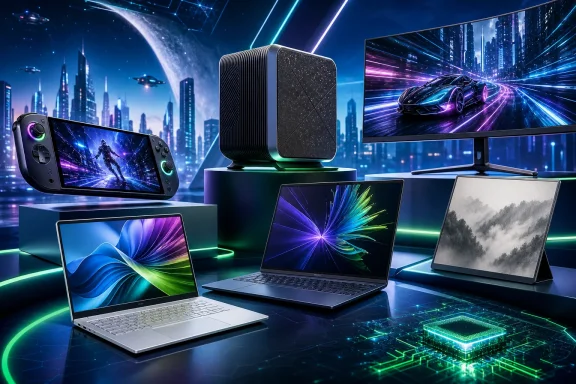
The important distinction for buyers is that this was not one conventional product launch. Some devices have regional release windows, some are only designs awaiting commercial details, and one of the more eye-catching machines is explicitly a concept. For Windows users, the practical value of Acer’s IFA slate therefore depends less on the sheer number of announcements than on separating confirmed hardware from promising but unfinished propositions.
The Predator Atlas 7 is the shipping handheld to watch
The Predator Atlas 7 is a real product rather than a demonstration unit. It joins the earlier, larger Atlas 8 in Acer’s handheld range, but uses a 7-inch touchscreen with a 1,920-by-1,080 resolution and 120 Hz refresh rate. Acer specifies Windows 11 Home, making it a straightforward PC handheld rather than a separate console ecosystem.
That operating-system choice is consequential. A Windows handheld can run the large existing catalogue of PC games and conventional Windows software, but it also inherits the compromises of the desktop-oriented platform: game launchers, small-text interfaces, touch and controller compatibility, and background Windows management all matter more on a 7-inch screen than on a laptop display. The 120 Hz panel gives the Atlas 7 a potentially useful ceiling for games capable of reaching high frame rates, but the screen specification alone does not establish how often particular games will do so.
Acer positions the Atlas 7 below the Atlas 8 while still listing configurations up to an Intel Arc G3 Extreme processor and Intel Arc B390 graphics. Lower configurations use Intel Arc G3 and B370 graphics. The company also specifies a battery of up to 80 Wh.
The repeated use of “up to” is worth treating seriously. It means prospective buyers should not assume every Atlas 7 has the top graphics option or the largest battery. Nor do the announced specifications tell us how battery life will vary across configurations and games. High-resolution rendering, refresh-rate settings, power profiles, and the selected hardware tier can all shape the experience, so final pricing and detailed configuration lists will be central to judging value.
Acer says the handheld will be available in North America from the fourth quarter of 2026 and in EMEA from November 2026. Its announcement does not list an Australian release date or price. That is not evidence that an Australian launch will not happen; it means Australian buyers do not yet have a confirmed local timetable or cost to plan around.
DualPlay Mini is intriguing, but not a purchase option
Acer also showed Project DualPlay Mini alongside the Atlas 7. The difference in status could not be clearer: DualPlay Mini is a concept only.
The 8-inch Intel-powered system is designed to flip and swivel between a handheld form and a miniature laptop. Acer describes it with a backlit physical keyboard and external-display support. This is a thoughtful response to a genuine Windows handheld tension: controller-first play is convenient, while text entry, settings changes, light productivity work, and many non-gaming applications work better with a keyboard and a larger display.
Yet the concept’s appeal should not be mistaken for a release commitment. Acer has not positioned it as a shipping product, has not specified its operating system, and has not provided market, price, or availability information. In particular, it should not be described as a Windows device merely because it is Intel-powered or resembles a tiny laptop. Until Acer turns the idea into a product with final specifications, it is best read as an exploration of form factor rather than a competitor buyers can compare with existing handheld PCs.
Swift Blade 14 and Swift Air 16 test the ultralight proposition
Acer’s other major consumer-PC announcement shifts from portable gaming to thin-and-light notebooks. The Swift Blade 14 and Swift Air 16 both use Intel Core Series 3 processors, the product family Intel previously referred to by the codename Wildcat Lake.
The Swift Blade 14’s standout published figure is its 799 g weight. For commuters, frequent travellers, and users who carry a laptop throughout the day, that is the kind of specification that can have a more immediate effect on ownership than a processor-brand change. The trade-off is that ultralight systems need to be evaluated as complete designs. Buyers still need final configuration, connectivity, battery-life, thermals, memory, storage, and price information before deciding whether the weight saving suits their workload.
Acer lists OLED options for the 14-inch model up to 2,880 by 1,800 at 90 Hz. The Swift Air 16 has OLED options up to the same 2,880-by-1,800 resolution at 120 Hz, plus an IPS touch option. Those alternatives matter because screen choice is not simply a quality ladder. A larger 16-inch display can aid document work and multitasking, while a lower-weight 14-inch chassis is more convenient in transit. Similarly, an IPS touch option may suit users who value touch input, whereas an OLED configuration emphasizes the display technology Acer is offering. Buyers should compare the actual SKU sold in their region rather than assuming every version has the headline panel.
Acer lists the Swift Blade 14 for EMEA availability in December 2026. The Swift Air 16 is scheduled for EMEA in December 2026 and North America in the first quarter of 2027. No Australian date is included for either machine in the announcement.
That regional split is especially relevant for Windows laptop shoppers tempted to wait. A confirmed European or North American window is not a substitute for local retail availability, warranty terms, keyboard configuration, or Australian pricing. It is reasonable to monitor for an Australian announcement, but not to make a buying decision on the assumption that the same models will arrive on the same timetable.
RTX Spark is a local-AI desktop design, not a released Acer PC
Acer’s most ambitious technical announcement is its compact SFF RTX Spark design. The company says it is intended for local agentic-AI workloads and describes a top configuration with up to 128 GB of high-speed unified memory and up to one petaflop of AI performance.
The underlying NVIDIA RTX Spark platform is described as pairing a Blackwell RTX GPU with 6,144 CUDA cores and a 20-core Grace CPU. That independently established platform description helps clarify the class of hardware Acer is targeting: a compact system aimed at substantial local AI computation, not a conventional entry-level desktop.
But two cautions are essential. First, Acer showcased a design rather than releasing a retail desktop. Availability is to be announced later, and final configurations, prices, and regions remain unknown. Second, the one-petaflop figure is a vendor performance claim for the platform and design, not an independently published benchmark of a finished Acer system.
For Windows users, local AI has a clear appeal in principle: work can potentially be performed on-device rather than sent to a remote service, and powerful local hardware may enable workloads that are impractical on ordinary PCs. However, the announcement does not prove a specific application’s speed, quality, compatibility, privacy properties, or electricity cost. Those questions require shipped hardware, software support, and repeatable testing.
The broader takeaway is that compact desktops are becoming a more visible vehicle for high-end AI hardware. That could be meaningful for developers and organisations that want substantial compute in a small footprint. For mainstream buyers, though, this remains a category to watch rather than a product to order.
Acer’s display story is more varied than “new OLED monitors”
The gaming-monitor announcement needs a similar degree of precision. Acer has announced one new QD-OLED Predator model, the 31.5-inch Predator X32 V3, with a QD-OLED Penta Tandem panel. It did not announce a whole new generation of Predator OLED monitors.
The other named models make the point. The Predator XB253Q U1 is an IPS monitor specified for Full HD at a remarkable 1,000 Hz refresh rate. The Predator XB273K V7 is also IPS, offering UHD at 160 Hz and a mode reaching Full HD at 500 Hz. They target a different set of compromises from the X32 V3.
For competitive players, the XB253Q U1’s headline is refresh rate, but a 1,000 Hz specification is not automatically a practical advantage in every game or with every PC. The benefit depends on whether the game, processor, graphics hardware, settings, and input setup can sustain the necessary frame rates. Meanwhile, the XB273K V7’s selectable resolutions and refresh ceilings illustrate the usual trade-off: prioritize pixel detail or prioritize speed. The QD-OLED X32 V3 is the display to consider for buyers specifically seeking that panel technology, rather than assuming the entire group shares it.
Acer also announced the EP130K portable ePaper monitor, aimed at deep work, reading, and mobile use. It combines paper-like visuals with glare-free use, touch and stylus support, colour and monochrome modes, and a specification of up to 3,200 by 2,400 at 60 Hz. This is a distinctly different proposition from a fast gaming monitor. Its stated appeal is the viewing experience for prolonged reading and work, not high-motion entertainment. Acer’s description supports glare-free, paper-like positioning, but it does not by itself establish a medical or ergonomic claim about reducing eye strain.
Availability is the deciding factor for Australia
The unifying challenge across the Atlas 7 and the new Swift models is not a lack of interesting hardware; it is the absence of Australian release dates and prices in Acer’s announcements. The only confirmed regional plans cited for those devices are North America and EMEA, and those windows differ by product.
There is also a wider market uncertainty. Industry analysis forecasts persistent memory shortages with no meaningful relief expected before the end of 2027, alongside rising prices and manufacturers struggling to maintain full product portfolios. That is a credible reason for consumers to expect an unsettled PC market. It is not, however, proof that memory supply will delay Acer’s Australian launches or determine the price of any particular Swift, handheld, or desktop configuration.
A sensible response is to treat Acer’s IFA portfolio as a roadmap with different degrees of certainty. The Atlas 7, Swift Blade 14, and Swift Air 16 are announced products with partial regional schedules. RTX Spark is an Acer desktop design awaiting commercial details. DualPlay Mini is a concept. And the display range spans distinct technologies and priorities rather than one uniform OLED refresh.
For Windows users, that distinction is more useful than the announcement volume. Wait for the local configuration, price, and availability details that determine whether a striking specification becomes a practical purchase.