
That timing matters because the Nitro 30 story is less about a fresh platform launch than about Acer taking a high-end Radeon RX 9070 XT configuration into additional regional sales channels. It is a fairly conventional prebuilt on AMD’s older AM5-based Ryzen 8000G-family silicon, wrapped around a considerably newer RDNA 4 graphics card. For Windows gamers looking at compact OEM desktops, the useful question is not whether the hardware exists—it clearly does—but which regional SKU is being offered, at what price, and with what upgrade and lighting controls.
Guru3D reported a Japanese price of ¥588,000, including regional tax and distribution, for the Ryzen 7 8700F/RX 9070 XT version. Acer has not made that pricing easy to independently verify from its broader Nitro 30 product page, which advertises the family rather than providing a uniform global configuration sheet. Buyers should therefore treat that figure as a Japan-specific quoted configuration, not a reference price for North American or European availability.
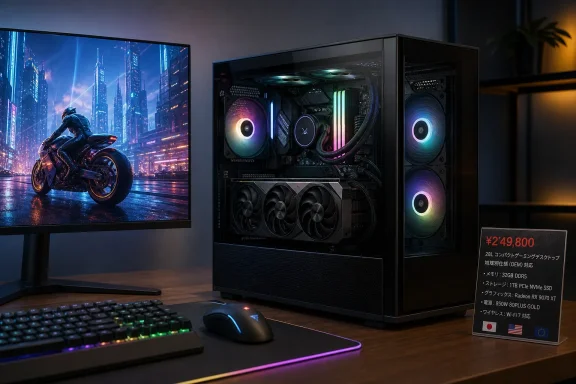 The Ryzen 7 8700F configuration predates the new report
Acer Taiwan announced the Nitro 30 N30-100 on May 22, offering a Ryzen 7 8700F with either Radeon RX 9070 XT or RX 9060 XT graphics. Taiwanese sellers have subsequently listed the higher-end model under part number DG.E53TA.002 with 32GB of DDR5, a 1TB SSD, an 850W power supply and Windows 11 Home. European retailers have also listed an RX 9070 XT variant, though model identifiers and regional accessory bundles differ.
That independently establishes that the Ryzen 7 8700F/RX 9070 XT machine is a shipping product rather than a paper configuration announced on August 21. The distinction is more than pedantic. OEM desktop launches often arrive region by region, and Acer’s marketing pages fold multiple possible CPU, graphics, storage and memory options into one product family. A reader who sees “Nitro 30” without the N30-100 model code could easily assume every market receives the same internals.
Acer’s own Japanese Nitro 30 family page illustrates the problem. It promotes configurations with a Ryzen 7 8700G and calls out the Radeon RX 9070 XT, while the regional retail SKU reported by Guru3D and the previously listed Taiwanese N30-100 use the Ryzen 7 8700F instead. Both processors are eight-core, 16-thread Zen 4 chips with 24MB of combined cache and a 65W default TDP, but the suffix matters: the 8700G includes integrated Radeon graphics and Ryzen AI hardware, while the 8700F is the discrete-GPU-oriented version with its integrated graphics disabled.
For a system built around a Radeon RX 9070 XT, the missing integrated GPU is not a major gaming handicap. It can, however, matter for troubleshooting a dead or removed graphics card, for certain low-power desktop scenarios, and for buyers who expected to use the processor’s onboard display outputs. Acer’s public family-page language about Ryzen AI should also not be automatically carried over to the 8700F model.
The graphics card defines the machine more than the CPU
The Radeon RX 9070 XT is the real performance anchor here. AMD’s RDNA 4 GPU carries 16GB of GDDR6 memory and targets high-refresh 1440p gaming, with enough memory headroom to make it more durable than 8GB and 12GB cards in modern Windows titles with demanding texture settings. Acer’s own Nitro RX 9070 XT board specifications cite a 304W total board power figure for the card, which explains the inclusion of an 850W 80 Plus Gold power supply in the complete desktop.
The Ryzen 7 8700F is capable enough for mainstream gaming, but it is not the same class of CPU as AMD’s Ryzen 7000 and Ryzen 9000 desktop chips that provide more PCIe lanes and newer platform options. AMD lists the 8700F as a PCIe 4.0 processor, while the RX 9070 XT itself supports PCIe 5.0. In the Nitro 30, that means the graphics card is unlikely to be used at its maximum possible interface generation—though PCIe 4.0 bandwidth is generally not a practical performance constraint for a current single-GPU gaming desktop.
The more concrete limitation is expandability. Acer describes the chassis as upgradeable and says the wider Nitro 30 family can support up to 32GB of DDR5-5600, a PCIe Gen 4 SSD and a 3.5-inch hard drive. But the company does not publicly spell out the motherboard layout, available M.2 slots, BIOS options, proprietary cabling or graphics-card clearance for every N30-100 regional build. That is typical of major-brand prebuilts, and it means shoppers should not equate “upgradeable” with the straightforward part swapping possible in a standard retail AM5 tower.
The 32GB dual-channel DDR5-5600 configuration is sensible for a system at this graphics tier. It avoids the avoidable compromise of 16GB memory in a premium 2026 gaming PC, particularly for users who leave browser tabs, Discord, streaming software, capture tools or mod managers open alongside a game. The 1TB PCIe 4.0 SSD is less generous. A modern game library can consume that capacity quickly, so a buyer should determine whether a second NVMe drive can be added before assuming storage expansion will be simple.
A compact chassis leaves cooling questions unanswered
At approximately 28 liters, the Nitro 30 is much smaller than a traditional mid-tower but not a tiny small-form-factor PC. The volume is a reasonable compromise: enough room for a full-sized, triple-fan RX 9070 XT-class board and an 850W PSU, without claiming the portability or component density of a 10- to 15-liter enthusiast build.
Acer says the chassis uses two 120mm system fans, with front and rear placement, alongside an illuminated CPU fan. The company’s product imagery also shows a tempered-glass side panel and RGB lighting. What Acer does not provide in the public family specifications is the CPU cooler’s heatsink type, the exact fan curve behavior, acoustics under sustained gaming load, GPU hotspot temperatures, or whether the supplied 850W unit uses standard modular connectors.
Those omissions are where reviews matter more than the promotional component list. A Radeon RX 9070 XT can draw roughly 300W on its own, and a compact case has less physical distance for heat to dissipate. Two 120mm case fans may be sufficient, but no thermal conclusion can be drawn from fan count alone. Until an outlet tests the N30-100 under long gaming and GPU-compute loads, Acer’s cooling claims remain claims.
Guru3D also noted that Acer says the system lighting cannot be disabled while the PC is operating. Acer’s general Nitro 30 page confirms RGB lighting but does not clearly document this limitation, its scope, or whether it applies to every region and configuration. That deserves caution rather than repetition as a settled universal fact. If the limitation applies to the Japanese SKU, it is a meaningful quality-of-life issue for users placing the desktop in a bedroom, office or otherwise dark environment; RGB hardware without a reliable off switch is a poor fit for a machine intended to remain on through downloads, backups and remote sessions.
Connectivity is current, but regional specifications still rule
The reported configuration includes Gigabit Ethernet, Wi-Fi 7 and Bluetooth 5.4, plus Windows 11 Home. Wi-Fi 7 gives the desktop a more current wireless specification than many older prebuilt designs, but it does not replace wired networking for large local transfers, game-server hosting or latency-sensitive competitive play. Acer’s Japanese Nitro 30 page says the family includes Realtek LAN and front and rear USB connectivity, but it does not establish the final port count and speeds for the ¥588,000 configuration.
That is another reason to demand a full regional spec sheet before buying. “Wi-Fi 7” does not tell a buyer whether the machine has a 2.5GbE port rather than 1GbE, how many USB-C ports are available, whether the rear USB-C supports high-speed data or display output, or what display outputs Acer’s particular RX 9070 XT card exposes. Those details affect monitors, external SSDs, docks and network upgrades far more than a generic networking label.
The price is the unresolved part of the announcement
The reported ¥588,000 Japanese price is the least portable part of this news. Taxes, warranty terms, local distribution costs and component allocation can radically reshape an OEM desktop’s sticker price from one market to another. Comparing it directly with Taiwanese Nitro 30 listings—or with a self-built PC in the United States—would produce a misleading verdict without equivalent taxes, warranty coverage and exact component models.
The verifiable takeaway is straightforward: Acer’s Nitro 30 N30-100 couples a current 16GB Radeon RX 9070 XT with an eight-core Ryzen 7 8700F in a relatively compact Windows 11 gaming desktop, and that combination had already surfaced in Taiwan and Europe before this Japanese pricing report. The remaining purchase decision turns on information Acer has not consistently published across regions: the exact motherboard and storage layout, noise and temperature behavior, RGB control, port selection, and whether the local price is competitive once those OEM constraints are counted.