
The launch was outlined in a Business News This Week report based on Acer India’s announcement from Delhi, which describes two products: the Nitro 5 and Nitro 5 Pro. Acer lists up to an Intel Core i7-14650HX, up to 32GB of DDR5-5600 memory, up to 2TB of PCIe Gen4 SSD storage, a 16-inch 1,920 × 1,200 display running at up to 165Hz, Wi-Fi 6E, HDMI 2.1, Ethernet, USB-C, and a four-zone RGB keyboard.
The substantive upgrade is the arrival of an RTX 5050 option in a mainstream Nitro chassis. NVIDIA independently confirms that the RTX 5050 Laptop GPU uses its Blackwell architecture, fifth-generation Tensor Cores, fourth-generation ray-tracing hardware, and support for DLSS 4 and Reflex 2. Intel’s specifications also confirm that the Core i7-14650HX is a 16-core, 24-thread 55W-class mobile CPU, with eight Performance cores and eight Efficient cores.
But laptop parts names are not a performance result. Acer has not said how much graphics power the RTX 4050 and RTX 5050 configurations receive, whether either machine uses a MUX switch or Advanced Optimus, which display panel is fitted to each SKU, or whether the advertised “up to” 165Hz panel accompanies the lower-priced variants. Those omissions decide whether two machines carrying the same GPU label perform within a few percentage points of each other or sit in very different classes.
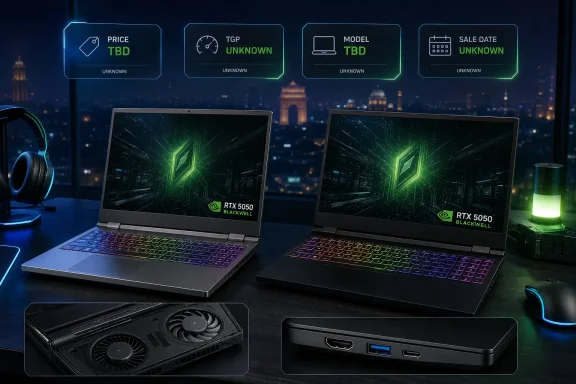 The RTX 5050 Is the Meaningful Change, but It Needs a Wattage
Acer divides the new Nitro 5 range by GPU and finish. The Herald Grey versions use an RTX 4050 Laptop GPU, a 62Wh battery and Nahimic audio, while Black configurations carry an RTX 5050 Laptop GPU, a 73Wh battery and Sound Blaster Studio+ audio. The same pairing applies to the nominally higher-tier Nitro 5 Pro.
That gives the RTX 5050 model an immediate practical advantage beyond its newer GPU architecture: an 11Wh larger battery. Acer does not publish runtime figures, however, and gaming notebooks rarely sustain their rated battery capacity under demanding games. The larger cell should matter more for general Windows use, web browsing, video playback and light productivity than for gaming away from an outlet.
The GPU question is more important. NVIDIA’s RTX 5050 Laptop GPU is capable of modern Blackwell features, including Multi Frame Generation in supported DLSS 4 games, but the silicon is configured by each laptop maker. A lower-power GPU may be appropriate in a thin machine, yet the Nitro 5 is being presented as a performance laptop with dual fans, two air intakes and two exhausts. Acer needs to publish the Total Graphics Power figure, dynamic-boost behavior, and whether the RTX 5050 gets an unrestricted connection to the display.
Until then, “RTX 5050” identifies a feature set and memory generation, not a dependable frame-rate tier. This matters especially in India’s market, where an older RTX 4060, an RTX 4050 at a higher power setting, or an aggressively discounted RTX 5060 system may offer a different balance of raster performance, VRAM, battery capacity and price.
Acer also describes the RTX 5050 as an eight-generation leap from the RTX 4050 configuration in terms of platform branding, but shoppers should resist treating the “50” suffix as an automatic replacement for every RTX 40-series choice. DLSS 4 support can substantially raise displayed frame rates in compatible games, while traditional performance still depends on the game, laptop cooling profile, CPU behavior and GPU power budget. Those are all details Acer has not yet supplied.
“Nitro 5 Pro” Has No Published Technical Separation
The launch’s biggest unresolved issue is Acer’s use of the Nitro 5 Pro name. The company’s supplied specifications present the Nitro 5 and Nitro 5 Pro with essentially the same advertised CPU ceiling, display size and resolution, memory ceiling, storage ceiling, GPU choices, cooling description, connectivity, keyboard lighting and audio/battery pairings.
Acer says the Pro model “elevates gaming performance” and frames it around next-generation AI features available on the RTX 50-series GPU. That is a description of NVIDIA’s GPU platform, though, rather than a clear hardware distinction between two Acer chassis. The standard Nitro 5 is also said to ship with the RTX 5050 option and the same Core i7-14650HX ceiling.
There may be unannounced differences in GPU wattage, internal cooling, display response times, panel brightness, SSD slot count, memory slot access, port layout, webcam specification, chassis dimensions or bundled software. None of those differences appeared in the announcement. No product code was supplied for either a Nitro 5 or Nitro 5 Pro configuration, making it impossible to match the systems to a manual, support page, retailer listing, driver package or warranty entry.
That is more than a paperwork problem. A “Pro” label has value only if it tells buyers what they receive that the base machine does not: more GPU power, a better panel, a stronger cooling system, more robust I/O, a better warranty, or a lower compromise in another area. On the information now available, the two names should be treated as unproven product tiers, rather than as evidence that the Nitro 5 Pro will outperform the Nitro 5.
Acer’s India site adds to the uncertainty. Its public Nitro 5 family page still describes an older 12th-generation Intel and RTX 30-series model, rather than the newly announced 14th-generation HX and RTX 50-series machines. Meanwhile, Acer’s India store search results have surfaced a Nitro 5 configuration identified as AN516-74G1 with a Core i5-14450HX, RTX 5050, 16GB of memory, 1TB SSD and 165Hz 16-inch Full HD display. That is useful evidence that at least one RTX 5050 Nitro 5 SKU exists in Acer’s retail pipeline, but it does not establish a price, confirm the announced Pro variant, or provide the GPU’s power limit.
The CPU, Memory and Screen Are Sensible for a Windows Gaming Notebook
The Core i7-14650HX is a familiar 2024 Intel HX processor rather than a current-generation Core Ultra design. It remains a capable chip for game workloads, compiling, editing, virtual machines and CPU-heavy multitasking, particularly when paired with DDR5-5600 memory. Its 16-core hybrid design is a clear step above the six- and eight-core CPUs often found in entry-level gaming laptops, though it also belongs in a system with enough cooling and a sufficiently large power adapter.
Acer’s 16:10 1,920 × 1,200 screen is also a sensible choice. Compared with a conventional 15.6-inch 16:9 1080p panel, the 16-inch format provides additional vertical workspace for code editors, timelines, documents and browser windows without asking an RTX 4050 or RTX 5050 to drive a much higher QHD resolution. The claimed 100% sRGB coverage is more meaningful for creators than a refresh-rate figure alone.
Yet “up to 165Hz” remains an incomplete display specification. Acer has not published brightness, contrast, response times, Adaptive-Sync support, panel vendor, HDR capability, color-calibration data or whether every version reaches 100% sRGB. A 165Hz display can be excellent, but it can also be the same refresh rate attached to a dim or slow panel. Buyers who intend to edit photos or video should wait for a SKU-specific panel specification or an independent measurement.
The dual-fan, dual-intake, dual-exhaust cooling claim is similarly baseline equipment for a gaming notebook, rather than proof of sustained performance. Nitro Control Centre’s performance modes and manual fan controls may be useful, but they cannot compensate for a chassis that limits the CPU or GPU under extended load. Independent thermal and noise testing will be needed before calling either model a strong creator workstation or a high-FPS competitive gaming machine.
Acer Has Announced Hardware, Not Yet a Buying Decision
The refreshed Nitro 5 range appears positioned to bridge Acer’s lower-cost Nitro offerings and its more expensive Predator systems: a 16-inch 16:10 chassis, Intel HX CPUs, upgradable DDR5 and PCIe Gen4 storage, and RTX 4050 or RTX 5050 graphics. For Windows users upgrading from an RTX 3050-era laptop, the RTX 5050 configuration in particular should bring access to a newer generation of ray tracing, Tensor hardware and DLSS features.
What Acer has not provided is the information that converts that positioning into a recommendation. There is no launch price, no availability schedule, no confirmed retailer list, no model-number map, no GPU TGP, and no stated difference that validates paying extra for the Nitro 5 Pro. The company also has not said whether current Nitro 5 owners receive any special upgrade, trade-in or warranty offer.
For now, the practical advice is simple: wait for Acer India to publish individual SKU pages. The first numbers to check are the RTX 5050’s wattage, the exact display specification, installed RAM and SSD capacity, and the price gap between the standard Nitro 5, Nitro 5 Pro and competing RTX 4060 or RTX 5060 machines. Without those four details, Acer’s new Nitro 5 Series is an announced platform, not a comparable product lineup.