
Electronics Weekly reported the lineup on August 27, citing Advantech’s claims that the hardware can handle real-time defect inspection, predictive maintenance, intelligent monitoring and endoscopic video inference at the edge. The underlying hardware and product material, however, shows this is a platform availability story rather than a same-day product launch: Advantech published a Core Ultra Series 3 edge-AI page in January 2026, while individual product pages and datasheets had already identified the SOM-5886, ARK-2252, MIO-5381 and AIMB-234 as Panther Lake designs.
For Windows and industrial IT teams, that distinction matters. The news is that Panther Lake has reached a broader set of Advantech form factors and can now be specified in systems intended to sit beside equipment rather than underneath a notebook screen. It does not establish that every board is shipping broadly in every region, nor does Advantech publish pricing, lead times, Windows image availability, validated driver versions or lifecycle terms alongside the announcement.
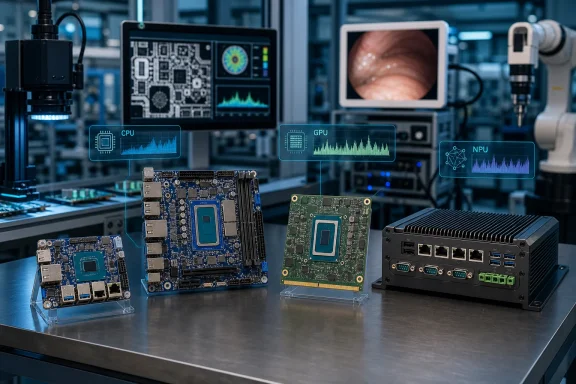 The 180 TOPS claim combines three engines
Intel’s Core Ultra Series 3 platform is the first client SoC family built on Intel 18A, the company’s newest manufacturing node. Intel rates the highest-end configurations at up to 180 platform TOPS, using a heterogeneous mix of CPU, Intel Arc Xe3 integrated graphics and NPU compute.
That headline number needs careful reading in an industrial purchase decision. Advantech’s own product listings place the dedicated NPU5 at up to 50 TOPS; the 180-TOPS total includes the GPU and CPU contribution. An application built around an NPU-compatible inference runtime will not automatically receive the entire platform figure. Conversely, workloads that can exploit the Intel Arc GPU may gain far more than an NPU-only pipeline, particularly vision models, image pre-processing, rendering and video analytics.
Intel says the top Core Ultra Series 3 processors include up to 16 CPU cores and an Arc GPU with up to 12 Xe3 cores. The company compares that GPU configuration with prior-generation products and claims more than 50% faster graphics performance. Those figures describe the top of a scalable product family, not a guarantee for each Advantech configuration.
The ARK-2252 page makes the limitation plain. It lists the Core Ultra 7 358H with 12 Xe cores and an up-to-180-TOPS platform rating, alongside a Core Ultra 5 325 configuration with four Xe cores and an up-to-95-TOPS rating. A buyer selecting the lower-power or lower-cost SKU is therefore choosing a substantially different graphics and AI envelope, even though both systems carry Core Ultra Series 3 branding.
Four formats target different replacement cycles
The four Advantech products serve markedly different integration paths. Treating them as interchangeable “edge AI computers” would obscure the actual deployment decision.
The MIO-5381 is a 3.5-inch MI/O-Compact single-board computer. Advantech lists up to 14 processor cores at 15 W or 28 W, two-channel DDR5-7200 memory up to 128 GB, four simultaneous displays, USB4, dual Ethernet, four UARTs, two CAN-FD interfaces and four M.2 expansion slots. Its specification explicitly names Windows 10/11 LTSC and Ubuntu 24.04 LTS support, plus DeviceOn remote management and EdgeBMC out-of-band control. That makes it the clearest fit in this announcement for organizations standardizing a Windows LTSC image across purpose-built operator terminals, controllers or inspection stations.
The AIMB-234 is a Mini-ITX motherboard for systems builders that need more conventional expansion. Advantech lists up to 128 GB of DDR5-7200, a PCIe Gen5 x8 slot, USB4, 2.5 GbE networking and up to four independent 4K displays. Its available CPU options include the Core Ultra 9 386H, Ultra 7 358H and 356H, and Ultra 5 325. The product is the most natural candidate where a site may want the integrated GPU and NPU for baseline inference but retain an upgrade path through PCIe for storage, field I/O or a discrete accelerator.
The SOM-5886 is a COM Express Basic Type 6 module, aimed at OEMs that already own a carrier-board design or need to preserve a custom mechanical and I/O arrangement. It supports up to 16 cores, an Arc GPU with up to 12 Xe cores, up to 128 GB of DDR5-7200 memory, 2.5 GbE, PCIe Gen4, USB4 and SATA. Its value is therefore design continuity: a manufacturer can update the compute module while retaining the bespoke carrier, connectors and enclosure that may be tied to regulatory approval or a years-long product line.
The ARK-2252 packages the platform into a ready-made embedded computer. Its specification lists a -20°C to 60°C operating range, 12 V to 24 V input, up to four Ethernet ports, six serial ports, CAN bus, digital I/O, TPM hardware, three 4K displays and options for PoE, Advantech iDoor expansion or GMSL cameras. Those features matter more in a plant, vehicle or utility enclosure than an abstract TOPS score: they determine whether the system can connect to existing PLCs, cameras and serial equipment without a stack of adapters.
AI acceleration does not remove deployment work
Advantech positions the boards for defect inspection, predictive maintenance and medical imaging, and it pairs the hardware with its EdgeAI SDK, GenAI Studio and fleet-orchestration tooling. Those software claims describe a route to deploy models and distribute updates; they do not demonstrate application-level throughput, latency, model accuracy or recovery behavior after a failed update.
No benchmark accompanying the announcement establishes frames per second for a named object-detection model, a specified camera count, a particular image resolution or a fixed power budget. There is also no published comparison with an Nvidia Jetson system, a discrete Intel Arc GPU, AMD Ryzen AI Embedded hardware or a prior Advantech Core Ultra Series 2 deployment. For installations that must meet a line-speed requirement, those omissions are decisive: 180 TOPS cannot answer whether a model will meet an inspection window after decoding, pre-processing, inference, post-processing and data logging are included.
The endoscopic-video example deserves the same caution. Video inference near a patient or instrument has a different burden from a general machine-vision proof of concept. Integrators need to validate camera drivers, capture latency, display pipeline behavior, failover operation, storage handling, cybersecurity controls and the regulated-software status of the final device. Advantech’s board can be a component in that system; it is not evidence that the completed medical workflow has been validated.
Windows administrators should confirm the board, SKU and image
The MIO-5381’s stated Windows 10/11 LTSC support is useful, but it should not be generalized automatically to the AIMB-234, SOM-5886 and ARK-2252. Their public product pages identify embedded software APIs and, in the ARK-2252’s case, an AMI BIOS and TPM, but they do not provide a comparable public Windows support matrix in the announcement itself.
Before approving hardware, administrators should obtain the exact CPU SKU, BIOS revision, chipset and graphics-driver package, supported Windows edition and LTSC release, and the vendor’s recovery-image process. This is especially important for systems expected to operate offline or in segmented networks, where a failed graphics or NPU driver update cannot be repaired through a standard end-user support process.
Remote management also needs a separate review. EdgeBMC out-of-band control on the MIO-5381 and DeviceOn or orchestration features across the portfolio can reduce site visits, but they create a management plane with privileged access to devices that may sit on operational technology networks. Inventory ownership, access controls, certificate handling, update approval and network segmentation should be decided before fleet tooling is connected to production equipment.
Advantech has supplied credible evidence that Intel’s Core Ultra Series 3 hardware is now available across a compact SBC, Mini-ITX board, COM Express module and industrial edge computer. The immediate consequence for buyers is a wider menu of integrated Intel GPU-and-NPU designs for Windows LTSC and embedded deployments—but the choice of processor SKU, I/O format and support image will determine far more than the 180-TOPS marketing ceiling.