
The surprise is not simply that Age of Empires III: Definitive Edition is receiving DLC again. It is that this is effectively the same planned content that was delayed, then officially cancelled, before returning with a full release target of September 10, 2026. An open beta began on Steam on July 23 and is scheduled to run through August 6, giving the community a meaningful opportunity to test the new civilizations and systems before launch.
For a game that has spent years living in the long shadow of Age of Empires II: Definitive Edition and the newer Age of Empires IV, this is a significant reversal. Age of Empires III has never lacked for dedicated players, but it has often lacked the predictable post-launch support enjoyed by other entries in the franchise. The Baltic Powers does not erase that history, yet it signals a welcome renewed investment in one of PC gaming’s most mechanically distinctive real-time strategy games.
More importantly, it appears designed around the elements that keep Age of Empires III: Definitive Edition compelling: asymmetric civilizations, timing-oriented economic decisions, naval warfare, revolutions, Home City shipments, and volatile cavalry engagements.
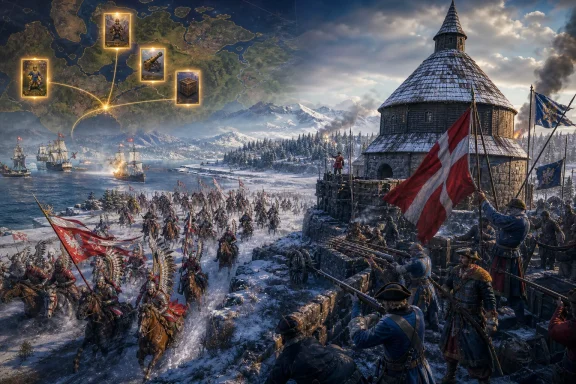 Background: From Delayed DLC to a Revived Expansion
The road to The Baltic Powers has been unusually turbulent. A new Age of Empires III: Definitive Edition DLC was originally announced as part of the franchise’s broader plans, with an intended release window near the end of 2024. That window passed, and the expansion was subsequently delayed amid competing development priorities across the wider Age of Empires portfolio.
Then came the more damaging development. In January 2025, the DLC was formally cancelled. The announcement explained that it had been revealed prematurely, before the content had actually been built to a point where release was assured. Support for servers and customer service would continue, but the message understandably created the impression that significant new content for Age of Empires III: DE had ended.
That conclusion now looks premature.
The July 2026 announcement of The Baltic Powers is not a minor balance patch or a limited cosmetic bundle. It is a conventional expansion package with:
- Two new playable civilizations
- Two dedicated Challenge Scenarios
- Two new multiplayer game modes
- More than 25 maps in total
- More than 50 hero customization options
- Broader balance, editor, spectator, replay, and revolution-related improvements expected alongside the DLC
That scope makes this revival more meaningful than a symbolic gesture. It also makes the earlier cancellation more complicated. Microsoft and World’s Edge are effectively asking players to return to a product road map that was once withdrawn. The only persuasive answer to that previous disappointment is a polished release, a clear support plan, and mechanics that genuinely expand the game rather than merely adding new flags to the civilization-select screen.
So far, the feature list suggests that the studio understands that challenge.
Why Age of Empires III Still Matters
The argument for new Age of Empires III: Definitive Edition content is straightforward for anyone who has spent time with the game’s competitive multiplayer or extensive mod scene. No other major Age of Empires title quite combines its period, pacing, and faction systems in the same way.
Its setting allows armies to evolve from musketeers and pikes toward artillery, rifles, warships, industrial economies, and revolutionary states. Its Home City system adds deck-building to traditional RTS resource management, allowing players to customize economic shipments, military reinforcements, upgrades, mercenaries, and timing attacks before a match begins.
That design has always divided opinion. Critics argue that shipments can make the game harder to read than a more straightforward RTS. Supporters see the system as the reason Age of Empires III has such remarkable strategic texture. The right shipment at the right time can rescue a weak opening, transform a booming economy into a sudden military push, or reward scouting information that would otherwise go unused.
The Definitive Edition strengthened that identity. Since its 2020 launch, it has introduced civilizations including the United States, Mexico, Ethiopians, Hausa, Italians, and Maltese, while expanding maps, historical content, balance options, and accessibility features. The last major expansion, Knights of the Mediterranean, arrived in 2022 and added the Italian and Maltese civilizations.
That gap matters. Four years without a traditional expansion is a long time in a live strategy game, particularly one where fresh matchups and new openings are central to replayability. The Baltic Powers therefore has to do more than look attractive on a store page. It needs to give multiplayer players unfamiliar matchups to study while providing enough single-player and casual content to justify its return.
The Danes: Information, Shipping Pressure, and Defense
The first new civilization is the Kingdom of Denmark-Norway, generally referred to in the expansion as the Danes. Their design centers on economic intelligence, naval authority, and layered defenses.
At a glance, Denmark-Norway appears positioned as a civ for players who enjoy turning map awareness into a measurable advantage. Their signature Customs House mechanic is intended to let them leverage shipments from other players from the beginning of a match. In a game where shipment timing can dictate an entire early-game plan, that concept has potentially enormous implications.
A civilization built around reading the match
The Danes’ strategic identity is less about raw aggression than smart control. A faction that benefits from understanding its opponent’s shipment choices has obvious appeal in team games and high-level one-on-one matches, where player scouting extends beyond army composition to include decks, resource gathering patterns, shipment landmarks, and age-up timings.
The essential question will be how much information and practical advantage the Customs House actually provides. If it merely helps Danish players react more intelligently, it could create a rewarding and skill-focused identity. If it gives too much value too early, however, it risks compressing the information gap that makes scouting and deck secrecy so important across the rest of the roster.
The Danes also gain economic strength while advancing through the Ages. This reinforces their theme as a civilization that becomes increasingly efficient as the match develops, perhaps allowing them to shift between defensive land play, water control, and shipment-driven counterattacks.
Defensive tools that could alter pressure games
Defensively, Denmark-Norway brings Snaphane levies, Gunboat levies, and the ability to shelter villagers in Round Churches. That is a substantial toolkit for resisting raids and protecting vulnerable economic zones.
In Age of Empires III, villagers are often exposed by the need to hunt, gather livestock, mine coin, or establish forward infrastructure. A safe-garrison mechanic can be extremely powerful because it reduces the punishment for imperfect positioning. Players who specialize in cavalry raids will be watching closely to see whether the Round Churches offer a meaningful but fair refuge, or whether they make Danish economies frustratingly difficult to disrupt.
The naval emphasis also deserves attention. Water maps in Age of Empires III can produce radically different games from standard land maps, and a civilization designed to claim early sea control may reshape established build orders. Gunboat-related levies and naval flexibility could make the Danes particularly dangerous around choke points, fishing economies, coastal settlements, and transport routes.
The potential strength—and danger—of a reactive civ
The Danes could become one of the expansion’s most technically satisfying civilizations. Their stated design rewards observing the enemy, establishing a resilient economy, and using the right response instead of pursuing a single scripted build.
That versatility can also become a balance concern. A civ that sees too much, defends too easily, and transitions too smoothly into naval dominance could be difficult to counter. The open beta will matter most here, because this type of system can look elegant in concept while proving oppressive when highly optimized players find its best uses.
The Poles: Agrarian Momentum Meets Winged Hussar Charges
The second civilization, the Polish-Lithuanian Commonwealth, looks more immediately familiar to traditional Age of Empires III players. The Poles are built around a powerful agrarian economy, reduced building costs, civic bonuses, and cavalry that can turn an economic lead into a decisive battlefield advantage.
If the Danes are the expansion’s information-and-defense faction, the Poles are its high-momentum economic cavalry power.
The Folwark economy and cheaper expansion
The Polish economy revolves around the Folwark, a historic agricultural estate concept adapted into a game mechanic. The expansion describes the Poles as an agrarian powerhouse capable of building an economy that feeds sustained mounted warfare.
That is a promising fit for Age of Empires III. Cavalry has always been one of the game’s most exciting unit classes because it can raid, flank artillery, exploit exposed villagers, and force opponents to spread defensive forces across the map. Its biggest limitation is usually cost. Food- and coin-intensive cavalry armies can become difficult to sustain if an early attack fails or a player’s economy is disrupted.
A strong agricultural system may address that limitation, enabling Polish players to create a broader and more durable cavalry economy rather than simply gambling on a single early raid. Lower building costs add another layer of flexibility, potentially supporting faster infrastructure, more convenient defensive setups, or aggressive forward construction.
As with the Danes, the balance challenge is obvious. Economic bonuses that feel modest in the opening minutes can compound dramatically by the midgame. If the Folwark system delivers too much sustained food income, the Poles could reach a point where their cavalry composition becomes difficult to exhaust.
The Sejm, branching choices, and historical flavor
The Poles also feature the Sejm parliament, which becomes more valuable as population grows. This suggests a civilization whose long-term power is linked to sustained development, not simply to an immediate rush.
There are also historical path choices involving early Cossack uprisings or the restoration of the Teutonic Knights. This may give the Polish-Lithuanian Commonwealth some of the decision-making flexibility that makes Age of Empires III civilizations feel distinct. The exact implementation will determine whether these are meaningful strategic branches or merely thematic flavor, but the concept has potential.
The inclusion of a mounted Hetman and Winged Hussars is likely to be the headline attraction. Winged Hussars are one of the most recognizable cavalry archetypes associated with the Polish-Lithuanian Commonwealth, and their arrival gives the expansion a strong visual and historical identity.
Winged Hussars need more than spectacle
There is little doubt that players will want to field Winged Hussars immediately. The critical design question is whether they become a compelling late-game unit or an overly dominant one.
Heavy cavalry in Age of Empires III is already capable of punishing poor anti-cavalry positioning. Any elite cavalry unit with exceptional survivability, speed, or charge damage must have clear counters, understandable costs, and opportunities for opponents to prepare. If the Poles can field them too early or too efficiently, matches could tilt toward repetitive anti-cavalry compositions.
Still, the Polish design appears to capture a core RTS fantasy: build a thriving homeland, reach a tipping point, and unleash a powerful mobile army. Done well, it could become one of the most satisfying civilization concepts in the entire Definitive Edition roster.
Challenge Scenarios Bring Needed Single-Player Variety
The Baltic Powers includes two new Challenge Scenarios: Commonwealth Charge and Havana Heat. These are not full multi-mission campaigns, and players hoping for a large narrative expansion should set expectations accordingly. However, the scenarios are designed around tactical execution, replayability, and high-score chasing rather than one-and-done story missions.
That is a sensible use of the format.
Commonwealth Charge
In Commonwealth Charge, players defend the Polish-Lithuanian realm against sustained invaders. Success involves securing nearby villages, increasing resources and population, and timing Winged Hussar attacks to survive escalating pressure.
This sounds like a survival-defense mission with an offensive edge. The player is not merely turtling behind walls; they must use cavalry mobility to secure objectives and relieve pressure. That makes it a useful showcase for the Poles, especially for players who want to understand how the faction’s economic engine and cavalry tools interact under stress.
Havana Heat
Havana Heat moves to a different theater, placing Spain under British assault. The player must defend a Town Center and inflict 1,000 casualties before enemy artillery becomes overwhelming, while also controlling key beach areas.
This scenario appears more immediately score-driven and time-sensitive. It could be especially effective if it forces players to divide attention between shoreline control, defensive positioning, artillery denial, and unit production. Age of Empires III is at its best when battlefield geography matters, and beach objectives offer a natural way to make naval and land pressure intersect.
The bigger point is that both missions create replayable objectives outside conventional skirmish matches. For a game often defined by multiplayer, that is valuable. Challenge Scenarios can serve as practical training grounds for micro-management, economy prioritization, and decision-making under pressure.
Regicide and Independence Change the Rules of Engagement
The expansion’s two new game modes could have a larger impact on community play than the scenario content. Both are designed to alter fundamental assumptions about how Age of Empires III matches unfold.
Regicide raises the stakes around scouting
Regicide is a familiar concept for strategy veterans: defeat the opposing ruler for an immediate victory. In this version, each side has a Regent who cannot hide within buildings.
That last detail is crucial. A vulnerable Regent changes everything from base layouts to patrol routes. Players will need to decide whether to keep the Regent protected inside the main army, use terrain and escort units to create a moving safe zone, or keep the figure distant and rely on map control to prevent an assassination attempt.
The mode should reward scouting, mobility, and decisive raids. It may also produce memorable games where a player loses a larger battle but wins by exploiting a small opening around an exposed Regent. For organized custom lobbies and groups tired of standard supremacy rules, Regicide could become a strong alternative.
Independence strips away Home City support
Independence is the more radical addition. It removes Home City support, the system that has defined Age of Empires III since the original 2005 release. Without shipments, players must win through core economy, unit composition, map control, age-up choices, and the adjusted civilization bonuses created for the mode.
This is an intriguing experiment because it addresses one of the game’s most debated systems without removing it from standard play. Players who love the complexity and personality of Home City decks can retain them in traditional modes. Players who prefer a more classical RTS structure can experience Age of Empires III without the shipment layer.
Independence may also reveal just how much of each civilization’s identity rests on deck access. Some factions may feel surprisingly robust without shipments; others may require careful bonus adjustments to remain competitive. That makes balance especially important. A mode built around stripped-down fundamentals only works if its alternative versions of the civilizations remain distinct and fair.
For Windows PC strategy fans, this is potentially the expansion’s most fascinating feature. It is not just another content checkbox. It is a controlled reimagining of what Age of Empires III feels like when its signature mechanic is absent.
More Than 25 Maps, With an Arctic Twist
Map support is another area where The Baltic Powers appears more ambitious than its title implies. The expansion offers more than 25 maps in total, including over 20 new thematic and historical battlegrounds, plus access to selected maps previously associated with other DLC content.
The geographic range extends from the Baltic and Scandinavian regions to the North American Arctic. That wider scope makes sense for Age of Empires III, whose historical canvas has always stretched across colonial trade routes, empires, and contested frontiers rather than remaining confined to a single region.
Arctic maps could make water play more interesting
The new Arctic-themed map content includes locations ranging from Svalbard to Nunavut. Players can expect environmental details such as Inuit dog sleds and whaling ships, alongside colder coastal and tundra spaces that could change movement, gathering, naval strategy, and settlement control.
Maps set in Nova Scotia and the Shetlands are also part of the package, with Scottish Clansmen connected to the House of Stuart appearing among the regional flavor. That diversity is welcome. A Baltic-themed expansion could easily have leaned too heavily on a narrow selection of northern European battlefields; instead, it appears to use the theme as a foundation for a broader northern maritime and frontier experience.
Historical maps should encourage specialized play
The historical map selection includes:
- The Livonian War
- The Dano-Swedish Wars
- The Wars of the Three Kingdoms
- The Deluge
- The Great Northern War
- The Great Turkish War
- The Thirty Years’ War
These names carry considerable potential, but a historical label alone does not guarantee a memorable map. The best Age of Empires III maps create distinctive strategic conditions without turning every match into a scripted exercise. Players need room to improvise, while still feeling that terrain, minor civilizations, waterways, and resources communicate something meaningful about the setting.
The expansion also grants access to random maps including Baltic, Danish Straits, Pomerania, Vistula Basin, Lithuania, Courland, Scandinavia, Pripet Marshes, Dnieper Basin, Scotland, Ireland, England, Wales, and Finland.
That is a substantial map contribution. For experienced multiplayer players, even a handful of excellent maps can matter more than a large list of forgettable ones. New terrain layouts create new scouting routes, new trading-post priorities, different water openings, and different places for cavalry to make an impact.
The Open Beta Is More Than Early Access
The Steam open beta is the practical test of whether this revived expansion earns confidence. It gives existing PC players access to the Danes and Poles before the September release, while also letting the developers gather gameplay feedback.
Joining requires the Steam version of Age of Empires III: Definitive Edition. In the Steam Library, players can open the game’s Properties menu, navigate to Game Versions & Betas, and select the open_beta branch. Steam should then download the relevant test files.
The beta matters for several reasons:
- Civilization balance needs real match data.
Internal testing cannot fully reproduce the creative build orders, team-game synergies, and timing attacks that dedicated RTS communities discover within days. - The new modes need stress testing.
Regicide and Independence may be excellent ideas, but both require clear rules, fair win conditions, and robust behavior across different maps and civilization combinations. - Maps need to prove their competitive value.
New maps can look spectacular while still producing imbalanced starting positions, awkward pathing, or overly predictable openings. - Technical improvements need scrutiny.
The accompanying release is expected to bring editor updates, spectator and replay improvements, new revolutions, and balance changes. Those systems are especially important to tournament organizers, modders, content creators, and long-term community players.
Players should nevertheless remember that beta content is inherently subject to change. Any civilization strength, unit interaction, or game-mode rule seen before August 6 should be treated as provisional rather than as the final launch specification.
The Risks: Trust, Balance, and Platform Questions
The revival is exciting, but it is not free from risk.
The first risk is trust. The DLC was delayed and later cancelled before returning. The current announcement is much more concrete, with an open beta, store listings, detailed mechanics, and a release date. Even so, players have good reason to expect transparent communication if plans change again.
The second risk is balance volatility. The Danes’ access to economic intelligence and defensive sheltering could be extraordinarily strong in skilled hands. The Poles’ Folwark-driven economy and Winged Hussars could become overwhelming if their food generation and cavalry scaling outpace counters. New factions always need tuning, but the impact may be especially pronounced in a mature RTS where players already understand every established matchup.
The third risk concerns value perception. The expansion includes many desirable components, but it does not appear to include a conventional campaign. Challenge Scenarios, maps, game modes, and cosmetic content can still make for a worthwhile DLC, particularly for multiplayer-oriented players. Yet fans who primarily play solo may judge its value differently.
There is also an unresolved availability question. The open beta is on Steam, while the DLC is listed for wishlisting on both Steam and the Microsoft Store. The final feature set, pricing, and exact platform rollout details deserve confirmation closer to release rather than assumption.
A Much-Needed Vote of Confidence in Age of Empires III
The Baltic Powers is more than an expansion announcement. It is a statement that Age of Empires III: Definitive Edition remains worth evolving.
The Danes offer a potentially deep blend of information play, defense, and naval control. The Poles provide an appealing agrarian-cavalry power fantasy built around booming infrastructure and hard-hitting mounted armies. Regicide and Independence broaden the game’s ruleset in meaningful ways, while the maps and Challenge Scenarios ensure the package is not exclusively aimed at ranked multiplayer regulars.
Most importantly, the expansion acknowledges what the Age of Empires III community has argued for years: this is not a finished relic kept alive only by nostalgia. It is a living real-time strategy game with a distinctive identity, a persistent player base, and mechanics that still support new ideas.
If the September 10 release delivers a balanced and polished version of what the beta promises, The Baltic Powers will not merely revive cancelled content. It will give Age of Empires III: Definitive Edition a credible new chapter—and a stronger reason for Windows PC gamers to return to the battlefield.


