
For Windows users, IT leaders, developers, and business decision-makers, this shift matters. AI is increasingly embedded in the tools people use every day: productivity suites, developer environments, search experiences, customer-service platforms, endpoint security products, analytics systems, and line-of-business applications. The strategic question is not whether AI will influence modern work. It is how organizations can use it to improve outcomes without sacrificing security, accuracy, privacy, accountability, or human judgment.
An effective speaker on AI for events can provide the common language required to begin that conversation. But the quality of the message matters. The best presentations frame AI as an organizational capability that depends on people, processes, data, leadership, and risk management—not as an autonomous solution waiting to transform a company by itself.
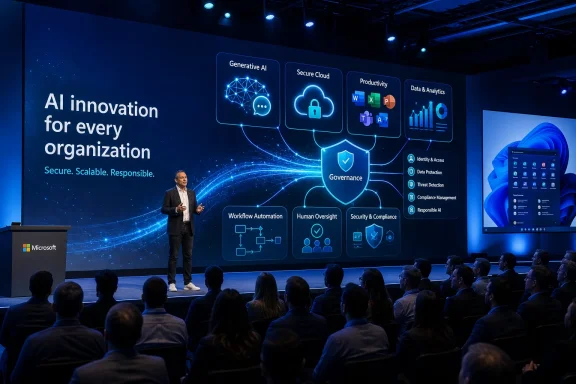 Why AI Keynotes Have Become a Business Priority
AI attracts event audiences because it sits at the intersection of productivity, innovation, workforce change, and technology strategy. Leaders want to understand where generative AI fits into their operations. Employees want clarity about how new tools may affect their roles. Technology teams need support for building realistic adoption roadmaps instead of reacting to isolated executive demands or viral product announcements.
A strong AI keynote gives these groups a shared starting point.
The appeal is understandable. Generative AI can draft text, summarize information, assist with code, generate visual concepts, help analyze documents, and support conversational interfaces. Traditional machine-learning systems can detect patterns, make predictions, classify information, and optimize recurring processes. Automation platforms can reduce repetitive administrative work and connect systems that previously required manual handoffs.
Yet these capabilities are not identical, and they are not equally suitable for every task. A keynote that treats “AI” as one universal solution can create confusion. A useful one explains the differences between technologies, their strengths, their limitations, and the operational controls required to use them safely.
The Real Need: Translation Between Technology and Action
Many organizations do not need another abstract explanation of neural networks or a slideshow filled with futuristic robots. They need an interpretation of what AI means for their specific environment.
That interpretation may include:
- Identifying high-value internal workflows that are suitable for AI assistance
- Separating low-risk experimentation from high-impact automated decision-making
- Explaining how to protect sensitive company, customer, and employee information
- Preparing managers to oversee human-AI collaboration
- Establishing expectations for accuracy, validation, and disclosure
- Creating a workforce learning plan that goes beyond basic prompting tips
- Connecting AI investments to business outcomes rather than novelty
This is where the AI innovation keynote speaker differs from a purely technical presenter. Technical expertise remains essential, but the audience also needs a bridge from capability to strategy.
Background: What an AI Innovation Speaker Actually Does
An AI innovation speaker is a presenter who explores how artificial intelligence can help organizations create value through better products, services, workflows, decisions, and customer experiences. The role overlaps with that of an AI strategist, futurist, digital transformation expert, and technology keynote speaker, but it has a distinct focus: using AI to stimulate practical innovation.
The strongest speakers translate complex concepts for mixed audiences. That often means explaining foundational topics in plain language without talking down to technical professionals in the room.
Core Areas Typically Covered
A well-designed presentation may address several AI domains:
- Generative AI, including tools that produce text, images, software code, audio, video, summaries, and structured content
- Machine learning, where systems identify patterns from data to classify, predict, recommend, or optimize
- Intelligent automation, combining AI capabilities with workflow orchestration and business process automation
- AI agents, which can plan and execute multi-step tasks within defined boundaries and connected systems
- Decision support, where AI helps people interpret large volumes of information but does not replace accountability
- Responsible AI, including privacy, bias, security, transparency, governance, and human oversight
- The future of work, particularly the changing division of labor between people and software
The best sessions avoid presenting these as isolated trends. Instead, they show how the pieces connect. A company may begin with secure generative AI assistance for internal knowledge work, move into workflow automation, and later consider more sophisticated AI-enabled processes. Each stage carries different benefits, dependencies, and risks.
Inspiration Is Only the Beginning
A keynote can energize an audience, but enthusiasm alone does not create a successful AI program. That is why an effective speaker should leave attendees with a framework for action.
The most useful presentations typically help organizations think through four questions:
- Which problem are we trying to solve?
- Why is AI the appropriate tool for that problem?
- What data, people, processes, and safeguards are required?
- How will we measure whether the initiative created value?
Without those questions, companies can fall into the trap of buying tools before identifying a use case. That produces scattered pilots, duplicated spending, unclear ownership, and employee frustration.
The Difference Between an AI Speaker and an AI Innovation Speaker
The AI speaker category is broad. Some presenters concentrate on explaining the underlying technology, while others focus on business adoption, governance, or future trends. An AI innovation speaker is most valuable when an event audience needs to move from awareness to possibility.
AI Technical Speaker
A technical AI speaker may emphasize:
- Model architectures
- Training methods
- Data engineering
- Retrieval-augmented generation
- Model evaluation
- Machine-learning operations
- Software development workflows
- Infrastructure, compute, and deployment design
This type of presentation is valuable for developers, data scientists, architects, and IT professionals. It may be the right choice for a specialized technology event, but it can be too detailed for a leadership audience that needs strategic context.
AI Strategy Speaker
An AI strategy speaker usually focuses on:
- Enterprise adoption roadmaps
- Investment prioritization
- Operating models
- Governance structures
- Vendor evaluation
- Workforce planning
- Program ownership
- Long-term implementation
This role is closely connected to AI innovation, although strategy sessions often concentrate more on structured planning than creative discovery.
AI Futurist Speaker
An AI futurist speaker looks further ahead, examining how artificial intelligence may reshape industries, society, consumer behavior, work, education, and institutions. This perspective can be compelling at conferences and executive summits, particularly when leaders want to explore emerging scenarios.
The potential weakness is that futurism can drift into speculation if it is not tied back to current operational decisions. The best AI futurist presentations connect long-range trends to choices that organizations can make now.
AI Innovation Speaker
An AI innovation speaker brings these perspectives together but centers the discussion on new value creation. The core message is not merely, “AI is changing everything.” It is, “Here is how disciplined organizations can use AI to rethink how they serve customers, equip employees, develop products, and solve meaningful problems.”
Where AI Creates Genuine Innovation
The word innovation is often overused. In an AI context, it should not mean inserting a chatbot into every product or automating a process simply because automation is possible. Meaningful AI innovation improves a result that matters: speed, quality, accessibility, resilience, personalization, revenue, safety, or employee experience.
Improving Knowledge Work
One of the most immediate uses of generative AI is support for knowledge-intensive tasks. Employees spend substantial time reading, drafting, searching, interpreting, documenting, and communicating. AI can reduce friction in those activities when it is used as an assistant rather than an unquestioned authority.
Potential applications include:
- Summarizing long internal documents
- Drafting first-pass reports and proposals
- Creating meeting notes and action lists
- Helping developers explain, test, and document code
- Searching approved internal knowledge bases
- Producing tailored communications for different audiences
- Translating and simplifying complex material
- Generating structured starting points for analysis
The phrase starting point is important. Generative systems can produce persuasive but inaccurate output. They can omit context, fabricate citations, make flawed calculations, or express unwarranted confidence. Human review must be proportional to the consequences of an error.
Reinventing Customer Experiences
AI can also improve how organizations interact with customers. Conversational interfaces, recommendation systems, predictive services, and intelligent routing can make experiences faster and more relevant.
However, a customer-facing AI system needs more than a polished interface. It requires careful testing, clear escalation paths, accessible design, brand alignment, data protections, and an ability to recognize when it should hand the interaction to a human.
A poor AI customer experience is often worse than no AI at all. If an automated assistant repeatedly misunderstands the problem, invents answers, blocks access to support, or exposes personal data, it damages trust quickly.
Accelerating Product Development
In product teams, AI can assist with ideation, prototyping, software development, testing, user research synthesis, requirements analysis, and documentation. It can reduce the time required to explore alternatives, but it does not eliminate the need for product judgment.
The real innovation comes from enabling teams to spend more time on high-value decisions:
- Which customer problem deserves attention?
- What trade-offs are acceptable?
- How should success be measured?
- What risks could affect users?
- What makes the product genuinely useful rather than merely impressive?
AI may accelerate execution. It does not automatically provide product-market fit.
Enhancing Operations
Operational AI can support forecasting, quality control, anomaly detection, maintenance planning, procurement analysis, inventory management, and service delivery. In these cases, reliability often matters more than novelty.
Organizations should not judge operational AI solely by a demo. They should evaluate it against real conditions: incomplete data, changing demand, unusual exceptions, legacy systems, employee workflows, and business continuity requirements.
The Most Important Message: AI Is a System, Not a Feature
A recurring weakness in AI discussions is the tendency to treat the model as the whole solution. In practice, an AI system includes much more:
- The data it receives
- The instructions and constraints applied to it
- The software and integrations around it
- The people who use or oversee it
- The processes it changes
- The permissions it receives
- The records it creates
- The decisions made from its output
- The governance rules that define acceptable use
This broader perspective should sit at the center of every corporate AI presentation.
Data Quality Determines Practical Value
AI is often described as a data problem, and there is truth in that statement. A model cannot deliver dependable organizational value if it is connected to outdated, incomplete, poorly structured, or improperly governed data.
Before deploying an AI assistant against internal content, organizations should understand:
- Who owns the underlying information
- Whether it is current and authoritative
- Which users should be allowed to access it
- Whether sensitive data needs to be excluded or redacted
- How updates will flow into the system
- How incorrect answers can be reported and corrected
- What audit trails are required
This is especially important for Windows-centered workplaces, where AI experiences may draw from files, collaboration platforms, email, identity systems, endpoint data, and business applications. Permissions must carry through the entire AI experience. A useful assistant that reveals information to the wrong person is not a productivity gain; it is a security failure.
Process Design Matters More Than Prompt Cleverness
Prompting is a helpful skill, but it is not an AI strategy. Employees can learn how to ask clearer questions, provide better context, and request structured outputs. Those techniques improve results. Still, they cannot compensate for missing governance, unreliable source data, or an undefined workflow.
A mature AI program designs the entire process around the task. It identifies where AI helps, where people review output, what conditions trigger escalation, and how results are measured.
For example, rather than telling staff to “use AI to improve customer responses,” a company could define a structured workflow:
- AI drafts a response using approved knowledge sources.
- A human agent reviews the draft for accuracy, tone, and account-specific context.
- The agent edits or approves the response.
- The final outcome is recorded for quality review.
- Recurring failure patterns inform improvements to the system and its knowledge base.
That approach is more repeatable, measurable, and defensible than a vague instruction to experiment.
Responsible AI Must Be Part of the Innovation Story
AI innovation and responsible AI are not competing priorities. In a business setting, responsible practices are what make innovation sustainable.
A keynote that discusses opportunity without risk may generate excitement, but it leaves leaders unprepared. Conversely, a presentation focused only on danger can cause organizations to miss legitimate opportunities. The right balance is clear-eyed: AI can create value, but its risks differ by use case and must be managed deliberately.
Key Risks to Address
A credible AI speaker should cover risks such as:
- Inaccurate output: Generative AI can state false information in confident language.
- Bias and unfairness: AI systems can reproduce or amplify harmful patterns in data, design choices, or human decision-making.
- Privacy exposure: Employees may inadvertently enter confidential information into tools that are not approved for that data.
- Security threats: AI systems can be targeted through malicious prompts, poisoned content, data theft, or unsafe integrations.
- Intellectual-property uncertainty: Inputs, outputs, training data, and generated materials can create complex ownership and usage questions.
- Overreliance: Users may defer to automated recommendations even when they are unsuitable or wrong.
- Lack of explainability: Some systems provide results without a sufficiently clear rationale for high-stakes decisions.
- Vendor dependency: Organizations may become locked into a platform without understanding costs, portability, service terms, or model changes.
These concerns are not reasons to abandon AI. They are reasons to adopt it with discipline.
Human Oversight Is Not a Checkbox
“Human in the loop” is often used as a reassuring phrase, but it only works when the human has the time, authority, information, and expertise to intervene meaningfully.
A person who is expected to approve hundreds of AI-generated decisions per hour may become a rubber stamp. A manager who cannot understand the basis of a recommendation cannot reliably challenge it. A support agent who is penalized for deviating from an AI suggestion may be unable to use judgment at all.
Effective oversight requires clear role design. Organizations should define when AI may recommend, when it may automate, when approval is mandatory, and who is accountable for the final result.
AI and the Future of Work: Augmentation Before Replacement
Workforce anxiety is one of the most sensitive topics at AI events. Employees may hear executives talk about efficiency and immediately worry about job loss. Leaders may hear vendors promise automation and assume that headcount reductions are the primary measure of value. Both reactions can narrow the conversation.
The most productive framing is augmentation: how AI can help people do more valuable work, reduce repetitive burdens, and improve access to information. That does not mean every job will remain unchanged. Roles, skills, and team structures will continue evolving. But organizations that focus solely on replacement may lose institutional knowledge, erode trust, and undermine adoption.
Skills That Matter in an AI-Enabled Workplace
Technical AI knowledge is valuable, but every employee does not need to become a machine-learning engineer. The broader workforce needs a combination of practical and critical skills:
- Evaluating AI output for accuracy and relevance
- Giving clear instructions and context to AI tools
- Protecting confidential and sensitive information
- Understanding when a task should not be delegated to AI
- Recognizing bias, ambiguity, and unsupported claims
- Applying domain expertise to validate results
- Documenting decisions and exceptions
- Working effectively in redesigned, AI-supported processes
This is why the best AI innovation speakers emphasize learning culture. AI readiness depends less on a one-time training session than on continuous adaptation, clear policies, peer support, and leadership behavior.
What Organizations Should Expect From an AI Event Speaker
The market for AI presentations is crowded. A compelling demo can be mistaken for expertise, while a famous name can overshadow the practical requirements of a particular audience. Event planners should evaluate an AI keynote speaker based on relevance and rigor rather than promotional language alone.
Characteristics of a High-Value Presenter
An effective speaker should demonstrate:
- Current technical awareness without exaggerating what tools can do
- Business fluency across strategy, operations, customer experience, and workforce issues
- Audience adaptability for executives, IT teams, employees, students, or industry specialists
- Clear communication that makes difficult concepts understandable
- Practical examples that illustrate both success and failure modes
- Balanced judgment about benefits, limitations, and trade-offs
- Responsible AI literacy covering governance, security, privacy, and oversight
- Actionable frameworks that audiences can carry into planning discussions
The presenter should also be transparent about the difference between examples, forecasts, and verified operational results. Claims about dramatic productivity gains or fully autonomous workflows require context. A pilot result from a controlled environment does not automatically translate into enterprise-wide performance.
Warning Signs of a Weak AI Keynote
Organizations should be cautious when presentations rely heavily on:
- Broad claims that AI will transform every function immediately
- Predictions that lack assumptions or time horizons
- Product demonstrations presented as proof of enterprise readiness
- Vague promises of “disruption” without use cases
- Dismissal of privacy, security, or legal concerns as obstacles
- Simplistic claims that prompt writing alone solves adoption
- A false choice between reckless acceleration and total inaction
AI is powerful enough to warrant ambition. It is also complex enough to require skepticism.
From Keynote Inspiration to an AI Adoption Roadmap
The lasting value of an AI event is determined after the audience leaves the room. Organizations should convert excitement into a focused sequence of decisions.
A practical post-keynote roadmap can look like this:
- Identify priority business problems.
Start with friction points that are real, measurable, and connected to organizational goals. Avoid beginning with a favorite tool or a generic mandate to “do AI.” - Classify use cases by risk.
A low-risk drafting assistant for internal brainstorming requires different safeguards than an AI system influencing hiring, credit, healthcare, legal outcomes, or customer eligibility. - Establish governance early.
Define ownership, approved tools, data-handling rules, review requirements, escalation procedures, and accountability before adoption becomes fragmented. - Run targeted pilots.
Keep pilots narrow enough to evaluate. Define success criteria, baseline performance, user groups, security controls, and exit conditions. - Measure more than time saved.
Assess quality, error rates, employee adoption, customer impact, security events, process consistency, and long-term operating costs. - Invest in workforce readiness.
Train people in responsible use, critical evaluation, secure practices, and the redesigned workflows that accompany the tools. - Scale carefully.
Expand only when a use case shows clear value and the organization can support it operationally.
This process may appear slower than a rush to deploy. In reality, it often prevents costly rework, failed pilots, and avoidable trust problems.
The Next Phase: Agents, Automation, and Organizational Redesign
The AI conversation is moving beyond isolated chat interfaces. Organizations are increasingly evaluating AI agents and autonomous workflows that can retrieve information, make plans, use software tools, and complete multi-step tasks. This could deliver substantial gains in areas such as IT operations, service management, software development, finance operations, procurement, research, and customer support.
But autonomy raises the stakes. A system that can take action inside enterprise software needs carefully limited permissions, secure identity controls, logging, monitoring, error handling, and rapid intervention mechanisms. The question is not simply whether an agent can perform a task. It is whether it can perform that task reliably, securely, and within defined authority.
This is an area where AI leadership speakers can add real value. They can help executives understand that the future of AI is not only about better models. It is about redesigning the organization around responsible delegation between people and intelligent systems.
Conclusion: The Most Useful AI Message Is Both Ambitious and Grounded
The demand for AI innovation speakers reflects a genuine need. Artificial intelligence is influencing how organizations create, compete, communicate, and operate. It is changing expectations for software, employee productivity, customer experiences, and leadership decision-making. Ignoring that shift is not a strategy.
At the same time, the most effective AI keynote does not promise instant transformation. It explains that durable results come from matching the right technology to the right problem, preparing people for changed work, protecting sensitive data, measuring outcomes, and maintaining accountability.
For corporate events, technology forums, executive meetings, and innovation summits, the best speaker on AI is therefore not merely a futurist or a product evangelist. The most valuable presenter is a translator of complexity, a catalyst for disciplined experimentation, and a guide to building AI capabilities that create lasting value rather than short-lived excitement.
