
AI Search Engineers says businesses that pair its Answer Engine Optimization service with an AI website chatbot generate three times more qualified leads than a pre-deployment baseline, but the August 5 announcement does not supply the comparison data needed to establish that the two products outperform either system on its own. The claim comes from the agency’s internal client records, distributed through ACCESS Newswire and republished by Digital Journal, rather than an independently audited study.
The distinction is more than academic for firms being pitched an “AI search” package. The release presents the result as a compounding effect: visibility work puts a firm in answers from ChatGPT, Google Gemini and Microsoft Copilot; the chatbot then converts those visitors through immediate answers, lead capture and calendar booking. That is a plausible operating model, but it is not the same thing as proving a threefold lift caused by combining the two systems.
AI Search Engineers also announced what it describes as free access to both components for qualifying businesses. In practice, the offer is narrower than “free deployment” suggests: the AEO portion is a website assessment tool, while the chatbot is a 30-day pilot for sites receiving at least 50 weekly visitors. The release does not state what either system costs after the trial, what ongoing AEO implementation includes, or what happens to the chatbot and captured conversation data when the 30 days end.
The company frames the research around three scenarios: AEO without a chatbot, a chatbot without AEO, and both together. Yet its central metric is described as a three-times increase in qualified leads “relative to the baseline period before either system was in place.”
That baseline is not a direct measurement of “either system deployed independently.” It is the period before deployment. To substantiate the headline’s stronger comparison, AI Search Engineers would need to publish the lead totals, traffic volumes, conversion rates and observation periods for each of the three scenarios, then show that the combined system beat both single-system groups under comparable conditions.
None of those figures appear in the release. There is no breakdown of how many engagements fell into each scenario, no indication that sites were matched by sector, traffic level, geography or seasonality, and no explanation of whether the same client websites moved through each stage over time. There is also no definition of the baseline period, no median result, and no account of clients that may have produced little or no improvement.
The agency does include a disclaimer stating that its comparative data covers client engagement information collected from January 2025 through June 2026 and has not been independently audited. That disclosure is welcome, but it does not resolve the basic attribution problem. A business that launches a chatbot while also revising service pages, adding schema, earning new reviews, expanding paid advertising, changing intake staff, or entering a busier season can see lead changes for several reasons at once.
The company’s own descriptions of the single-product scenarios are qualitative. AEO alone reportedly improved AI-referred traffic but lost visitors to ordinary contact forms; chatbots alone reportedly improved conversion from existing traffic but did not improve visitor quality. Those are reasonable hypotheses. They are not the numerical evidence required to establish a threefold multiplier.
Taken at face value, that works out to contact information captured in about 31 percent of conversations, with bookings in roughly 11 percent. About 37 percent of the reported leads reached the calendar-booking stage. Those are potentially meaningful numbers for an intake team, but the release does not identify the websites, their starting traffic, their normal form-conversion rate, their services, or whether the bookings became attended consultations, retained clients or revenue.
More importantly, “qualified” is left undefined. The release says the 387 leads included complete contact details, but supplying a name, email address and phone number is a capture event, not necessarily a sales-qualified lead. Professional services commonly filter inquiries based on jurisdiction, matter type, budget, urgency, conflict checks, eligibility, insurance coverage or client fit. Without a stated qualification rubric and an outcome beyond booking, readers cannot translate the number into a reliable estimate of pipeline value.
The agency reports that 61 percent of conversations included a variation of “do you handle my specific situation?” That is useful chatbot-training feedback, especially for law firms, medical practices and financial advisors that field recurring eligibility questions. But it also underlines why volume alone is a weak commercial measure: a conversational system can answer a high number of preliminary questions without producing viable engagements.
For IT teams and marketing operations staff, the minimum useful reporting set would include tagged referral source, unique visitor counts, conversation starts, lead captures, sales-qualified leads, booked appointments, no-shows, closed business and revenue. Each should be reported against a defined pre-launch period and, where possible, a control group or staggered rollout. The announcement provides only the middle of that funnel.
Google’s published guidance is particularly direct on this point. Google says conventional SEO best practices remain applicable to AI Overviews and AI Mode, but there are no additional requirements or special optimizations that secure inclusion. Pages must be indexed and eligible to appear in ordinary Google Search, and even compliant pages are not guaranteed to be crawled, indexed or served. Google also says correctly implemented structured data does not guarantee a search appearance.
OpenAI similarly says there is no way to guarantee top placement in ChatGPT search. Site owners can make a site eligible by allowing the OAI-SearchBot crawler, but ranking depends on relevance and reliability factors rather than a published AEO checklist. Microsoft’s documentation describes Copilot web grounding as a Bing-powered process that returns relevant search results and citations; it does not endorse a vendor-defined set of five signals as a mechanism for being selected in responses.
This does not make the agency’s work useless. Clean entity information, accurate structured data, crawlable text, documented services and well-maintained pages are sensible investments. The unsupported part is the leap from those practices to a predictable placement outcome across several AI products that use different retrieval systems, indexes, models, user context and query formulations.
AI Search Engineers says nine completed professional-service engagements raised an internally defined “AI Search Visibility Score” from an average of 31 to 74 in 90 days. The score is proprietary, the scoring methodology is not published in the announcement, and the company has not released the underlying client-level results. A proprietary score can help an agency track its own work, but it cannot independently establish visibility gains without the prompts tested, the platforms used, the scoring rules, the dates and the raw answer appearances.
The “free AI Marketing Tool” evaluates a website across the company’s five categories and produces an AI Search Visibility Score, gap analysis and action plan. It is an assessment product. The release does not say that the company will implement technical fixes, create authority content, secure third-party citations, monitor prompts or provide a continuing AEO campaign free of charge.
The chatbot offer is more concrete but still a trial: a trained system deployed for 30 days, with stated eligibility requirements of at least 50 weekly website visitors and website-led customer acquisition. In a July 16 ACCESS Newswire release, AI Search Engineers described the same pilot as being deployed within five business days after eligibility confirmation, but the August 5 announcement does not repeat that timetable or provide terms governing post-pilot pricing, data retention, integrations, accessibility, security review, or human escalation.
That missing operational detail should concern Windows and IT administrators as much as marketers. A chatbot trained on services, pricing and client outcomes needs an owner for source-content approvals, an audit trail for answers, a process for correcting stale information, limits on what it may collect, and a handoff path for sensitive matters. Those requirements are more demanding in legal, financial and medical settings—the same verticals AI Search Engineers names as its core market.
Businesses interested in the pilot should treat it as an opportunity to measure a chatbot’s intake effect, not as proof that an AEO-plus-chatbot bundle will automatically triple leads. Before placing it on a production site, they should require access to conversation transcripts and exports, define what constitutes a qualified lead, set data-handling and retention terms, verify calendar and CRM permissions, and establish a before-and-after reporting window that separates AI referrals from organic, paid, direct and referral traffic.
The agency’s announcement identifies a real operational gap: a visitor who arrives after hours and encounters only a contact form may leave. Its data does not yet establish that a proprietary AEO framework plus a chatbot closes that gap at three times the rate of either component alone. The 30-day pilot can answer that question for an individual site only if the business measures the entire funnel through retained client or booked revenue—and keeps the vendor’s internal visibility score separate from the result it can independently verify.
AI Search Engineers also announced what it describes as free access to both components for qualifying businesses. In practice, the offer is narrower than “free deployment” suggests: the AEO portion is a website assessment tool, while the chatbot is a 30-day pilot for sites receiving at least 50 weekly visitors. The release does not state what either system costs after the trial, what ongoing AEO implementation includes, or what happens to the chatbot and captured conversation data when the 30 days end.
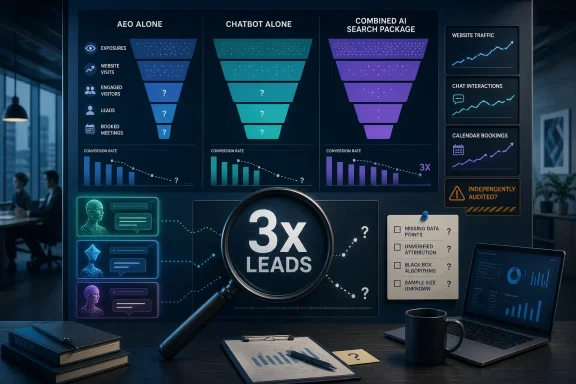 The 3x headline lacks the comparison needed to support it
The company frames the research around three scenarios: AEO without a chatbot, a chatbot without AEO, and both together. Yet its central metric is described as a three-times increase in qualified leads “relative to the baseline period before either system was in place.”That baseline is not a direct measurement of “either system deployed independently.” It is the period before deployment. To substantiate the headline’s stronger comparison, AI Search Engineers would need to publish the lead totals, traffic volumes, conversion rates and observation periods for each of the three scenarios, then show that the combined system beat both single-system groups under comparable conditions.
None of those figures appear in the release. There is no breakdown of how many engagements fell into each scenario, no indication that sites were matched by sector, traffic level, geography or seasonality, and no explanation of whether the same client websites moved through each stage over time. There is also no definition of the baseline period, no median result, and no account of clients that may have produced little or no improvement.
The agency does include a disclaimer stating that its comparative data covers client engagement information collected from January 2025 through June 2026 and has not been independently audited. That disclosure is welcome, but it does not resolve the basic attribution problem. A business that launches a chatbot while also revising service pages, adding schema, earning new reviews, expanding paid advertising, changing intake staff, or entering a busier season can see lead changes for several reasons at once.
The company’s own descriptions of the single-product scenarios are qualitative. AEO alone reportedly improved AI-referred traffic but lost visitors to ordinary contact forms; chatbots alone reportedly improved conversion from existing traffic but did not improve visitor quality. Those are reasonable hypotheses. They are not the numerical evidence required to establish a threefold multiplier.
“Qualified lead” is the number doing most of the work
AI Search Engineers gives one set of operational figures from a 30-day chatbot deployment across 10 professional-service websites: 1,247 conversations, 387 “qualified leads” with full contact information, and 143 consultation bookings completed inside chatbot conversations.Taken at face value, that works out to contact information captured in about 31 percent of conversations, with bookings in roughly 11 percent. About 37 percent of the reported leads reached the calendar-booking stage. Those are potentially meaningful numbers for an intake team, but the release does not identify the websites, their starting traffic, their normal form-conversion rate, their services, or whether the bookings became attended consultations, retained clients or revenue.
More importantly, “qualified” is left undefined. The release says the 387 leads included complete contact details, but supplying a name, email address and phone number is a capture event, not necessarily a sales-qualified lead. Professional services commonly filter inquiries based on jurisdiction, matter type, budget, urgency, conflict checks, eligibility, insurance coverage or client fit. Without a stated qualification rubric and an outcome beyond booking, readers cannot translate the number into a reliable estimate of pipeline value.
The agency reports that 61 percent of conversations included a variation of “do you handle my specific situation?” That is useful chatbot-training feedback, especially for law firms, medical practices and financial advisors that field recurring eligibility questions. But it also underlines why volume alone is a weak commercial measure: a conversational system can answer a high number of preliminary questions without producing viable engagements.
For IT teams and marketing operations staff, the minimum useful reporting set would include tagged referral source, unique visitor counts, conversation starts, lead captures, sales-qualified leads, booked appointments, no-shows, closed business and revenue. Each should be reported against a defined pre-launch period and, where possible, a control group or staggered rollout. The announcement provides only the middle of that funnel.
AEO is not a documented ranking switch for ChatGPT, Gemini or Copilot
The release identifies five “authority signals”: entity cleanup, structured-data deployment, trusted-source citation building, answer-focused content, and monthly prompt testing. Most are familiar website hygiene and content operations under a new answer engine optimization label. They can make a site clearer for crawlers and easier for visitors to use, but they do not create a guaranteed route into AI-generated recommendations.Google’s published guidance is particularly direct on this point. Google says conventional SEO best practices remain applicable to AI Overviews and AI Mode, but there are no additional requirements or special optimizations that secure inclusion. Pages must be indexed and eligible to appear in ordinary Google Search, and even compliant pages are not guaranteed to be crawled, indexed or served. Google also says correctly implemented structured data does not guarantee a search appearance.
OpenAI similarly says there is no way to guarantee top placement in ChatGPT search. Site owners can make a site eligible by allowing the OAI-SearchBot crawler, but ranking depends on relevance and reliability factors rather than a published AEO checklist. Microsoft’s documentation describes Copilot web grounding as a Bing-powered process that returns relevant search results and citations; it does not endorse a vendor-defined set of five signals as a mechanism for being selected in responses.
This does not make the agency’s work useless. Clean entity information, accurate structured data, crawlable text, documented services and well-maintained pages are sensible investments. The unsupported part is the leap from those practices to a predictable placement outcome across several AI products that use different retrieval systems, indexes, models, user context and query formulations.
AI Search Engineers says nine completed professional-service engagements raised an internally defined “AI Search Visibility Score” from an average of 31 to 74 in 90 days. The score is proprietary, the scoring methodology is not published in the announcement, and the company has not released the underlying client-level results. A proprietary score can help an agency track its own work, but it cannot independently establish visibility gains without the prompts tested, the platforms used, the scoring rules, the dates and the raw answer appearances.
The free offer is an audit plus a time-limited chatbot test
The company’s August 5 release says both tools are available at no cost to businesses that use their websites for client acquisition. Its details describe two different offers.The “free AI Marketing Tool” evaluates a website across the company’s five categories and produces an AI Search Visibility Score, gap analysis and action plan. It is an assessment product. The release does not say that the company will implement technical fixes, create authority content, secure third-party citations, monitor prompts or provide a continuing AEO campaign free of charge.
The chatbot offer is more concrete but still a trial: a trained system deployed for 30 days, with stated eligibility requirements of at least 50 weekly website visitors and website-led customer acquisition. In a July 16 ACCESS Newswire release, AI Search Engineers described the same pilot as being deployed within five business days after eligibility confirmation, but the August 5 announcement does not repeat that timetable or provide terms governing post-pilot pricing, data retention, integrations, accessibility, security review, or human escalation.
That missing operational detail should concern Windows and IT administrators as much as marketers. A chatbot trained on services, pricing and client outcomes needs an owner for source-content approvals, an audit trail for answers, a process for correcting stale information, limits on what it may collect, and a handoff path for sensitive matters. Those requirements are more demanding in legal, financial and medical settings—the same verticals AI Search Engineers names as its core market.
The practical test is a controlled funnel report
No independent outlet or third-party analyst appears to have reported verification of AI Search Engineers’ 3x finding. The public record located for the agency’s methodology consists chiefly of its own announcements and syndicated press-release copies, including prior releases describing its self-created AEO Differentiation Standard and its status within that standard.Businesses interested in the pilot should treat it as an opportunity to measure a chatbot’s intake effect, not as proof that an AEO-plus-chatbot bundle will automatically triple leads. Before placing it on a production site, they should require access to conversation transcripts and exports, define what constitutes a qualified lead, set data-handling and retention terms, verify calendar and CRM permissions, and establish a before-and-after reporting window that separates AI referrals from organic, paid, direct and referral traffic.
The agency’s announcement identifies a real operational gap: a visitor who arrives after hours and encounters only a contact form may leave. Its data does not yet establish that a proprietary AEO framework plus a chatbot closes that gap at three times the rate of either component alone. The 30-day pilot can answer that question for an individual site only if the business measures the entire funnel through retained client or booked revenue—and keeps the vendor’s internal visibility score separate from the result it can independently verify.
References
- Primary source: Digital Journal
Published: 2026-08-05T17:57:44+00:00
- Related coverage: openai.com
Introducing ChatGPT search | OpenAI
Get fast, timely answers with links to relevant web sourcesopenai.com - Related coverage: openai.com
Research with ChatGPT | OpenAI
Learn how to research with ChatGPT using search and deep research to find up-to-date information, analyze sources, and generate structured insights.openai.com - Related coverage: learn.microsoft.com
Data, privacy, and security for web search - Microsoft Copilot Studio | Microsoft Learn
Information on the Web Search functionality in Microsoft Copilot Studio regarding data privacy and security.learn.microsoft.com - Related coverage: learn.microsoft.com
Use public websites to improve generative answers - Microsoft Copilot Studio | Microsoft Learn
Learn how to structure generative answers nodes using public websites in Microsoft Copilot Studio. Optimize Bing Custom Search for accurate, grounded responses.learn.microsoft.com - Related coverage: help.openai.com
ChatGPT search for Enterprise and Edu | OpenAI Help Center
Learn how ChatGPT search works for Enterprise and Edu workspaces, including admin controls, data sharing, sources, and usage limits. help.openai.com
- Related coverage: morningstar.com
- Related coverage: morningstar.com
- Related coverage: newswire.com
- Related coverage: newswire.com
AI Search Engineers Identify the Five Authority Gaps Keeping Most Businesses Out of ChatGPT and Gemini Answers | Newswire
The only AEO Verified agency in the United States publishes findings from 50+ AI visibility audits revealing why businesses with strong SEO remain invisible in AI-generated search resultswww.newswire.com - Related coverage: newsroom.seaprwire.com
AI Search Engineers Launches AI Visibility Audit to Identify Why Businesses Fail to Appear in AI Search Results – Fintech Insights & Global Trend Analysis | SeaPRwire Newsroom
Independent experts dissect the truth behind fintech evolution, geopolitical policy, and global market reshuffles at SeaPRwire. newsroom.seaprwire.com
- Related coverage: pressrelease.com
- Related coverage: developers.google.com
AI Features and Your Website | Google Search Central | Documentation | Google for Developers
Google Search's AI features can help users find your website. Learn more about how AI features work in Search and how to approach your content's inclusion in these experiences. developers.google.com
- Related coverage: developers.google.com
Google Search's Guidance on Generative AI Content on Your Website | Google Search Central | Documentation | Google for Developers
Learn how to use generative AI content on your website in a way that complies with Google's policies.
developers.google.com
