
But the results published August 3 in a GlobeNewswire release carried by The Manila Times remain agency-reported claims, not independently audited performance data. JDM’s own case-studies page confirms that Rachel Mintz Mobile Notary and Apostille is a client and identifies the work as web redesign, SEO, Local SEO, link building, content writing, and guest blogging. Neither the press release nor the public case-study listing supplies the campaign period, Google Search Console data, ranking-tracker methodology, traffic growth, calls, appointment requests, or revenue results needed to establish the commercial impact behind the rankings.
That omission changes how businesses should read the announcement. Ranking for a group of high-intent searches can matter, particularly for an urgent, service-area business such as a mobile notary. Yet a first-page position is not a stable, universal result: it can vary by searcher location, device, query wording, history, competition, and the mix of Maps, ads, organic listings, and AI-generated features shown on a particular results page.
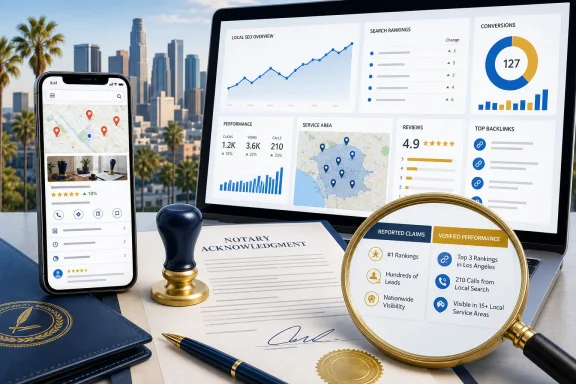 The campaign combined the parts that Google actually documents
JDM describes a broad campaign rather than a single trick: technical SEO, a site redesign, keyword and competitor research, internal linking, localized service pages, structured data, Google Business Profile work, citation management, reviews, content, guest blogging, and ongoing monitoring. For a local service business, that is the right general shape, because local visibility is not determined by one page title or a batch of directory listings.
Google’s Business Profile documentation says local results are principally driven by relevance, distance, and prominence. A complete profile can improve the system’s understanding of what a company does; proximity still limits where it can surface; and prominence incorporates signals including links and reviews. A notary may improve the service information, hours, category, address or service-area details, photos, and customer-review process, but it cannot optimize away the fact that a searcher may be closer to another qualified provider.
That puts an important boundary around JDM’s reported location-based wins. “Mobile Notary Beverly Hills,” “Mobile Notary Hollywood,” and “Mobile Notary Los Angeles” look similar in a keyword report, but they describe searches that can produce materially different local results depending on where the user is standing. Businesses buying Local SEO should therefore ask for map-grid or location-specific reporting, not merely a single rank reported from an unspecified location.
Google also advises businesses that travel to customers to represent their real service area accurately. That is especially relevant for mobile notaries, locksmiths, plumbers, repair technicians, and other service-area operations. Inflating a service area or presenting virtual offices as staffed locations may create short-term visibility claims, but it creates a profile-policy risk and does not solve the underlying proximity problem.
The redesign component deserves more attention than it gets in the release. For an appointment-driven business, organic visibility only has value if a customer can establish service availability, understand the process, see where the business operates, and request help without fighting a slow or confusing mobile page. A ranking report measures whether a page appeared; it does not show whether the visitor trusted it enough to call.
Domain Authority is a benchmark, not proof of Google performance
The headline figure in the announcement is the reported increase in Domain Authority from 1 to 25. That is a potentially useful directional benchmark for link-profile development, but it is not a Google ranking factor.
Domain Authority is Moz’s proprietary predictive metric, scored from 1 to 100. Moz itself has long cautioned that the number is comparative rather than an absolute grade, and that Google does not use it in search rankings. Search Engine Land and Search Engine Journal have separately documented the same distinction: Domain Authority can move with the link data and model used by Moz, but it is not an internal Google signal that a business can “raise” to trigger better rankings.
JDM also reports an expansion from fewer than 50 backlinks to more than 350 “quality backlinks,” and from 38 referring domains to more than 350. Those figures are arithmetically possible, although the rounded “more than 350” wording does not reveal the exact counts, source tools, dates, whether lost links were counted, or the editorial standards used to classify a link as quality.
For buyers of SEO services, the missing detail is consequential. Links from respected local organizations, professional associations, legitimately earned editorial coverage, and relevant partner sites can reinforce a company’s prominence and referral visibility. Large volumes of low-value directories, syndicated guest-post placements, or sites built chiefly to sell links can create an impressive-looking backlink chart without adding much customer trust or durable search value.
The better scorecard is therefore a mixed one: qualified organic sessions from the actual service territory, calls or booking requests attributable to those sessions, impressions and actions on the Google Business Profile, non-branded rankings by neighborhood, review quality and response time, and the indexing and performance health of service pages. Domain Authority can sit on that dashboard, but it should never be the dashboard.
Google supports conventional SEO for AI results — not an AI-search shortcut
The release frames the campaign around a newer anxiety: visibility in Google AI Overviews as well as ChatGPT, Gemini, Microsoft Copilot, Perplexity, and other AI-powered answers. It is correct that users increasingly encounter synthesized answers rather than a traditional ten-blue-links page. It is not established that a conventional local SEO campaign makes a business visible across all of those products.
Google’s recently published guidance on generative AI features is unusually direct on this point. Google says its AI Overviews and AI Mode remain rooted in the company’s core Search ranking and quality systems, and recommends ordinary, durable work: crawlable pages, clear technical structure, useful and original content, good page experience, and accurate business information. It specifically warns that there is no special schema markup required for generative search and no advantage to artificial tactics such as creating llms.txt files for Google.
In other words, the phrase “AI optimization” can be useful only when it describes basic information quality and retrieval readiness. A service company should make it easy for systems and customers to identify the business, its service area, hours, credentials, pricing approach where appropriate, booking path, and the details that distinguish its work from generic competitors. It should not assume that publishing many thin pages for every city-and-service permutation will win an AI answer or a local pack.
Google’s guidance also cuts against a tempting interpretation of the JDM release: structured data is useful for communicating business details and can support eligibility for certain Search appearances, but it is not a guaranteed passage into AI Overviews. Google says structured data is not required for generative AI search, and pages still must be crawlable, indexed, and otherwise eligible to appear in ordinary Search. Visibility is not guaranteed even then.
The announcement provides no data showing that Rachel Mintz Mobile Notary and Apostille has been selected or cited by Google AI Overviews, Copilot, ChatGPT, Gemini, Perplexity, or any other answer engine. JDM presents that cross-platform claim as a strategic conclusion, but no independent outlet has reported platform-specific visibility, and no screenshots, query set, monitoring interval, or referral measurements accompany it.
Local SEO needs evidence that reaches beyond rankings
The campaign’s strongest practical argument is its emphasis on localized information. Google says complete and accurate Business Profile information improves the chances of appearing for relevant local searches, while positive reviews and helpful responses can help a business stand out. LocalBusiness structured data can also help Google understand basic details such as hours, location, and business information, though it must match visible page content and be technically valid.
For a service business, the disciplined version of this work is straightforward:
- Service pages should explain what the company actually does, where it serves customers, what the customer needs to prepare, and how quickly the business can respond.
- The Google Business Profile, website, appointment system, and legitimate business directories should present consistent real-world contact and service information.
- Reviews should be earned from customers and answered as customer-service records, rather than treated as a ranking commodity.
- Reporting should separate branded searches from new-customer discovery queries and connect both to calls, forms, bookings, and completed jobs.
JDM’s release makes a reasonable case for combining technical, content, and local business work rather than chasing a few headline keywords. What it does not yet prove is that the reported first-page positions produced sustainable leads, or that the campaign secured meaningful presence inside the AI products named in the announcement.
The next meaningful measure for Rachel Mintz Mobile Notary and Apostille is not whether its Moz number climbs above 25 or whether its backlink count passes another round threshold. It is whether searchers in Los Angeles-area service zones can reliably find accurate information, choose the business, and complete a notary or apostille request—and whether JDM can document that outcome with conversion and location-level data rather than rank snapshots alone.
