

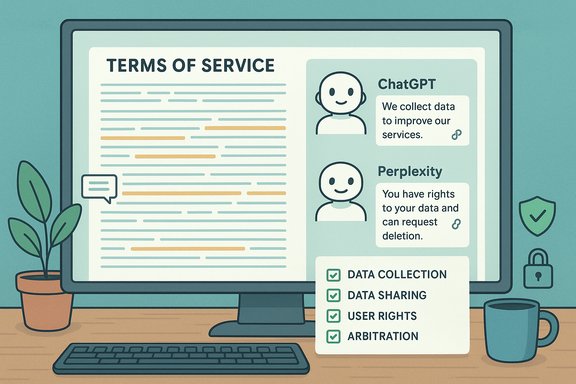
AI can cut the chore of reading dense Terms of Service (ToS), but not all assistants are created equal — in a hands‑on comparison, ChatGPT and Perplexity produced the most usable, trustworthy summaries of an Apple privacy ToS page, while other mainstream assistants often sacrificed depth or provenance for brevity.
Background
Long, jargon‑heavy Terms of Service are ubiquitous. They affect privacy, security, data sharing, user rights, and liability — but the average reader rarely has time, legal training, or patience to parse them line‑by‑line. AI summarization tools promise to bridge that gap by extracting the most important obligations and risks and presenting them in plain language you can actually use.
A brief experiment reported in a technology outlet asked seven AI assistants (ChatGPT, Microsoft Copilot, Google Gemini, Anthropic Claude, Perplexity, xAI Grok, and Meta AI) to summarize the same Apple privacy ToS page. The goal was simple: give each assistant the URL, ask for an analysis and a readable summary, and compare the results. The testers judged outputs on clarity, completeness, helpful structure, and whether the assistant provided verifiable links to the underlying clauses. Two tools stood out for balancing depth and digestibility: ChatGPT and Perplexity.
This outcome aligns with broader independent audits showing that assistants designed for citation‑forward responses tend to outperform others on verifiability; a consumer audit by Which? found Perplexity scored highest on practical reliability across a set of consumer queries, while several mainstream assistants made errors on jurisdictional or numeric details.
Why AI summaries of ToS matter
The problem: unread contracts with real consequences
Most ToS documents are long and written for legal completeness rather than user comprehension. That matters because:
- Privacy choices (what data is collected, how it’s used and shared) are buried in dense text.
- User obligations (behavior rules, prohibited activity) can carry account suspension or other penalties.
- Automatic changes (roll‑forward clauses, consent to future modifications) often live in near‑invisible sections.
- Liability and arbitration clauses may waive users’ rights or require out‑of‑court dispute resolution.
An AI that reliably surfaces these items — and flags material changes or unusual clauses — can save time and reduce risk.
What good looks like for a ToS summary
A useful AI ToS summary should:
- Extract and clearly label the core topics: data collection, data sharing, user rights, retention, security commitments, third‑party sharing, jurisdiction/venue, termination, and changes to the agreement.
- Provide direct evidence: point to specific sections or clause text so readers can verify the claim.
- Highlight red flags: nondisclosure of data recipients, broad data‑use grants, automatic renewals, mandatory arbitration, or asymmetrical termination rights.
- Offer actionable guidance: what to change in settings, what to audit, or whether legal review is recommended.
ChatGPT and Perplexity tended to meet more of these criteria in the cited comparison: ChatGPT delivered an organized, multi‑section summary with useful talking points, while Perplexity condensed the essentials into a compact, citation‑rich nugget that still felt complete.
How the top performers differed (practical takeaways)
ChatGPT — depth, structure, and readable detail
ChatGPT’s summary approach in the test leaned toward a long‑form, organized layout: multiple sections, each with bullet points, end‑section talking points, and readable plain language. That format works well when you want a thorough walkthrough without reading the full ToS yourself.
Strengths:
- Comprehensive structure that maps to legal topics.
- Readable prose that lowers the barrier for non‑lawyers.
- Good for users who want both the gist and enough detail to act.
Caveats:
- Longer summaries require more reading time than ultra‑short digests.
- ChatGPT’s factual reliability depends on the prompt, model version, and whether it can access the live page or only a pasted excerpt.
Perplexity — compact, citation‑forward synthesis
Perplexity’s output was shorter but dense with the key points. It emphasized the “what, why, and your rights” structure and often paired claims with direct links to relevant sections. That made it feel efficient and verifiable — ideal when you need a quick, defensible briefing.
Strengths:
- Concise yet comprehensive: hits the major categories without excess verbiage.
- Provenance emphasis: built‑in citations reduce the extra work of back‑checking.
Caveats:
- The brevity can hide nuance; if a clause has conditional language, a short summary can miss caveats.
Where other assistants fell short
- Microsoft Copilot: produced an overview but was too terse and left out substantive details in the test, making it less useful for reading legal obligations.
- Google Gemini and Anthropic Claude: tended toward brief summaries that captured high‑level points but didn’t always expand on conditional or nuanced clauses.
- xAI Grok and Meta AI: Grok offered a readable summary with pros/cons analysis, while Meta AI’s output was the briefest and least comprehensive in the sample.
These observed differences mirror broader comparative testing that shows design choices matter: systems optimized for citation and research do better at verifiable summaries; generalist copilots aimed at productivity may prioritize short answers and workflow integrations over legal completeness.
The strengths: what AI does well with ToS
- Saves time: AI reduces hours of reading to minutes of digestible content, especially useful for long corporate privacy policies or multi‑page ToS documents.
- Standardizes the reading: the same prompt yields comparable structure across multiple documents, making it easier to compare policies.
- Flags and highlights: assistants can mark Renewal clauses, Data‑sharing blocks, and Mandatory Arbitration quickly.
- Scales: for teams that must review dozens of vendor agreements, an AI workflow that extracts key clauses into a checklist is a pragmatic win.
These benefits explain why researchers and product teams are building specialized interfaces (e.g., ToS‑focused readers and contract‑summarizers) that layer plain English, visual highlights, and contextual examples on top of generative models. Academic work like TermSight explores this problem space explicitly and finds measurable improvements in user comprehension when AI is used to highlight relevance and power imbalances in contracts.
The risks and failure modes you must watch
AI summarization is powerful, but it is not a substitute for legal review or critical verification. The most important risks:
- Hallucination and oversimplification: models occasionally invent specific details or paraphrase in ways that change legal meaning. Independent audits show that assistants still make substantive errors on jurisdictional rules, numerical thresholds, and conditional rights — errors that can be costly if acted on.
- Loss of nuance: a clause that looks benign on a first pass (e.g., “we may share aggregated data”) could have hidden exceptions or broad delegations; concise summaries sometimes suppress the conditional language that matters.
- Provenance illusions: an answer that looks confident does not guarantee fidelity. Citation presence helps but does not eliminate the need to read the cited clause directly — citations can be selective or truncated. Perplexity’s citation focus reduces this risk, but users must still check the original text.
- Privacy and data exposure: uploading contract text or pasting URLs into consumer AI services can expose potentially sensitive business data. Enterprise contracts and model‑use clauses vary; consumer tiers often allow vendors to use prompts and outputs for model training unless a commercial, non‑training agreement applies. Verify the vendor’s data‑handling policy or use an enterprise plan that explicitly excludes training use.
- Agentic browsing and paywalls: AI browsers and agentic assistants that “read” behind paywalls or operate across subscriber sessions create legal and ethical questions about content reuse and data access. If you depend on an assistant that scrapes or reconstructs gated content, the provenance trail becomes more complex.
- Security surface: research and press coverage have raised concerns about tool vulnerabilities (for example, agentic browser features and extension APIs). Keep client software patched and be wary of advanced integrations that require elevated permissions. Recent public disputes highlight the need for careful security review of “Comet”‑style agentic browser features.
Practical, journalist‑grade checklist for using AI to summarize ToS
When you ask an AI to summarize a ToS, use a structured, verifiable workflow:
- Start with a precise prompt: “Analyze and summarize this ToS page at . Produce:
- A 6‑point executive summary (max 3 sentences each),
- A bullet list of mandatory user obligations,
- A list of data collection and sharing categories,
- Any clauses that limit user remedy (arbitration, class action waiver),
- Direct quotes (≤25 words) from the most consequential clauses and line numbers or headings.”
This forces the assistant to produce both summary and citations.
- Demand provenance: ask the assistant to return the section heading and a short direct quote for each claim. If the tool doesn’t provide exact text positions, treat the output as a starting point, not a final authority. Perplexity’s citation‑rich answers make this easier; ChatGPT can do it when instructed to reference exact clause text.
- Verify the five most load‑bearing claims yourself: data recipients, retention period, opt‑out mechanics, arbitration/venue, and modification notice period. Read the original clauses for these. Treat AI as triage — it highlights where you should read closely.
- Protect sensitive inputs: for contracts that contain trade secrets, personal data, or privileged material, use vendor enterprise offerings with non‑training guarantees, on‑tenant deployments, or local/offline LLMs to prevent unintended training or retention.
- Keep a human‑in‑the‑loop: require a qualified reviewer (legal, privacy, or compliance) to validate any AI‑extracted obligations before decisions or vendor commitments are made. The cost of an erroneous summary can exceed the time saved.
- Log and audit: store the AI prompt, the assistant output, and screenshots or copies of the original ToS. This creates an audit trail if a later dispute requires showing what you were told at the time of decision.
- Use a contract checklist template: convert the AI’s output into a short checklist you can reuse across vendors: data types, third‑party sharing, deletion right, retention, security standards, breach notice procedures, and termination conditions.
Example prompts that work (practical templates)
- Short triage prompt (fast):
- “Summarize this ToS in five bullets emphasizing data collection, third‑party sharing, user control, retention, and dispute resolution. Cite the section headings used as evidence.”
- Deep‑dive prompt (verification and quotes):
- “Produce a clause‑level summary. For each claim, include: section heading, a 1–2 sentence paraphrase, an exact quoted excerpt ≤25 words, and my recommended immediate actions (none / change setting X / consult legal).”
- Comparison prompt (vendor decision):
- “Compare Vendor A’s privacy ToS with Vendor B’s. Produce a two‑column table: (A) Clauses favorable to the user, (B) Clauses favorable to the vendor, and (C) Red flags. Highlight where legal review is required.”
These prompt templates produce more consistent and verifiable outputs and were mirrored in hands‑on testing approaches for ToS summarizers.
When to avoid solely relying on AI
AI summaries are inappropriate as the only basis for action in these situations:
- High‑value contracts: multi‑year SaaS deals or enterprise agreements with substantial fees, liability exposure, or compliance implications.
- Regulated data: agreements involving health data (HIPAA), financial data (GLBA), or other regulated personal data.
- Litigation risk: clauses that alter dispute resolution, indemnities, or shifting liability.
- Ambiguous or contradictory language: if the clause could reasonably be interpreted in multiple ways, get legal counsel.
Independent audits and research consistently show conversational assistants still trip up on high‑stakes, jurisdiction‑sensitive questions; Which? and academic red‑team studies highlight examples where AI produced incorrect or risky consumer guidance on taxes, refunds, and other legal matters. In short: for low‑stakes triage, AI is excellent; for high‑stakes legal certainty, it’s a triage tool, not a verdict.
Broader implications for publishers, vendors, and consumers
- For publishers and vendors, AI summarizers reduce friction for users and can increase transparency — but they also change the economics of access when agents synthesize paywalled content. Agentic browsers and sidecar assistants raise new IP and licensing questions that publishers and platforms are still negotiating.
- For product teams and enterprise buyers, the imperative is governance: define clear data handling, vendor training opt‑outs, and retention policies before integrating AI into contract review workflows. Commercial enterprise tiers increasingly offer non‑training guarantees and tenant‑level data controls; these should be contractually enforced for sensitive work.
- For consumers, the net effect is empowerment if used prudently: AI reduces the cognitive cost of understanding rights and obligations — provided users verify provenance and understand the assistant’s limitations.
Critical appraisal and final judgment
The ZDNET comparison highlights a practical truth: not all assistants are equally suited to legal or compliance‑adjacent summarization. ChatGPT’s strength is readable comprehensiveness; Perplexity’s is compact, citation‑first clarity. These are complementary — one is better when you want a guided tour through the text, the other when you need a fast, auditable checklist.
Yet broader audits and peer‑reviewed work underline the same cautionary note: AI summarizers can and do make errors, especially on jurisdictional rules, numeric thresholds, and conditional eligibility statements. Independent evaluations have repeatedly flagged gaps in safety and accuracy for consumer‑facing advice, reinforcing the need for human validation in any consequential decision. In practice, the best approach blends AI speed with human judgement:
- Use AI to triage and prioritize the clauses that need reading.
- Demand citations and direct quotes for the five most important claims.
- Protect sensitive inputs with enterprise controls or local models.
- Keep a human reviewer responsible for final verification on any material decision.
AI is already the most practical way most people will interact with ToS going forward. With the right prompts, provenance checks, and governance, it can be a genuine productivity multiplier — but only when treated as an assistant, not an arbiter.
Conclusion
AI summarizers have reached the point where they can meaningfully reduce the friction of reading Terms of Service. In hands‑on comparisons, ChatGPT and Perplexity stood out for their complementary strengths: ChatGPT for clear, structured depth, and Perplexity for concise, citation‑oriented clarity. Both offer real value as triage and decision‑support tools, but neither replaces careful verification for high‑stakes agreements. Users and organizations should design workflows that pair AI speed with human review, insist on provenance, and protect sensitive inputs to get the benefit of summarization without taking on undue risk.