
Wccftech first highlighted the addition, while AMD’s July 23 Advancing AI 2026 roadmap established the larger context: Zen 7-based EPYC CPUs are planned for 2028 under the Florence, Ferrara, and Fidenza names. AIDA64’s beta support arrives roughly two years before that stated window, yet the vendor has disclosed no model numbers, socket details, core counts, stepping IDs, or performance data.
For Windows users who use AIDA64 to inventory machines, validate new server deployments, or collect sensor data, the immediate consequence is modest: current systems gain nothing. The practical value is that FinalWire has begun preparing its detection stack before AMD’s next server generation reaches system builders, OEM validation labs, and eventually enterprise deployments.
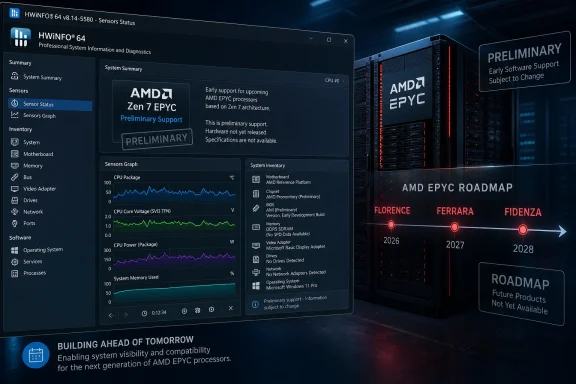 AIDA64’s release notes confirm the entry — and little else
The relevant line in AIDA64 Extreme 8.35.8405 beta is short: “preliminary support for AMD Zen 7 server processors.” The same August 16 release also adds a 2GB Memory Copy block-size option to the GPGPU benchmark, sensor support for two Lenovo ThinkCentre models, motherboard definitions, Radeon RX 9050 and RX 9060 XT LP identification, and a fix for a Blue Screen of Death on a Dell PowerEdge R740.
That surrounding changelog matters. Zen 7 is not presented as a product announcement or a detailed compatibility certification; it is one early-recognition item among ordinary device-database and bug-fix work. AIDA64 has not said which attributes it can recognize, whether it has access to an engineering sample, or whether its code merely contains expected CPU-family identifiers and provisional labels.
Hardware-monitoring developers commonly add those definitions before a public launch so that the operating system tools and support workflows can name new hardware correctly on day one. Early support can cover CPU identification, sensor mappings, cache fields, platform labels, or warning logic. It does not, by itself, prove that the vendor possesses final processors, final firmware, or a shipping motherboard platform.
That distinction is the core limitation in the Wccftech framing. The AIDA64 entry is a useful signal that Zen 7 is sufficiently defined for software preparation, but it cannot establish how far AMD’s silicon program has advanced. Software vendors can work from documentation, expected CPUID values, or partner information long before the final platform is ready for broad testing.
AMD has confirmed a three-part Zen 7 EPYC plan for 2028
AMD’s own July roadmap announcement goes further than the AIDA64 release notes on the product-family names but stops well short of a specification sheet. The company said Zen 7-based EPYC server CPUs—Florence, Ferrara, and Fidenza—are expected in 2028. It also described the follow-on Zen 8 EPYC family, Ravenna, as planned for 2030.
AMD chief executive Lisa Su described Florence as bringing next-generation Zen 7 cores, leading-edge process technology, new AI compute extensions, and support for newer memory technologies. AMD did not publish the instruction-set details of those AI extensions, memory-channel counts, socket compatibility, product segmentation, or a quarter-specific availability date.
Tom’s Hardware, reporting from the AMD event, noted that the company did not disclose core counts, the memory subsystem, the manufacturing node, or detailed AI-extension information for Zen 7. This is important because it separates AMD’s confirmed roadmap from the much more granular claims now circulating around the architecture.
The submitted report says Florence will offer both conventional Zen 7 and compute-optimized Zen 7c core variants. AIDA64’s release notes do not mention Zen 7c, and AMD’s July announcement did not confirm that split either. It may turn out to be AMD’s approach, given its existing use of dense-core EPYC designs, but it is not a feature that the AIDA64 beta entry validates.
The memory claim needs a correction
The report also places MRDIMM and LPDDR support under Zen 7 Florence. AMD’s public record is more complicated and, at this point, points in a different direction.
In an April 2026 technical post, AMD said its sixth-generation EPYC family will support DDR5 RDIMMs and MRDIMMs. It then said the first AMD EPYC platform to support LPDDR5X SOCAMM2 would be Verano, another sixth-generation EPYC processor family expected in 2027. AMD has described Verano as an optimized host CPU for future Instinct GPU generations and AI rack-scale systems.
That makes LPDDR a Zen 6-era, Verano-specific commitment, not a Zen 7 feature first established by the Florence roadmap. AMD has said Florence supports “the latest memory technologies,” but has not named LPDDR, MRDIMM speeds, DDR generations, SOCAMM variants, or a supported module list for Florence.
For infrastructure planners, that is more than a wording dispute. Memory topology, DIMM type, serviceability, capacity per socket, and power consumption determine server-board design and fleet purchasing decisions years before a CPU launch. Conflating Verano’s announced LPDDR5X SOCAMM2 support with Florence risks making a 2027 platform feature look like unannounced 2028 product detail.
The disciplined reading is simpler: AMD has disclosed a memory direction for Verano, while Florence’s memory implementation remains unannounced.
Windows administrators should treat this as inventory preparation, not deployment guidance
AIDA64 v8 officially supports 64-bit Windows 10 and later. Its beta builds are distributed as ZIP archives, and FinalWire instructs users to close the application and extract the beta over an existing installation; settings and license information are retained. That is appropriate for a lab machine or a hardware-validation workstation, but it is not a reason to introduce a beta monitoring build into a tightly controlled production fleet merely because it recognizes a processor family that will not ship until 2028.
The beta’s potential future benefit is straightforward. When EPYC Zen 7 systems reach OEMs and enterprise labs, monitoring and asset-inventory tools need to distinguish CPU families accurately, report valid platform information, and avoid mislabeling unreleased hardware as an older generation. Early tooling work reduces the awkward launch-period gap in which a server runs correctly but management utilities report incomplete or incorrect information.
For organizations using AIDA64 Engineer, Business, or Network Audit editions, there is also a distinction worth preserving: consumer-facing AIDA64 Extreme is designed for enthusiast use, while FinalWire itself positions the business-oriented editions for broader auditing and network needs. The new Zen 7 entry is currently listed in the Extreme beta changelog, not as a promise of enterprise inventory support across every AIDA64 product edition or every third-party management suite.
Admins planning 2027 and 2028 refreshes should continue to use AMD’s official roadmap milestones, OEM qualification schedules, operating-system certification information, and platform documentation as their planning baseline. An AIDA64 beta string cannot answer the questions that will determine a real rollout: platform availability, BIOS maturity, Windows Server support posture, virtualization validation, memory qualification, thermals, power budgets, or pricing.
Florence is now visible in software, but its technical profile is still mostly blank
The concrete news is that FinalWire has put preliminary Zen 7 server recognition into a public AIDA64 beta dated August 16, 2026. That is independently verifiable and consistent with AMD’s officially announced 2028 EPYC roadmap.
What it does not reveal is equally clear. There are no Zen 7 model numbers, no cache hierarchy data, no CPU-core configuration, no confirmed Zen 7c lineup, no socket information, no memory-controller specifications, and no proof of shipping or near-shipping silicon. AMD has announced Florence, Ferrara, and Fidenza as 2028 families; AIDA64 is simply one of the first Windows tools visibly preparing to recognize them.
The next meaningful evidence will be more substantial than a database entry: an AMD technical disclosure, an OEM platform roadmap, firmware support, a Linux or Windows driver reference, or a validated system announcement. Until then, AIDA64’s new line item is a useful early marker for the EPYC roadmap—not a specification leak.