
Wccftech first reported the v8.35 release, citing FinalWire’s AIDA64 update notes. The changes extend earlier AIDA64 references to AMD’s future silicon, but they should not be read as a product announcement or a confirmation of final specifications.
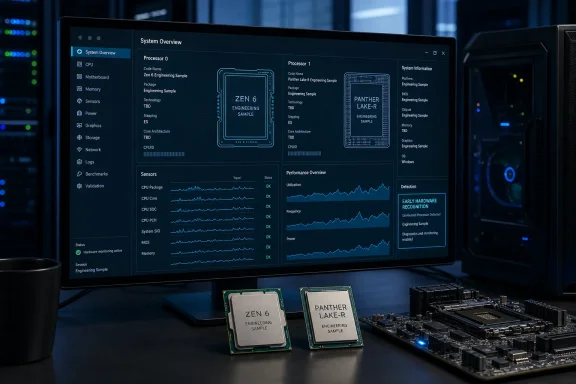 Recognition arrives before retail hardware
AIDA64 is widely used for system inventory, sensor monitoring, stress testing, and benchmark reporting on Windows PCs. Early compatibility usually means the software can interpret processor IDs, enumerate more platform data, and avoid misleading generic labels during bring-up and validation.
The new build reportedly improves Zen 6 and Zen 6 APU coverage while adding early Mustang Peak compatibility. Mustang Peak is widely associated with AMD’s next Threadripper generation, although AMD has not formally announced that product family or its specifications.
AIDA64’s June beta had already listed Mustang Peak and Olympic Ridge CPU identifiers alongside Medusa APU entries. That chronology makes v8.35 an incremental expansion of support, not a sudden leak of a finalized AMD roadmap.
Panther Lake-R is the Intel addition to watch
Intel Panther Lake-R is the other notable entry. The “R” designation is reportedly aimed at ruggedized systems, where long validation cycles and dependable hardware identification are especially important. AIDA64 support could therefore be useful to device makers and field-service teams testing early industrial, embedded, or durable mobile designs.
For ordinary PC buyers, the update changes nothing today. It does not establish launch dates, core counts, process nodes, sockets, graphics configurations, or performance for Zen 6, Mustang Peak, or Panther Lake-R.
The practical takeaway is narrower: Windows diagnostic tooling is being prepared for hardware that has not reached retail. That is a useful signal that platform development is advancing, but final product details still belong with AMD and Intel—not a monitoring utility’s changelog.
