
The new AKS guidance, highlighted by InfoQ and detailed in Microsoft’s AKS documentation and engineering blog, focuses on the operational side of Node Auto-Provisioning, or NAP. NAP uses Karpenter to create capacity for pending pods and to later remove, replace, or consolidate nodes when it calculates that the cluster can run workloads more efficiently. The feature can reduce idle VM spend, but it also turns node removal into a recurring production event rather than an occasional maintenance task.
Microsoft’s message is sound: PodDisruptionBudgets protect the availability of pods, while NAP disruption settings control the rate and conditions of changes to nodes. The important finding is that neither layer substitutes for the other. A cluster may have carefully configured PodDisruptionBudgets and still permit a large number of nodes to be consolidated at once; conversely, a NodePool can impose a strict node disruption budget while an unprotected application still loses all of its replicas during a drain.
For platform teams considering NAP as a replacement for conventional node pools with Cluster Autoscaler, this is a design requirement, not optional tuning.
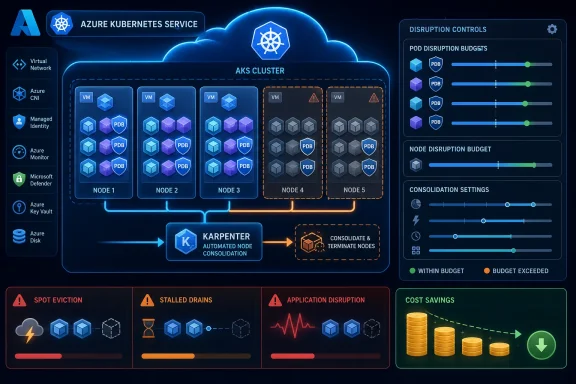 PodDisruptionBudgets can protect availability—or stop drains cold
A Kubernetes PodDisruptionBudget, usually called a PDB, limits voluntary pod evictions for a selected workload. Node drains caused by consolidation, planned upgrades, drift remediation, and other managed changes rely on those evictions. Kubernetes’ own documentation is explicit: a PDB with maxUnavailable: 0, maxUnavailable: 0%, minAvailable: 100%, or a minAvailable count equal to the total replica count permits no voluntary disruptions.
That result is sometimes misunderstood as an availability win. It is only a promise that Kubernetes will refuse an eviction when the budget cannot be satisfied. For a single-replica Deployment with minAvailable: 1, the pod cannot be voluntarily evicted at all. If that pod sits on a NAP-managed node selected for consolidation or an upgrade-related drain, the node may remain stuck until the underlying condition changes or an operator intervenes.
Microsoft’s new migration guidance makes the consequence unusually plain: workloads need properly sized resource requests, replica counts, and PDBs before they can be consolidated safely. This is the operational catch in moving to NAP. A workload that only ever ran on a static node pool may have survived with no meaningful eviction design. Once the platform routinely considers relocating its pods to save money, the application’s declared availability model is tested continuously.
The right answer is not to remove PDBs wholesale. For a replicated service, allowing one unavailable replica during voluntary maintenance may preserve user-facing capacity while enabling drains to finish. But that depends on the service’s real redundancy, startup time, readiness checks, topology rules, and downstream dependencies. A two-replica service whose replicas are co-located in one availability zone is not made highly available by writing maxUnavailable: 1.
There is a harder conclusion for singleton workloads: a PDB cannot create resilience that the application has not deployed. If one pod is genuinely indispensable, teams must choose whether to add redundancy, isolate it from aggressive consolidation, or accept that planned node work will need a manual process.
NAP has its own disruption budget, and it counts nodes
NAP’s NodePool spec.disruption.budgets field is a separate throttle. It limits how many NAP-managed nodes Karpenter may voluntarily disrupt concurrently through consolidation, emptiness, or drift. Microsoft says that if no budget is configured, the default is one budget allowing disruption of 10% of nodes in the NodePool.
This is the control that stops a cost-optimization pass from becoming a broad infrastructure reshuffle. It operates on nodes, not application replicas. In a 50-node pool, a 10% default can still allow five nodes to be disrupted, subject to other conditions. Whether that is harmless or risky depends on which workloads are on those nodes and whether their PDBs, spread constraints, capacity reservations, and replacement capacity can handle the movement.
Microsoft’s documentation also spells out a detail administrators should account for when calculating a budget: nodes already deleting and nodes in NotReady state reduce the number of additional disruptions permitted. With percentage budgets, Karpenter rounds up the allowed percentage before subtracting those unavailable nodes. When several budgets apply, the most restrictive result wins.
The practical advantage is that teams can combine a percentage ceiling with an absolute cap. A large production NodePool may allow 20% disruption in principle but impose a maximum of five nodes, keeping an unusually large pool from authorizing an unexpectedly large maintenance wave. Scheduled budgets can also temporarily set permitted disruption to zero during a known sensitive period.
That last option is valuable for business events, batch-processing windows, and controlled rollout periods, but it needs a careful companion setting. Microsoft advises setting expireAfter: Never when operators want disruption confined to a maintenance window and intend to rely on budget-gated drift and consolidation. Otherwise, node expiration can introduce a different, more forceful path to removal.
Consolidation policy decides how aggressively NAP searches for savings
NAP’s consolidation setting has a direct effect on how often applications encounter voluntary disruption. WhenEmpty limits NAP to nodes without workload pods. WhenEmptyOrUnderutilized allows the service to evaluate more ambitious changes: moving pods to other nodes, selecting a more suitable VM shape, or replacing multiple nodes with a smaller arrangement that lowers cost.
Microsoft’s AKS engineering blog describes this as an internal cost simulation across VM combinations. The important operational implication is that “underutilized” is not a CPU threshold an administrator can simply tune. NAP judges whether the cluster can be rearranged more cheaply while honoring the constraints it sees.
That makes resource requests especially consequential. Kubernetes schedules from requested resources, not from a workload’s best-case utilization graph. Requests that are materially larger than real needs can make workloads harder to pack and make consolidation less effective. Requests set unrealistically low can enable overly dense placement, leaving too little room for a safe drain or a startup surge. NAP cannot infer an application’s actual fault tolerance from its VM costs.
Operators also have consolidateAfter, a delay between finding a consolidation opportunity and disrupting a node. The official AKS documentation currently says this field can be set when consolidationPolicy is WhenEmpty; Microsoft’s July engineering blog, however, describes it as working with consolidation policy more generally and uses an underutilization example. That is a documentation inconsistency administrators should resolve against the API version and AKS feature behavior in their own cluster before treating consolidateAfter as a debounce timer for underutilized-node consolidation.
The distinction matters for bursty services. If NAP quickly removes capacity after a temporary scale-down, an incoming traffic burst may require node provisioning again moments later. A longer delay retains headroom and reduces churn, but it also keeps billable capacity alive longer. There is no universally safe number: development environments may accept short delays, while production services with slow-starting containers, large images, GPU scheduling, or fragile dependencies may require a more conservative policy.
Expiration and termination settings are the escape hatches
Microsoft separates NAP’s automated node disruption methods into graceful and forceful categories. Consolidation and drift are graceful paths that are subject to NodePool disruption budgets. Expiration is forceful: once a node reaches the lifetime configured in spec.disruption.expireAfter, it is marked expired and disrupted.
This is a major limitation on what node budgets promise. A budget can rate-limit consolidation and drift, but it does not rate-limit expiration. Microsoft says PDBs can still govern application-level evictions during an expiration-driven drain—unless the NodePool defines a termination grace period.
That exception deserves attention. NAP’s spec.template.spec.terminationGracePeriod establishes how long Karpenter waits for pods to shut down gracefully, but Microsoft documents that it takes precedence over individual pods’ terminationGracePeriodSeconds and bypasses both PDBs and Karpenter’s do-not-disrupt annotation. It is a deadline mechanism, not an extra safety layer.
For workloads with lengthy shutdown behavior, databases requiring careful handoff, or applications where PDBs are intentionally used as an admission control for disruption, setting a NodePool-level termination grace period without testing it can override the very safeguards administrators expected to enforce. It may be appropriate for nodes that must be retired on schedule, but it should be treated as an explicit policy decision.
Drift creates another maintenance path that is easy to underestimate. A node can become drifted when its desired configuration no longer matches the NodePool or associated class configuration. Microsoft’s NAP node-image update documentation says NAP VM nodes are updated automatically when a newer image is available by default, while AKS-managed OS maintenance schedules and disruption controls can shape when the resulting change happens. In other words, selecting NAP means node-image lifecycle management is part of the autoscaling model.
Spot capacity remains outside the promise
Neither PDBs nor NAP NodePool disruption budgets protect an application from involuntary infrastructure loss. Microsoft distinguishes planned changes—including consolidation, drift, and controlled maintenance—from hardware faults, host failures, and Azure Spot VM evictions.
Spot is particularly important because interruption is part of the purchasing model. AKS can react to an impending eviction by provisioning replacement capacity, but it cannot make an evicted VM remain available. A PDB may prevent a voluntary eviction, yet it cannot veto Azure reclaiming Spot capacity.
Teams should therefore avoid reading the new guidance as a way to make Spot-backed workloads equivalent to on-demand workloads. Spot can be a good fit for interruptible jobs, elastic CI runners, stateless batch work, and sufficiently replicated services with spare capacity. It is a poor fit for a workload whose PDB configuration implies it cannot lose even one pod.
The same principle applies beyond Spot. PDBs are about controlled voluntary disruption, not disaster recovery. Readiness probes, replica distribution, persistent-volume failover behavior, capacity availability, and application retry logic still determine whether a service survives an unplanned node loss.
Treat a NAP rollout as a disruption-policy review
Microsoft’s guidance is most useful as a reminder that NAP changes the operating contract of an AKS cluster. The platform is no longer simply adding nodes when pods are pending; it is actively deciding when existing capacity should disappear. That can save money and improve packing efficiency, but only when the cluster’s workload declarations make safe decisions possible.
Before enabling aggressive WhenEmptyOrUnderutilized consolidation in production, teams should inventory workloads with one replica, PDBs that allow zero voluntary evictions, long startup or shutdown times, restrictive anti-affinity and topology rules, and Spot-only placement. They should then inspect NAP disruption events alongside pending-pod and drain failures, rather than waiting for a stalled upgrade to reveal a budget conflict.
The immediate payoff from Microsoft’s new NAP guidance is predictability: applications define how much service disruption they can absorb, while NodePools define how much infrastructure change the cluster can initiate. If either side is missing or contradictory, Kubernetes will still make the conflict visible—usually when a node needs to be drained.
