
The underlying announcement was made by Aleria on March 19, not August 3. Khaleej Times and Gulf News published the story on August 3, but the company’s own March release, later coverage by The National, and reporting from TechX Media all describe the same deployment plan announced around Nvidia GTC 2026. There is no evidence in those reports of a newly signed August purchase, a completed expansion to 16,000 GPUs, or a newly disclosed rollout schedule.
For IT buyers and infrastructure teams, the announcement is still consequential. It describes a large, cross-border AI deployment built around Nvidia’s newest rack-scale systems and DDN storage. But it also demonstrates how “sovereign AI” marketing can obscure the operational questions that decide whether an installation is genuinely sovereign: who owns the facility, where it is located, who holds administrative access, what network paths leave the country, and which vendor software remains essential to operate it.
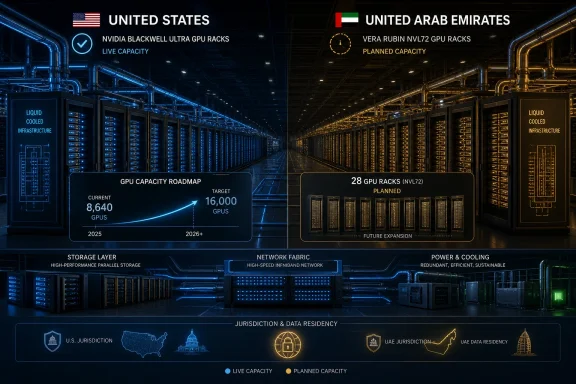 The 16,000-GPU figure is a target, not the installed base
Aleria’s original announcement is unusually clear in one place and muddy in another. It says 8,640 Nvidia Grace Blackwell Ultra GPUs are being brought to the United States, with plans to expand to 16,000. Aleria CEO Eric Leandri later described the 8,640-GPU U.S. capacity as live, while Aleria’s press material elsewhere uses language suggesting that the expansion “adds” 16,000 GPUs.
The consistent number across Aleria’s announcement, Leandri’s public comments, The National, and TechX Media is 8,640 in the initial U.S. phase and 16,000 as the eventual U.S. scale. That makes the most defensible reading straightforward: Aleria has a stated path to add 7,360 further Blackwell Ultra GPUs, but neither Aleria nor Nvidia has publicly said that the final 16,000-GPU deployment is installed, powered, or available to customers.
That distinction has immediate consequences. A capacity plan is not available capacity. It says little about data-center construction, grid connection, liquid-cooling completion, network fabric installation, acceptance testing, or whether the planned systems have been delivered. Aleria also has not identified the U.S. data-center location, the hosting entity, a delivery date for the remaining GPUs, a contract value, or named customers using the U.S. installation.
Those omissions do not mean the build will not happen. They do mean the scale headline should be treated as a roadmap rather than a completed fleet.
The U.S. number is large enough to be meaningful even before the planned expansion. Nvidia’s GB300 NVL72 architecture packs 72 Blackwell Ultra GPUs and 36 Grace CPUs into a liquid-cooled rack-scale system. Dividing Aleria’s stated 8,640 GPUs by 72 suggests the initial deployment is equivalent to roughly 120 full NVL72-scale GPU domains, assuming Aleria uses that configuration consistently. The 16,000-GPU target would be roughly 222 such 72-GPU groupings, though the company has not disclosed its exact server and rack topology.
The UAE deployment is a different product generation
The UAE component is not another 16,000 Blackwell Ultra GPUs. It is described as 28 racks of DGX Vera Rubin NVL72, Nvidia’s next-generation system based on 72 Rubin GPUs and 36 Vera CPUs per rack-scale unit.
On Nvidia’s published preliminary specifications, 28 full Vera Rubin NVL72 systems would amount to 2,016 Rubin GPUs. That is a substantial installation in its own right, but it remains separate from the U.S. Blackwell Ultra count. The distinction matters because Blackwell Ultra and Vera Rubin are different Nvidia generations, with different delivery timelines, management stacks, performance expectations, and facility requirements.
Aleria calls the UAE project one of the first regional deployments of Vera Rubin. What it has not supplied is the information an infrastructure team would need to put that claim on a schedule: no delivery quarter, no facility name, no system integrator beyond the Nvidia and DDN partnership, no stated power allocation, and no indication that the 28 racks have arrived or are online.
Nvidia’s own Vera Rubin product material still labels key technical specifications preliminary. That is normal for a next-generation platform, but it reinforces the basic point: the UAE project is an announced deployment commitment, not a demonstrated operating environment. The phrase “to come in the UAE,” used by Leandri in the announcement, is more revealing than the broad claim that Aleria has working infrastructure in both countries.
Aleria has separately said that its UAE sovereign AI environment is already live and handling national workloads. That may refer to existing infrastructure rather than the forthcoming Vera Rubin systems. The company has not publicly named the workloads, agencies, data centers, models, or service-level arrangements involved, so outside observers cannot independently assess the scale or nature of that live operation.
Sovereignty depends on operations, not the nationality of the customer
Aleria’s pitch is that governments and critical-sector customers can operate AI systems within their own jurisdictions, retaining control over sensitive data from sectors such as government, finance, healthcare, energy, utilities, and telecommunications. For organizations accustomed to sending documents, logs, source code, or records into external AI APIs, the appeal is obvious: preserve data residency and keep high-value inference and training inside a controlled environment.
But sovereign AI is not a technical standard. It is a claim about governance and control, and the details Aleria has disclosed establish only part of that chain.
The hardware is American. The accelerator platform, networking, libraries, orchestration components, and AI microservices come from Nvidia. The high-performance storage layer comes from DDN. Aleria supplies its own platform across data management, enterprise applications, video AI, and orchestration. That can produce a locally hosted, customer-operated stack. It does not, by itself, establish independence from foreign vendors for firmware, drivers, vulnerability response, support escalation, replacement parts, proprietary management tooling, or model software.
This is not a flaw unique to Aleria. It is the real condition of most national AI initiatives: data can be held locally while critical parts of the compute stack remain supplied by a small number of foreign companies. The more specific and credible claim is data and workload residency under local operational control, not absolute technological autonomy.
The deployment’s U.S. component adds another wrinkle. A UAE-headquartered company operating capacity in the United States can offer sovereign environments to customers that need U.S. data residency, but that U.S. location does not make UAE government workloads sovereign in the UAE. Sovereignty is jurisdiction-specific. The buyer’s data, workload, administrators, encryption keys, monitoring, backups, and support channels must each be evaluated against the jurisdiction being promised.
For Windows and enterprise administrators, the immediate takeaway is familiar: “private” and “on-premises” are not sufficient security answers. Procurement teams should demand a clear control-plane diagram. They should ask whether management traffic traverses external services, where telemetry is stored, who can access BMC and GPU-management interfaces, how Nvidia and DDN support sessions are authorized, what logs leave the environment, and whether tenant encryption keys remain solely under the customer’s control.
The storage and power details are where the project becomes real
Aleria’s announcement makes DDN more than a supporting supplier. Large-scale AI inference and training are constrained by the entire system: GPU availability, interconnect bandwidth, storage throughput, metadata performance, data-pipeline design, and operational automation. DDN is providing the multi-petabyte storage layer intended to feed training, retrieval, video, and inference workloads without leaving expensive accelerators stalled on I/O.
That is why the project cannot be judged solely by its GPU count. A 16,000-GPU environment with inadequate data ingestion, poorly designed storage tiers, or insufficient east-west networking can turn into a costly underutilized cluster. Aleria says it will use Nvidia accelerated computing and DDN high-performance storage, and TechX Media reported that the design incorporates Nvidia Quantum-X800 InfiniBand and Spectrum-X Ethernet. Neither Aleria nor DDN has published a reference architecture for this project, however, so the final network design, effective storage capacity, usable performance, and resilience model remain undisclosed.
Power is the other missing number. Nvidia’s published reference architecture for a GB300 NVL72 rack says a full rack can require up to 142 kW. A large deployment of Blackwell Ultra infrastructure therefore implies multi-megawatt utility, cooling, and electrical work well beyond ordinary enterprise data-center operations. TechX Media reported a 25-megawatt data center associated with the deployment, but Aleria’s original release did not provide that figure, name the site, or identify whether the capacity is dedicated to Aleria.
The absence of a facility name matters more than it might in a conventional cloud launch. For customers buying sovereign capacity, facility ownership, operating jurisdiction, physical security, and remote-access procedures are part of the product. They cannot be left as marketing background.
Export rules have become part of the deployment plan
The timing also looks different in August than it did when Aleria announced the project in March. In July, the U.S. Commerce Department eased export treatment for the UAE government and approved UAE entities, allowing eligible advanced computing items to move license-free under specified rules. The decision followed the U.S.-UAE artificial-intelligence cooperation framework and removed a major source of uncertainty for high-end American AI hardware entering the country.
That does not establish that Aleria has received, installed, or activated its 28 Vera Rubin racks. It does mean the broader policy environment is now more favorable to supplying advanced Nvidia systems to approved UAE recipients than it was when Aleria first announced the plan.
It also places an obligation on customers and suppliers to be precise. U.S. export compliance is not erased by calling an installation sovereign; it remains material to the location, end user, remote access, support model, and onward use of advanced computing hardware. Aleria has not said whether its UAE deployment sits within any particular approval structure or what compliance controls govern access to the system.
Aleria’s announcement should therefore be read as a meaningful infrastructure commitment with an initial 8,640-GPU U.S. footprint, an aspirational 16,000-GPU U.S. endpoint, and a separate future UAE Vera Rubin installation. The advertised scale is real on paper, but the public record still lacks the dates, locations, customers, facilities, commercial terms, and acceptance milestones needed to call the full project deployed.
