
But the operative word is plan. Neither company has published a release date, an Azure region list, supported ALLAM versions, pricing, licensing terms, data-residency commitments, or a definitive list of Microsoft 365 Copilot experiences that will use the model. IT leaders should treat this as a strategic integration announcement, not as a feature now available for tenant-wide deployment.
HUMAIN said the first milestone of its long-term collaboration with Microsoft is to make ALLAM available through Microsoft Foundry and the Microsoft 365 Copilot ecosystem. The companies also said HUMAIN specialists will work alongside Microsoft’s Forward Deployed Engineers, or FDEs, to help customers identify use cases, integrate AI into existing workflows, and move deployments from experiments toward production.
The immediate value is not that Arabic text can suddenly be generated in Word, Outlook, Teams, or Copilot Chat. Microsoft’s products already support Arabic interfaces and multilingual prompting. The potential change is more consequential: a locally developed Arabic model may offer enterprises another option when dialect, regional language conventions, local content, or Arabic-first workflows are central to the job.
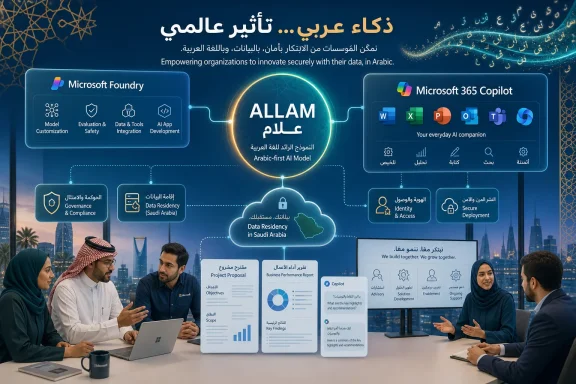 Foundry availability and Microsoft 365 availability are different promises
The announcement groups Microsoft Foundry and Microsoft 365 Copilot together, but those are materially different delivery paths.
Microsoft Foundry is Microsoft’s development and model-management environment. It is where organizations evaluate models, build AI applications and agents, attach enterprise data, apply identity controls, and put systems into production. If ALLAM becomes available there, developers could potentially choose it for custom Arabic-speaking copilots, retrieval-augmented generation systems, customer-service tools, document processing, or internal knowledge agents.
That would be useful, but it would also leave key decisions with the customer. An organization would still need to determine what data the model can access, whether its answers meet internal accuracy requirements, how Arabic and English content are handled together, and whether the system obeys retention, audit, and regional compliance policies.
Microsoft 365 Copilot is a different proposition. Customers will want to know whether ALLAM will be selectable for a custom Copilot agent, used behind specific Microsoft 365 features, available only in certain geographies, or simply interoperable through Microsoft’s wider AI stack. The announcement does not say.
That absence is important because Microsoft has recently integrated third-party models into different parts of its portfolio through different mechanisms. A model appearing in Foundry does not automatically mean it powers Microsoft 365 Copilot prompts, Teams meeting summaries, or Outlook drafting. Until Microsoft publishes product documentation, administrators should not assume their users’ existing Copilot experience will change.
ALLAM is aimed at a harder problem than Arabic translation
Arabic AI is not a matter of swapping an English interface for Arabic labels. Arabic varies widely by region and by context, while many business environments combine Modern Standard Arabic, local dialects, English terminology, numerals, product names, and regulatory language in the same document or conversation.
That is where a model trained specifically for Arabic can matter. HUMAIN describes ALLAM as an Arabic-first model developed in Saudi Arabia, and the company has emphasized dialect-sensitive interaction as part of its broader AI offering. The promise is that a model built around Arabic language material may interpret phrasing and context more naturally than a system whose primary training and evaluation have centered on English.
The announcement does not provide public benchmark results for the Microsoft-bound version of ALLAM, however. It does not identify a specific parameter size, context-window limit, supported modalities, safety evaluation, model card, or independent testing against Microsoft’s existing options.
For enterprise buyers, that means the eventual decision should be empirical. A retailer building Arabic customer-service automation, a public-sector body processing Arabic forms, and a multinational summarizing bilingual Teams meetings will each need different tests. A model can excel at formal Arabic question answering and still fail at Gulf dialects, Arabic-English code-switching, scanned documents, legal drafting, or company-specific terminology.
The practical question will be whether ALLAM improves the actual task while meeting the same security and operating requirements that organizations demand from any other model in their Microsoft environment.
Microsoft is selling deployment help alongside the model
The more revealing part of the announcement is the engineering component.
Microsoft and HUMAIN say their experts will work with customers to identify high-value AI work, integrate systems into existing workflows, configure deployments, and help turn pilot projects into production services. That approach follows Microsoft’s broader 2026 push toward forward-deployed engineering: placing technical staff closer to customer environments rather than relying only on self-service cloud tools and partner implementation.
This is an admission of where enterprise AI projects tend to stall. The obstacle is often not access to a capable model. It is connecting that model to approved data, defining who can use it, protecting sensitive material, setting human review points, logging activity, and proving that the system produces a result worth maintaining.
For Saudi organizations and regional enterprises, HUMAIN’s involvement could bring useful local knowledge to those decisions. But customers should avoid treating FDE involvement as a substitute for their own architecture, security, legal, and records-management ownership. An embedded engineering team can accelerate a project; it cannot decide what data an organization is permitted to expose or which operational decisions can safely be automated.
The announcement also does not disclose which customers, industries, or public-sector entities will receive this joint support first. Nor does it say whether the work will be included with existing Microsoft agreements, delivered through a paid engagement, limited to large strategic accounts, or offered only in Saudi Arabia.
The governance questions have not been answered
The companies frame the alliance around enterprise and public-sector requirements, including security and governance. That is directionally reassuring, but it is not a technical commitment.
Customers evaluating an eventual ALLAM deployment in Microsoft Foundry will need answers to several specific questions before placing proprietary data behind it:
- They will need to know in which Azure regions inference, fine-tuning, storage, and logging occur, especially where national data-residency requirements apply.
- They will need to know whether prompts and outputs are retained, who can access diagnostic logs, and whether customer content is used for model improvement.
- They will need model-specific documentation on safety controls, content filtering, Arabic-language red-team testing, and the handling of dialectal or culturally sensitive material.
- They will need clear identity, network-isolation, encryption, auditing, and private-endpoint options that match the controls available for other Foundry-hosted models.
- They will need a support and incident-response model that states where responsibility sits between Microsoft, HUMAIN, and the customer.
Those are normal questions for any production AI service. They become more pressing when an offering is positioned for regulated industries and public-sector workloads, where regional processing and linguistic suitability are often procurement requirements rather than optional enhancements.
What Microsoft 365 administrators can do now
There is no immediate configuration change for Microsoft 365 tenants based on this announcement. Administrators should not alter Copilot governance rules or promise Arabic-model capabilities to users before a product release is documented.
Instead, organizations with Arabic-heavy workflows should use the announcement to prepare a measurable evaluation plan. Identify the workflows where generic multilingual AI has produced weak outcomes: Arabic document classification, customer correspondence, policy search, call-center summaries, field-service notes, procurement documents, and bilingual meeting follow-up are likely candidates.
Build a test set from approved, de-identified material and define what success means before a pilot begins. Accuracy alone is not enough. Teams should assess whether the system preserves names and numbers, distinguishes formal from informal phrasing appropriately, manages Arabic-English mixed content, cites internal material correctly when retrieval is used, and routes uncertain outputs to a human reviewer.
They should also inventory the data sources that an eventual Copilot or Foundry agent would need. The quality of SharePoint permissions, document metadata, data classification, retention labels, and Entra ID access policies will shape the deployment more than the marketing label attached to a model.
Microsoft and HUMAIN have promised broader details in the coming months, with HUMAIN pointing to LEAP as the next venue for announcements. Until then, the concrete development is a planned route for ALLAM into Microsoft’s enterprise AI stack—and a commitment to hands-on deployment services—not a finished Arabic AI feature inside Microsoft 365.