

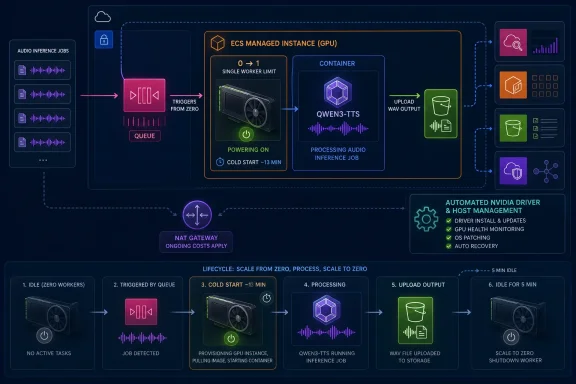
For teams that have been maintaining ECS-on-EC2 GPU fleets themselves, the operational change is genuine. ECS Managed Instances takes over instance provisioning, AMI refreshes, NVIDIA driver management, and host patching while the workload remains in the customer’s AWS account. The included configuration uses attribute-based instance selection rather than pinning a GPU SKU: NVIDIA, exactly one GPU, at least 20 GB of GPU memory, four to 96 vCPUs, and 16 GB to 512 GB of RAM.
AWS’s published sample repository confirms the moving parts described in the blog, including the initial desired task count of zero and the CloudWatch alarms that manipulate it. It also carries a warning absent from the more promotional framing: the repository is for demonstration and educational use and is not intended for direct production deployment.
The sample scales from zero to one, not out with demand
The most important constraint is in the CloudFormation template. The Application Auto Scaling target has a minimum capacity of zero and a maximum capacity of one. Its scale-out policy uses ExactCapacity to set desired count to exactly one whenever SQS has a visible message; it does not calculate workers from queue depth, age of oldest message, or a target jobs-per-worker figure.
That makes the example a serial batch processor. A burst of one job and a burst of 10,000 jobs produce the same initial response: one ECS task, consuming one GPU, with one worker polling SQS and processing one message at a time. Backlog is durable, but it is not parallelized.
This is a sensible guardrail for a tutorial. A GPU fleet should not stampede into expensive capacity because an SQS metric crossed a threshold during a cold start. But it changes how readers should interpret “batch inference.” The template demonstrates on-demand activation and host lifecycle automation; it does not demonstrate queue-driven throughput scaling.
The repository’s own customization notes point to MaxCapacity as the control to adjust for concurrent tasks, but raising it alone is not a complete production design. An operator would need a scale-out policy that maps backlog to task count, appropriate account and regional GPU quotas, capacity expectations for the eligible instance pool, dead-letter queue monitoring, and a cost limit that stops a bad producer from requesting an uncontrolled number of GPUs.
The first result takes about 13 minutes
AWS estimates roughly 13 minutes from job submission to the first WAV file: up to two minutes for CloudWatch to observe the queue depth and fire the alarm, roughly eight to nine minutes for GPU capacity provisioning and a roughly 14 GB ECR image pull, about a minute to start vLLM-Omni and load weights into VRAM, then about 30 seconds for the first inference. Subsequent inferences on the already-running task are estimated at about two seconds, depending on input length.
That gap is the dividing line for where this pattern belongs. It is appropriate for offline narration generation, bulk media enrichment, research processing, and other workflows where the caller can place work in a queue and come back later. It is unsuitable for an interactive text-to-speech feature, a synchronous API, or anything whose user experience treats a 13-minute first response as failure.
AWS is explicit that workloads requiring sub-second responses should retain a minimum desired count of one. That solves response latency, but it also removes the main economic feature of the design: the GPU no longer disappears between bursts.
The five-minute scale-in threshold also has a practical consequence. Sparse workloads can repeatedly incur the full cold-start penalty if jobs land more than five minutes apart. Keeping the task alive longer raises idle GPU spend but can make a dramatically larger difference to job completion time than tuning the model itself. The right idle window is therefore a workload measurement problem, not a constant that should be copied from the example.
“Zero cost” means zero idle GPU compute, not a zero AWS bill
AWS’s broad cost claim needs a narrower reading. When the queue is empty, the ECS service has zero desired tasks and its Managed Instances capacity provider can terminate the GPU host. That stops the EC2 GPU instance charge and the ECS Managed Instances management fee associated with that host.
But the supplied CloudFormation stack does not scale the whole architecture to zero. It creates a NAT Gateway, an Elastic IP address, a VPC, SQS queues, S3 storage, ECR images, CloudWatch log groups, and a CodeBuild project. The NAT Gateway alone is designed to remain available while no inference task is running, because private subnets route outbound traffic through it. AWS acknowledges the NAT Gateway’s hourly and per-gigabyte charges in the post, but that cost sits awkwardly beside the phrase “return to zero cost.”
The more accurate formulation is zero idle GPU-instance cost, with ongoing infrastructure and storage costs. For an intermittently used but low-volume pipeline, a continuously billed NAT Gateway can materially reduce the savings from eliminating an occasional GPU instance. AWS suggests ECR VPC endpoints to reduce image-pull transfer; a production cost review should also examine whether interface endpoints for the AWS APIs the task needs, a shared existing VPC, or a different network layout better fits the deployment.
The sample’s cost examples require the same caution. Its repository estimates a g5.xlarge at about $1.01 per hour and shows a roughly $0.056 compute cost for 200 seconds of warm inference, but that is not an all-in unit cost. Region, selected instance type, ECS Managed Instances management fee, image and log retention, S3 operations, NAT traffic, CodeBuild, and failed or retried jobs all change the effective cost per completed output.
AWS did reduce ECS Managed Instances GPU management fees effective July 1, 2026: G-series fees fell 35%, while P-series and AWS Trainium fees fell 60%. The reduction applies automatically to existing users, and it improves the economics of the GPU portion of the stack. It does not eliminate the non-GPU floor created by the reference architecture.
Instance selection reduces maintenance, but it also removes SKU certainty
The 20 GB memory requirement is doing more work than the blog’s architecture diagram suggests. It excludes older single-GPU NVIDIA options such as T4 and V100 instances with 16 GB of VRAM, while admitting Ampere-class or newer hardware needed by the sample’s FlashAttention-backed vLLM-Omni setup. The broad attribute filter lets ECS select a qualifying, cost-effective option without updating a launch template when a new GPU family becomes available.
That flexibility is useful for avoiding maintenance work, but it makes the underlying accelerator less deterministic. Different qualifying instance types can differ in price, host CPU capacity, storage and network performance, GPU model, and real inference throughput. A team promising an output-completion SLA cannot treat “one NVIDIA GPU with at least 20 GB” as equivalent to a specified g5, g6, or P-series deployment without testing each eligible path.
The deployment also remains regional-capacity dependent. The sample has users run an EC2 instance-type query before deployment to check whether the target region exposes a qualifying instance type. That confirms that an instance family exists in the regional catalog; it does not reserve capacity for the moment a job arrives. For workloads with firm deadlines, capacity reservations, a fixed approved instance family, or a warm baseline may be more defensible than relying entirely on on-demand selection.
The reliability model is simple and appropriately limited
The worker does not delete an SQS message until it has uploaded the result to S3. If the task crashes or the host is terminated before that step, the message becomes visible after its 20-minute visibility timeout and can be retried. The stack also sends messages to a dead-letter queue after five receives. For independent inference jobs, this is a clean recovery model: there is no half-finished model state to preserve and no checkpointing machinery to operate.
The scale-in alarm is more careful than a basic visible-message check. It combines visible and in-flight SQS counts, then waits for five consecutive one-minute idle periods before setting desired count to zero. That prevents the service from terminating while a worker has already received a message but has not yet produced its S3 output.
What it does not establish is production-grade delivery semantics for every model and job type. The sample assumes duplicate processing is tolerable if a visibility timeout or worker failure creates another delivery, and its output naming and downstream workflow need to accommodate that. It also assumes one task is enough to drain the queue. Both are reasonable tutorial assumptions, but they are decisions application owners must revisit before putting customer workloads behind the pattern.
AWS has delivered a useful managed replacement for the familiar “SQS wakes an EC2 GPU worker” design. The reference stack proves the lifecycle mechanics, including GPU-aware monitoring and automatic repair, while its own template makes the operational boundary clear: it buys low-touch, scale-to-zero execution for asynchronous jobs, one GPU worker at a time.