
For Windows PC builders, gamers, workstation users, and small-form-factor enthusiasts, the implication is substantial. An AM5 motherboard purchased today may not merely support one or two new CPU upgrades. It could span Zen 4, Zen 5, Zen 6, and potentially Zen 7—an extraordinary run in an industry where motherboard replacement has often been treated as a routine cost of keeping pace.
The key qualification is equally important: AMD has not announced an AM6 socket, confirmed Zen 7 desktop compatibility with AM5, or published a consumer Ryzen roadmap through Zen 8. The Zen 7-on-AM5 and Zen 8-on-AM6 proposition is an informed projection based on AMD’s confirmed socket-support window and its newly disclosed server architecture schedule. That distinction matters, especially for anyone making an expensive PC purchase today.
Still, the available evidence makes the scenario technically plausible—and it offers a revealing look at how AMD may be planning the next several years of desktop platform transitions.
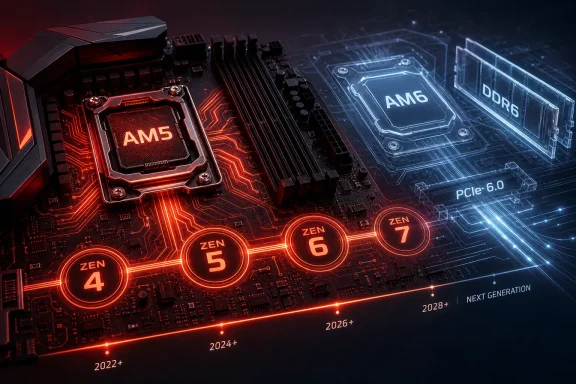 The Confirmed Part: AM5 Is Supported Through 2029
The strongest fact in this discussion is not a leak or a rumor. AMD has formally extended Socket AM5 support through 2029, expanding on an earlier promise of support through “2027 and beyond.” AMD framed the change as a commitment to upgradeability, longer-term investment protection, and fewer forced platform rebuilds for gamers and PC builders. AMD’s Computex 2026 announcement makes that policy explicit.
That revised timeline is meaningful because AM5 first arrived alongside Ryzen 7000 desktop processors and Zen 4 in 2022. At launch, AMD positioned AM5 as its DDR5- and PCIe 5.0-capable successor to AM4, with a move from PGA to LGA packaging and an ecosystem intended to last across multiple processor generations. AMD’s original Ryzen 7000 announcement described the platform as introducing dual-channel DDR5 capability, while its earlier Computex presentation highlighted up to 24 PCIe 5.0 lanes. AMD’s Computex 2022 release
The platform has already accumulated a diverse portfolio:
- Ryzen 7000 “Raphael” brought Zen 4 desktop CPUs to AM5.
- Ryzen 8000G expanded the socket’s APU role with more capable integrated graphics.
- Ryzen 9000 “Granite Ridge” introduced Zen 5 desktop CPUs.
- Ryzen AI 400 desktop processors brought an NPU-equipped Ryzen AI family to AM5 systems in 2026. AMD’s Ryzen AI 400 announcement confirms that OEM AM5 systems with these processors were scheduled from the second quarter of 2026.
That last addition is easy to overlook, but it reinforces a core point: AM5 is no longer just a conventional enthusiast CPU platform. It is becoming a broader desktop foundation for gaming, local AI acceleration, commercial PCs, mainstream systems, and high-end content creation.
AMD’s own AM5 chipset material currently lists compatibility across Ryzen 7000, 8000, and 9000 families, alongside DDR5, PCIe 5.0, USB4 support on appropriate boards, and AMD EXPO memory tuning. AMD’s AM5 chipset overview illustrates just how much platform capability has been accumulated without changing the socket.
Why Zen 7 Looks Like a Logical AM5 Candidate
Wccftech’s argument rests on timing. AMD has now disclosed its broader Zen architecture cadence at the server level: Zen 6-based EPYC Venice is arriving in 2026, Zen 7-based EPYC Florence is planned for 2028, and AMD says Zen 8-based EPYC Ravenna is already in development for 2030. Tom’s Hardware’s report on AMD’s Advancing AI roadmap quotes AMD CEO Lisa Su describing Florence as a Zen 7 product with next-generation process technology, AI compute extensions, and support for the latest memory technologies.
AMD’s public roadmap is explicitly about EPYC, not Ryzen. That means it cannot by itself tell consumers whether a desktop Zen 7 part will use AM5, AM6, or a different naming convention. Yet history suggests that AMD’s server and client CPU roadmaps often move in the same architectural direction, even when launches occur at different times and with different I/O dies, cache layouts, and platform requirements.
The Wccftech analysis therefore places a hypothetical consumer Zen 7 launch around 2029, after the expected desktop arrival of Zen 6. Its timeline reasoning does not establish an official Ryzen schedule, but it aligns with the AM5 support commitment in a way that is difficult to ignore.
If AMD intends to support AM5 through 2029, a Zen 7 Ryzen generation is a natural candidate to fill that final major window. It would also echo the company’s AM4 strategy, where the socket persisted through several architectures and remained relevant long after its original launch generation.
The Difference Between “Supported Through” and “Every Board Supports Every CPU”
The phrase “AM5 support through 2029” should not be interpreted as a blanket promise that every AM5 motherboard sold since 2022 will run every future AM5 processor. This is a critical distinction for builders who bought early X670E, X670, B650E, B650, A620, X870E, X870, or B850 boards.
Socket continuity is only one layer of compatibility. A future CPU may depend on:
- A sufficiently large BIOS ROM.
- A motherboard vendor providing an updated UEFI/AGESA firmware.
- Appropriate power delivery for higher-core-count or higher-current processors.
- Memory-training changes that older boards handle less gracefully.
- Newer chipset features, storage support, or connectivity requirements.
- Vendor validation for a specific processor model.
This does not reduce the value of the AM5 commitment. It simply defines what the promise means in practice. A platform can be long-lived without every individual motherboard being equally future-proof.
That caution has precedent. Even within a stable socket generation, older boards sometimes receive limited BIOS interfaces, drop support for the oldest CPUs to make room for newer microcode, or gain compatibility only after a later firmware revision. Users planning for a late-cycle AM5 processor should pay attention not only to chipset labels, but also to a motherboard maker’s BIOS cadence, ROM size, VRM quality, and stated CPU-support list.
Zen 6 Is the More Immediate Upgrade Story
For most AM5 owners, Zen 6 is the practical upgrade question—not Zen 7 or AM6. AMD’s server roadmap identifies Zen 6 as the architecture underpinning EPYC Venice, and AMD’s Advancing AI event materials place Venice prominently in the company’s next-generation data-center strategy. AMD’s Advancing AI 2026 event page specifically references next-generation Azure instances powered by EPYC Venice.
The desktop version has not been fully detailed by AMD in the material discussed here, but the industry expectation is that Zen 6 Ryzen will extend AM5’s lifecycle before any eventual socket transition. That makes sense on several levels.
First, AM5 still has room to improve within its existing DDR5 and PCIe 5.0 framework. Faster DDR5 kits, more mature EXPO profiles, better memory-controller behavior, cache innovations, denser CPU chiplets, and improved power efficiency can all deliver meaningful gains without a socket overhaul.
Second, major I/O transitions are expensive. They require motherboard redesigns, new signal-integrity validation, new memory kits, revised firmware, updated cooling assumptions, and higher costs across the board. AMD can deliver better CPU performance while avoiding that disruption for as long as the existing platform remains competitive.
Third, the case for a new socket becomes much clearer only when there is a genuinely mature ecosystem around technologies that AM5 cannot reasonably absorb. That is why DDR6 and native PCIe 6.0 loom so large in AM6 speculation.
DDR6 and PCIe 6.0 Are Bigger Than a Spec Sheet Refresh
The expected AM6 conversation is not really about changing a socket name from five to six. It is about the moment when memory and I/O requirements exceed what a mature DDR5/PCIe 5.0 platform can sensibly support.
DDR6 Would Be the Natural Memory Boundary
AM5 was designed for DDR5. A move to DDR6 would almost certainly require new motherboards, new memory modules, new validation rules, and a new integrated memory controller. It may also introduce early-adopter premiums and compatibility growing pains similar to those seen during prior memory transitions.
The important point is that more bandwidth does not automatically produce proportionally faster Windows PC performance. Gaming performance is often limited by CPU architecture, cache capacity, GPU capability, game-engine behavior, and latency. Everyday office work can be almost unaffected by a large theoretical increase in memory throughput.
Where newer memory standards could matter more is in workloads that continuously move large amounts of data:
- Integrated graphics systems that share system memory.
- Local AI inference and AI-assisted content creation.
- Video editing and large media workflows.
- Scientific and engineering applications.
- Virtual machines and developer workloads.
- Heavy multitasking with memory-hungry applications.
- Future CPUs with more cores competing for memory bandwidth.
AMD is already positioning desktop Ryzen AI products around local AI compute. Ryzen AI 400 desktop processors combine Zen 5 CPU cores, RDNA 3.5 graphics, and XDNA 2 NPUs, with AMD claiming up to 50 TOPS of NPU AI compute for the desktop line. AMD’s Ryzen AI 400 desktop release The proliferation of CPU, GPU, and NPU workloads inside a single desktop system makes memory bandwidth and efficient data movement increasingly relevant.
However, no consumer should buy or delay a PC today solely on the assumption that DDR6 will transform ordinary desktop responsiveness. It may become a major platform milestone, but the real-world payoff will depend on applications—not just peak transfer-rate figures.
PCIe 6.0 Is Technically Impressive, but Its Consumer Case Will Take Time
PCIe 6.0 doubles PCIe 5.0’s raw signaling rate to 64.0 GT/s, using PAM4 signaling and moving up to 256 GB/s in an x16 configuration, according to the PCI-SIG’s PCIe 6.0 specification overview. Those are enormous numbers.
But PC builders should be clear-eyed about what those figures do—and do not—mean.
A future PCIe 6.0 x16 graphics slot will not automatically double frame rates. Current GPUs frequently operate with bandwidth headroom, and game performance is generally dictated by GPU shader resources, CPU performance, graphics APIs, game engines, memory behavior, and rendering techniques rather than interface bandwidth alone.
Similarly, a PCIe 6.0 SSD will not necessarily make Windows boot twice as fast or make every application launch feel radically different. Random I/O behavior, latency, software design, decompression pipelines, memory capacity, and caching all influence user experience.
The more persuasive PCIe 6.0 case is long-term platform headroom:
- Higher-bandwidth external and internal storage.
- More capable add-in accelerators.
- Networking adapters beyond today’s mainstream needs.
- Multi-device workstations.
- AI accelerator cards that need rapid host-device transfers.
- Future GPUs and capture hardware with more demanding data paths.
In other words, PCIe 6.0 may matter first to enterprise systems, professional users, and niche high-bandwidth workloads. Mainstream gaming PCs may not feel the full benefit for years after the first consumer platform arrives.
Why AMD Might Keep Zen 7 on DDR5
One of the most interesting parts of Wccftech’s analysis is the possibility that Zen 7 may still be fundamentally tied to DDR5-era platforms. The article notes that the Zen 7-based EPYC Florence family is expected to remain associated with existing server platforms that use DDR5, making a broad DDR6 transition at that architecture less obvious. Wccftech’s analysis raises the prospect that references to “latest memory technologies” could mean advanced DDR5 implementations, LPDDR variants, or MRDIMM technologies rather than consumer DDR6.
That interpretation is consistent with the wording AMD used when discussing Florence. AMD said Zen 7 would support the “latest memory technologies,” but did not provide a public specification naming DDR6, a desktop memory controller, core counts, consumer launch timing, or an AM5 socket plan. Tom’s Hardware’s event report
This is where analysts and enthusiasts should resist overconfidence. The following points remain unconfirmed:
- Whether Zen 7 Ryzen will exist in the same form and timeframe implied by EPYC Florence.
- Whether Zen 7 desktop CPUs will use AM5 exclusively.
- Whether AMD could offer distinct DDR5 and DDR6 client implementations.
- Whether PCIe 6.0 could arrive on a late AM5 platform in a limited or selective fashion.
- Whether Zen 8 will be the first consumer architecture on a new socket.
- Whether that socket will actually be named AM6.
The socket name is especially worth treating carefully. “AM6” is logical shorthand, not a published AMD product designation. AMD’s historical socket naming makes the label plausible, but plausibility is not confirmation.
The Strength of AMD’s Platform Strategy
Regardless of where Zen 7 ultimately lands, AMD’s decision to extend AM5 has strategic value that goes beyond enthusiast goodwill.
It Reduces the Total Cost of Upgrading
A CPU upgrade can be expensive even before adding a motherboard, DDR5 kit, Windows license considerations, storage migration, and the time required to rebuild or troubleshoot a system. Reusing a capable motherboard and memory kit helps preserve budget for the components that make the largest difference to a particular workload.
For a gamer, that might mean directing more money toward a graphics card. For a creator, it may mean additional RAM, faster storage, or a better monitor. For an IT-conscious home user, it may mean retaining a known-stable Windows 11 setup instead of rebuilding the platform from scratch.
It Gives Windows Users a More Predictable Upgrade Path
Long platform life is especially valuable in the Windows ecosystem because desktop PCs are highly modular. A user may retain the same case, cooling system, storage, GPU, operating system installation, and peripherals while upgrading only the CPU after several years.
That approach can limit disruption. It also allows more flexible timing: users can start with a mainstream Ryzen 5, move to a higher-core Ryzen 7 or Ryzen 9 later, and potentially add an X3D model when pricing or game requirements make the jump worthwhile.
AMD explicitly cites this kind of upgrade flexibility as a reason for extending AM5, comparing the strategy with the longevity of AM4. AMD’s AM5 support announcement
It Strengthens the Motherboard and Memory Ecosystem
A stable socket lets motherboard vendors amortize engineering work across more generations. Memory makers can refine DDR5 products, BIOS teams can improve training and compatibility, and system integrators can carry forward validated board designs.
That does not guarantee low prices. In fact, late-cycle premium boards can be expensive, and high-end DDR5 kits may remain costly. But it can reduce ecosystem churn and make mature components easier to source, support, and understand.
The Risks of Waiting for the “Last Great AM5 Upgrade”
There is an understandable temptation to postpone a build and wait for the apparent final AM5 generation. If Zen 7 does become AM5’s farewell act, it may be an appealing endpoint for users who want mature boards, refined firmware, and a potentially powerful final CPU upgrade.
But waiting has risks.
Roadmaps Can Change
AMD’s AM5 support promise is strong, but it does not publish every processor model, core count, cache configuration, or launch schedule years in advance. Process technology changes, market demand, manufacturing availability, memory pricing, competition, and architectural priorities can all reshape product plans.
A theoretical 2029 Zen 7 Ryzen launch should therefore be treated as a planning possibility, not a purchase guarantee.
The Best Upgrade Is Often the One That Solves Today’s Problem
A Ryzen 7000 or Ryzen 9000 owner whose current system already handles gaming, work, and Windows 11 workloads well may benefit from waiting. But a user held back by slow compilation, video rendering, virtual machines, high-refresh-rate gaming, or AI workloads should not assume that a distant platform transition is the only answer.
Zen 6, additional memory, a faster GPU, storage upgrades, or a more appropriate current CPU can deliver practical gains long before DDR6 becomes mainstream.
Early AM5 Boards May Age Unevenly
The AM5 socket may remain viable through 2029, but a first-generation board may not offer the same experience as a later platform model. Firmware support, memory tuning, USB options, Wi-Fi standards, M.2 layout, PCIe lane allocation, and VRM capability all vary widely.
For a new AM5 build intended to last, buyers should prioritize:
- A motherboard vendor with a consistent BIOS support record.
- Adequate VRM design for the CPU class they may eventually install.
- Enough M.2 slots and USB connectivity for likely future needs.
- A BIOS Flashback or equivalent recovery feature.
- Memory compatibility with a sensible DDR5 kit rather than chasing extreme overclocks.
- A case and cooler that can accommodate future higher-power CPUs if necessary.
This is not glamorous advice, but it is the difference between owning an upgradeable platform and owning a socket-compatible board that becomes inconvenient to upgrade.
What This Means for AM5 Buyers Today
The most rational conclusion is not that everyone should wait for Zen 7, nor that AM6 will immediately render AM5 obsolete. Instead, AMD’s commitment creates unusually favorable conditions for buying into AM5 based on current needs.
AM5 Makes Sense Now If You Need a New Windows PC
AM5 is a sensible platform for users who need a system now and want a credible multi-generation upgrade path. It already supports multiple Ryzen CPU families, DDR5, PCIe 5.0, and a growing collection of boards at different price points. AMD’s current AM5 platform page
The platform’s longevity reduces the fear that a new motherboard will become a dead end after a single CPU cycle. That is a meaningful advantage when comparing platform investment over several years rather than comparing only launch-day benchmark results.
Existing AM5 Owners Can Be Selective
Users already on a capable Zen 4 or Zen 5 processor have the luxury of watching AMD’s Zen 6 rollout without urgency. They can evaluate real benchmarks, motherboard BIOS compatibility, pricing, power consumption, and application-specific performance before deciding whether an upgrade is worthwhile.
For many gamers, a GPU upgrade may remain more transformative than a CPU swap. For productivity users, a higher-core-count CPU, more RAM, or faster storage may offer a better return depending on the workload.
AM6 Will Be an Opportunity, Not an Obligation
If AMD eventually introduces a DDR6- and PCIe 6.0-focused AM6 platform with Zen 8, it will represent a new foundation rather than an indictment of AM5. New sockets are necessary when the underlying electrical, memory, and I/O requirements genuinely change.
That future platform will likely bring more bandwidth, new motherboard features, and a fresh upgrade runway. It may also bring the usual first-generation platform realities: premium motherboard pricing, expensive early memory kits, firmware maturity work, and uncertainty over which applications benefit most.
For many users, the mature final years of AM5 could be more attractive than the first year of AM6.
A Potentially Exceptional Farewell for AM5
The notion of Zen 7 serving as the final major Ryzen architecture for AM5 is compelling because it would give AMD’s DDR5 platform an unusually complete lifecycle. AM5 would begin with Zen 4 in 2022, broaden through Zen 5 and Ryzen AI desktop products, likely continue through Zen 6, and perhaps conclude with Zen 7 before AMD transitions to a DDR6-oriented successor.
That remains an informed projection rather than an AMD-confirmed consumer roadmap. Yet the building blocks are now public: AMD has committed AM5 through 2029, confirmed Zen 7-based EPYC Florence for 2028, and disclosed Zen 8-based EPYC Ravenna development for 2030. AMD’s AM5 commitment and its wider Zen roadmap as reported from Advancing AI make the theory increasingly credible.
The larger lesson is that platform longevity has become a competitive feature in its own right. AMD’s AM5 roadmap does not eliminate the need for careful motherboard selection, firmware updates, or realistic expectations around next-generation standards. It does, however, give Windows PC builders something unusually valuable: time.
If Zen 7 truly becomes AM5’s closing chapter, AMD may be turning a platform transition into a long-running upgrade story—one where users can keep their systems relevant not by replacing everything at once, but by improving the components that matter when the moment is right.
