
G.Skill’s Trident Z5 NeoX RGB is the first practical test of AMD’s new EXPO Ultra Low Latency memory profile for AM5 builders, and KitGuru’s results support AMD’s central claim: enabling the profile can deliver a small performance gain without manual RAM tuning. The more consequential finding is that this is a BIOS-dependent tuning feature wrapped in a new memory-kit label, not a wholesale change in DDR5 speed or capacity.
KitGuru tested 32GB DDR5-6000 Trident Z5 NeoX RGB kits on an MSI MAG X870 Tomahawk WiFi with Ryzen 7 9700X and Ryzen 7 9850X3D processors, comparing them with regular EXPO memory. Its August 3 review found a modest advantage in Geekbench and memory-copy testing, plus roughly a 3% uplift in Assassin’s Creed Mirage at 1440p on the conventional Ryzen 7 chip. On the 3D V-Cache processor, the gaming return was minimal.
That puts the review broadly in line with AMD’s May 2026 Computex claim that EXPO ULL can add an average 4% FPS over standard EXPO memory in selected games. Wccftech’s independent July testing found 4% to 5% gains in some games with a DDR5-6000 CL36 NeoX kit. Digital Citizen also measured lower memory latency with the new profile, though its reported gap between the NeoX and a standard Neo kit was only 1.8ns in AIDA64.
The evidence now says EXPO ULL works. It also says buyers should treat it as a finishing touch for a new AM5 system, rather than a reason to replace working DDR5.
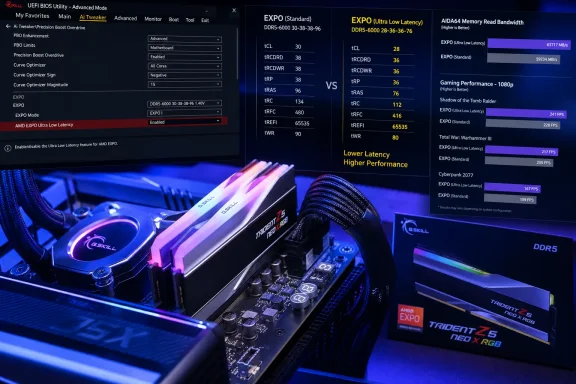
AMD EXPO has always been a stored overclocking profile: enable it in firmware, and the motherboard applies a vendor-tested memory frequency, voltage and timing configuration rather than leaving DDR5 at conservative JEDEC defaults. EXPO ULL extends that model by including more tightly tuned secondary and tertiary timings—settings most users would otherwise never touch manually.
The visible headline specifications can therefore be misleading. G.Skill’s product database lists both the ULL and normal EXPO options on its Trident Z5 NeoX RGB kits at the same 6000 MT/s data rate. A DDR5-6000 CL30 NeoX kit is still DDR5-6000 CL30 in either mode. What changes is the profile’s broader timing configuration.
G.Skill identifies the two presets explicitly as AMD EXPO ULL Profile 1 and regular AMD EXPO Profile 2. For example, its listed DDR5-6000 CL30 configuration changes from 30-38-38-96 under the ordinary EXPO profile to 30-38-38-32 under ULL. The first three figures are the familiar primary timings; the final value is one example of the less conspicuous timings that ULL tightens.
That distinction explains why the performance gain is small but believable. ULL does not increase bandwidth dramatically by pushing memory from 6000 MT/s to 8000 MT/s. It reduces the delay involved in particular memory operations while retaining a frequency AMD platforms already handle well. In latency-sensitive games, especially at settings where the CPU rather than the GPU limits frame rate, that can translate into higher average frame rates and potentially better frame delivery. In GPU-bound games, the same memory changes may barely register.
KitGuru’s test results underline the limitation. A Ryzen 7 9850X3D has a large stacked L3 cache, which reduces the occasions when a game needs to go out to system DRAM. That makes it reasonable that the 9850X3D saw less benefit than the 9700X. Buyers of an X3D chip should not assume a 4% uplift merely because AMD’s broader average says 4%; the processor, game, graphics settings and GPU bottleneck still determine whether memory latency is exposed.
The important compatibility threshold is AMD AGESA ComboAM5 PI 1.3.0.1b Patch A or later. G.Skill’s own product information and several independent reviews identify that firmware generation as the prerequisite for ULL support. ASUS has published BIOS notes for at least some AM5 boards stating that an AGESA 1.3.0.1b Patch A update adds EXPO ULL memory-profile support, while MSI’s update notes use the wording “optimized with AMD EXPO Technology: Featuring Ultra Low Latency.”
This means a NeoX buyer should not assume that any AM5 board will expose the ULL option just because it can run ordinary EXPO at DDR5-6000. Before buying, check the exact motherboard support page, download the current BIOS, and inspect the release notes for EXPO ULL or AGESA 1.3.0.1b Patch A support. A board with an older firmware branch may still boot the kit, but only with ordinary EXPO or JEDEC defaults available.
There is also a more subtle point for system builders: ULL is still overclocked memory. AMD’s own EXPO documentation describes EXPO as an overclocking path and warns that operating memory outside published specifications can affect warranty coverage and can introduce stability, corruption or data-loss risk. G.Skill and reviewers report successful testing on supported boards, but a stored profile is not the same as a universal guarantee across every CPU memory controller, DIMM population and BIOS revision.
For a two-DIMM, 32GB DDR5-6000 build on a recent X870, X670E, B850 or B650 board with current firmware, the setup should be straightforward. The confidence level drops with four DIMMs, high-capacity kits, an older board BIOS, or a system that is already marginally stable with standard EXPO. In those cases, users should perform a real memory-stability check after enabling ULL rather than relying solely on a successful Windows boot.
MSI’s own comparison, as reported by Tom’s Hardware, used a standard Trident Z5 Neo DDR5-6000 CL30 kit and a NeoX ULL counterpart. With High-Efficiency Mode’s tightest preset, the regular kit’s measured memory latency dropped from 79.4ns to 71.6ns—very close to the NeoX’s 71.1ns. That does not prove every standard DDR5-6000 kit can match a factory-qualified ULL profile. MSI itself warns that results depend on the hardware and silicon quality, and that aggressive automated tuning can create instability.
But it does change the buying equation. EXPO ULL’s practical advantage is not that the DIMMs contain a fundamentally different memory technology. It is that the memory maker has supplied a validated low-latency configuration. If an updated motherboard can safely approximate those subtimings with a regular kit, the value of buying a replacement NeoX kit narrows sharply.
This is especially relevant for existing AM5 owners with a good 32GB or 64GB DDR5-6000 EXPO kit. They should update the BIOS first, see whether their board offers an equivalent tuning mode, and only then decide whether a memory swap is justified. Replacing a functioning DDR5-6000 CL30 kit for a few percent in selected games is difficult to defend, particularly if the system uses an X3D processor or plays primarily at GPU-limited 1440p and 4K settings.
The actual NeoX premium varies sharply by specification, which is why a blanket claim that ULL costs little more than ordinary EXPO does not hold across the range. Wccftech listed the 32GB DDR5-6000 CL36 NeoX at $529, compared with $499 for a regular Neo kit with the same advertised speed and primary latency—a $30 difference. But its table put a CL30 NeoX at $629 versus $544 for the comparable standard Neo, and its CL26 examples were vastly more expensive still.
Digital Citizen likewise reported a $529.99 list price for a 32GB DDR5-6000 CL36 NeoX kit. Those figures are not a stable street-price guarantee, but they establish the problem: a modest ULL surcharge can be acceptable in a new enthusiast build, while a high bin or a volatile retail listing can turn a 3% to 5% gaming improvement into a poor return.
The NeoX series makes the most sense for someone already buying an AM5 platform, a compatible motherboard and a DDR5 kit at the same time. In that situation, choosing the ULL-qualified version over a near-equivalent standard kit can remove manual timing work and preserve a bit more CPU-limited gaming performance. For an existing system, the sensible order is BIOS update, compatibility check, stability testing, and only then a pricing comparison.
G.Skill’s NeoX review confirms AMD has delivered a useful refinement to EXPO rather than an empty badge. Yet the real story is less glamorous: EXPO ULL is validated sub-timing tuning, and its value depends as much on the motherboard firmware and the price gap as on the DIMMs themselves.
That puts the review broadly in line with AMD’s May 2026 Computex claim that EXPO ULL can add an average 4% FPS over standard EXPO memory in selected games. Wccftech’s independent July testing found 4% to 5% gains in some games with a DDR5-6000 CL36 NeoX kit. Digital Citizen also measured lower memory latency with the new profile, though its reported gap between the NeoX and a standard Neo kit was only 1.8ns in AIDA64.
The evidence now says EXPO ULL works. It also says buyers should treat it as a finishing touch for a new AM5 system, rather than a reason to replace working DDR5.
EXPO ULL changes the profile, not the memory speed
AMD EXPO has always been a stored overclocking profile: enable it in firmware, and the motherboard applies a vendor-tested memory frequency, voltage and timing configuration rather than leaving DDR5 at conservative JEDEC defaults. EXPO ULL extends that model by including more tightly tuned secondary and tertiary timings—settings most users would otherwise never touch manually.The visible headline specifications can therefore be misleading. G.Skill’s product database lists both the ULL and normal EXPO options on its Trident Z5 NeoX RGB kits at the same 6000 MT/s data rate. A DDR5-6000 CL30 NeoX kit is still DDR5-6000 CL30 in either mode. What changes is the profile’s broader timing configuration.
G.Skill identifies the two presets explicitly as AMD EXPO ULL Profile 1 and regular AMD EXPO Profile 2. For example, its listed DDR5-6000 CL30 configuration changes from 30-38-38-96 under the ordinary EXPO profile to 30-38-38-32 under ULL. The first three figures are the familiar primary timings; the final value is one example of the less conspicuous timings that ULL tightens.
That distinction explains why the performance gain is small but believable. ULL does not increase bandwidth dramatically by pushing memory from 6000 MT/s to 8000 MT/s. It reduces the delay involved in particular memory operations while retaining a frequency AMD platforms already handle well. In latency-sensitive games, especially at settings where the CPU rather than the GPU limits frame rate, that can translate into higher average frame rates and potentially better frame delivery. In GPU-bound games, the same memory changes may barely register.
KitGuru’s test results underline the limitation. A Ryzen 7 9850X3D has a large stacked L3 cache, which reduces the occasions when a game needs to go out to system DRAM. That makes it reasonable that the 9850X3D saw less benefit than the 9700X. Buyers of an X3D chip should not assume a 4% uplift merely because AMD’s broader average says 4%; the processor, game, graphics settings and GPU bottleneck still determine whether memory latency is exposed.
The motherboard BIOS is part of the product
The “one-click” part of EXPO ULL is real from the user’s perspective, but it shifts the engineering burden to memory vendors and motherboard firmware teams. G.Skill can encode its preferred subtimings in the DIMM profile, but the motherboard BIOS must recognize and train the profile reliably with the installed CPU and board.The important compatibility threshold is AMD AGESA ComboAM5 PI 1.3.0.1b Patch A or later. G.Skill’s own product information and several independent reviews identify that firmware generation as the prerequisite for ULL support. ASUS has published BIOS notes for at least some AM5 boards stating that an AGESA 1.3.0.1b Patch A update adds EXPO ULL memory-profile support, while MSI’s update notes use the wording “optimized with AMD EXPO Technology: Featuring Ultra Low Latency.”
This means a NeoX buyer should not assume that any AM5 board will expose the ULL option just because it can run ordinary EXPO at DDR5-6000. Before buying, check the exact motherboard support page, download the current BIOS, and inspect the release notes for EXPO ULL or AGESA 1.3.0.1b Patch A support. A board with an older firmware branch may still boot the kit, but only with ordinary EXPO or JEDEC defaults available.
There is also a more subtle point for system builders: ULL is still overclocked memory. AMD’s own EXPO documentation describes EXPO as an overclocking path and warns that operating memory outside published specifications can affect warranty coverage and can introduce stability, corruption or data-loss risk. G.Skill and reviewers report successful testing on supported boards, but a stored profile is not the same as a universal guarantee across every CPU memory controller, DIMM population and BIOS revision.
For a two-DIMM, 32GB DDR5-6000 build on a recent X870, X670E, B850 or B650 board with current firmware, the setup should be straightforward. The confidence level drops with four DIMMs, high-capacity kits, an older board BIOS, or a system that is already marginally stable with standard EXPO. In those cases, users should perform a real memory-stability check after enabling ULL rather than relying solely on a successful Windows boot.
The premium may be easier to avoid than G.Skill suggests
The strongest case against treating NeoX as a mandatory upgrade is emerging from motherboard vendors themselves. MSI has introduced High-Efficiency Mode, a BIOS feature intended to tune standard DDR5 memory more aggressively on AMD boards. Tom’s Hardware reports that MSI positions the feature as an EXPO ULL-like optimization for existing non-ULL memory kits.MSI’s own comparison, as reported by Tom’s Hardware, used a standard Trident Z5 Neo DDR5-6000 CL30 kit and a NeoX ULL counterpart. With High-Efficiency Mode’s tightest preset, the regular kit’s measured memory latency dropped from 79.4ns to 71.6ns—very close to the NeoX’s 71.1ns. That does not prove every standard DDR5-6000 kit can match a factory-qualified ULL profile. MSI itself warns that results depend on the hardware and silicon quality, and that aggressive automated tuning can create instability.
But it does change the buying equation. EXPO ULL’s practical advantage is not that the DIMMs contain a fundamentally different memory technology. It is that the memory maker has supplied a validated low-latency configuration. If an updated motherboard can safely approximate those subtimings with a regular kit, the value of buying a replacement NeoX kit narrows sharply.
This is especially relevant for existing AM5 owners with a good 32GB or 64GB DDR5-6000 EXPO kit. They should update the BIOS first, see whether their board offers an equivalent tuning mode, and only then decide whether a memory swap is justified. Replacing a functioning DDR5-6000 CL30 kit for a few percent in selected games is difficult to defend, particularly if the system uses an X3D processor or plays primarily at GPU-limited 1440p and 4K settings.
DDR5 pricing turns a small gain into a poor upgrade case
KitGuru’s conclusion that DDR5 pricing makes a memory upgrade unattractive is supported by the wider market record. G.Skill currently carries a notice on its product pages blaming industry-wide DRAM volatility and supply constraints, driven by AI demand, for substantially higher component costs. It also warns that pricing can change without notice.The actual NeoX premium varies sharply by specification, which is why a blanket claim that ULL costs little more than ordinary EXPO does not hold across the range. Wccftech listed the 32GB DDR5-6000 CL36 NeoX at $529, compared with $499 for a regular Neo kit with the same advertised speed and primary latency—a $30 difference. But its table put a CL30 NeoX at $629 versus $544 for the comparable standard Neo, and its CL26 examples were vastly more expensive still.
Digital Citizen likewise reported a $529.99 list price for a 32GB DDR5-6000 CL36 NeoX kit. Those figures are not a stable street-price guarantee, but they establish the problem: a modest ULL surcharge can be acceptable in a new enthusiast build, while a high bin or a volatile retail listing can turn a 3% to 5% gaming improvement into a poor return.
The NeoX series makes the most sense for someone already buying an AM5 platform, a compatible motherboard and a DDR5 kit at the same time. In that situation, choosing the ULL-qualified version over a near-equivalent standard kit can remove manual timing work and preserve a bit more CPU-limited gaming performance. For an existing system, the sensible order is BIOS update, compatibility check, stability testing, and only then a pricing comparison.
G.Skill’s NeoX review confirms AMD has delivered a useful refinement to EXPO rather than an empty badge. Yet the real story is less glamorous: EXPO ULL is validated sub-timing tuning, and its value depends as much on the motherboard firmware and the price gap as on the DIMMs themselves.
References
- Primary source: KitGuru
Published: 2026-08-03T10:43:11+00:00
G.Skill Trident Z5 NeoX w/ EXPO ULL! | KitGuru
G.Skill has sent us two kits of their new Trident Z5 NeoX RGB DDR5 memory that features AMD EXPO Ultwww.kitguru.net - Independent coverage: KitGuru
Published: 2026-08-03T10:43:11+00:00
G.Skill Trident Z5 NeoX w/ EXPO ULL! | KitGuru
G.Skill has sent us two kits of their new Trident Z5 NeoX RGB DDR5 memory that features AMD EXPO Ultwww.kitguru.net - Related coverage: tomshardware.com
MSI promises an EXPO ULL-like boost for your existing DDR5 memory — High-Efficiency Mode brings low-latency tuning to older RAM | Tom's Hardware
Same RAM, lower latencywww.tomshardware.com - Related coverage: digitalcitizen.life
G.Skill Trident Z5 NEOX RGB review shows EXPO ULL memory is faster, but pricing is the real problem
G.Skill’s Trident Z5 NEOX RGB DDR5 memory kit arrives at a difficult time for PC builders. Memory prices have climbed sharply in 2026 as AI and data center demand continues to pressure supply, making even mainstream DDR5 kits harder to justify for many buyers. The kit reviewed here is a 32GB...www.digitalcitizen.life
- Related coverage: gskill.com
Desktop Memory (U-DIMM/CU-DIMM) - Trident Z5 NeoX RGB (DDR5/AMD EXPO) - G.SKILL International Enterprise Co., Ltd.
Designed for performance, G.SKILL desktop memory is engineered from hand-selected components and rigorously tested for stability and compatibility.www.gskill.com - Related coverage: wccftech.com
G.Skill Trident Z5 NEOX RGB DDR5 32 GB (2 x 16 GB) 6000 MT/s CL36 EXPO ULL Memory Kit Review – Ultra Low Latency At A Time of Ultra High Pricing
G.Skill's Trident Z5 NEOX 32 GB DDR5-6000 kit offers EXPO ULL specs with tight timings at $529, improving performance over standard kits.wccftech.com
- Related coverage: pdxtechtee.com
G.Skill Trident Z5 Neo DDR5-6000 Review: EXPO Results | PDX Tech & Tee
G.Skill Trident Z5 Neo DDR5-6000 review: EXPO enabled at 6000MT/s in a Ryzen 7 9800X3D build with zero issues. Full setup and performance breakdown.pdxtechtee.com - Related coverage: gskill.us
G.SKILL Releases Low Latency DDR5-6000 CL26 & CL28 Memory Kits - G.SKILL TECH FORUM
...thrilled to release new low CAS latency memory kits featuring AMD EXPO overclock profile for the new AMD Ryzen 9000 series processors and performance X870 chipset motherboards. These new specifications include DDR5-6000 CL26 2x16GB/2x32GB kits and a high capacity DDR5-6000 CL28 2x48GB memory...www.gskill.us
- Related coverage: pcmrace.com
G.Skill Trident Z5 Neo RGB DDR5 2x16GB 6000 MHz CL30 - Review | PC Master Race Latinoamérica
Luego de haber analizado las memorias G.Skill Trident Z5 Neo DDR5 de 7200 Mhz junto con un Core i9-13900K y una motherboard Z790 de alta gama, lo cual fuewww.pcmrace.com - Related coverage: pcguide.com
G.Skill Trident Z5 Neo review: simple yet effective - PC Guide
We put the G.Skill Trident Z5 Neo to the test, with 32GB of capacity and 6000MT/s overclock we see how well it doeswww.pcguide.com - Related coverage: tech.yahoo.com
AMD EXPO ULL shows middling performance gains in initial tests despite eye-watering price increase — first...
The first independent benchmarks for AMD's EXPO ULL memory are available, showing just up to a 4% improvement despite an increase in price.tech.yahoo.com - Related coverage: techpowerup.com
G.SKILL Trident Z5 NEO RGB DDR5-6000 32 GB CL26 Review - AMD EXPO - Intel Core 13900K: 1920 x 1080 Game Benchmarks | TechPowerUp
Today’s review focuses on the G.SKILL Trident Z5 NEO CL26 memory kit. Tailored for AMD Ryzen processors and systems, this kit aims to deliver peak performance thanks to ultra-low timings paired with a 6000 MT/s clock config, hitting the Ryzen Memory Controller's sweet spot.www.techpowerup.com - Related coverage: hardwareluxx.ru
Тест и обзор: G.Skill Trident Z5 NeoX RGB с EXPO ULL — упрощенная настройка субтаймингов - Hardwareluxx Russia
Тест и обзор: G.Skill Trident Z5 NeoX RGB с EXPO ULL — упрощенная настройка субтаймингов
www.hardwareluxx.ru
- Related coverage: amd.com
AMD EXPO™ Technology for AMD Ryzen™ Processors for Socket AM5
AMD Extended Profiles for Overclocking (AMD EXPO™) allows user-friendly memory-overclocking support, and accelerated power to achieve best gaming performance.www.amd.com - Related coverage: tomshardware.com
Various vendors add AMD EXPO Ultra-Low Latency to 600-series motherboards in latest BIOS updates — tech tightens memory subtimings on compatible kits, boosting FPS by up to 4% | Tom's Hardware
Existing RAM does not support ULL.www.tomshardware.com