
Kodiak and AMD announced the deployment on August 26. FreightWaves independently added the practical hardware details: the EPYC configuration supplies 80 PCIe lanes, a 3.15 GHz base clock and boosts up to 4.4 GHz; AMD says this is a 25% clock-speed gain over Kodiak’s previous processor. The Trucker, Robotics & Automation News, and HPCwire each reported the arrangement, although the latter is explicitly labeled an “Off The Wire” press release and the other accounts chiefly restate Kodiak’s announcement.
The partnership is meaningful for AMD because it moves EPYC beyond the data center rack and into a rugged, power-constrained edge system with real-time deadlines. For Kodiak, it is a component swap within a Gen7 hardware redesign that the company says has nearly 50% more total compute capacity than Gen6. But neither company has identified the precise EPYC model, the previous CPU, the power envelope, redundancy design, or the number of trucks already fitted with AMD hardware. Those omissions make it impossible to independently quantify the claimed platform-level gain or assign it solely to the new processor.
 EPYC Is Handling the CPU Side of the Driving Stack
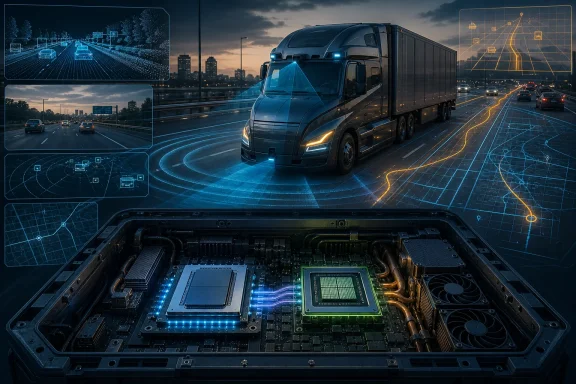
The Kodiak Driver combines cameras, radar and lidar in external SensorPods, then has to turn those raw data streams into a current representation of the road quickly enough to guide a heavy truck. AMD says EPYC will aggregate and preprocess that sensor data, while also supporting localization, logistics functions and path planning.
Those jobs are different from the massively parallel AI inference commonly associated with automotive GPUs. A vision model may run efficiently across many accelerators, but a planning loop often has serial dependencies: ingest current sensor and vehicle state, estimate the truck’s position, evaluate safe trajectories, then issue the next command. Delays or timing jitter in that chain can matter as much as total theoretical AI throughput.
That division of labor explains why the headline should not be read as Kodiak replacing NVIDIA. Kodiak announced in March that its next-generation autonomous-driving solution would use NVIDIA DRIVE Hyperion and DRIVE AGX Thor, a Blackwell-based automotive computing platform intended for AI acceleration. The AMD deployment fills the CPU role alongside that GPU-oriented system. In other words, Kodiak is using heterogeneous compute, with EPYC moving data and executing timing-sensitive host work while NVIDIA hardware remains central to the neural-network side of the autonomous-driving stack.
For enterprise IT readers, this is a familiar architecture translated to a moving vehicle: high-bandwidth I/O and deterministic CPU performance are paired with specialized accelerators rather than asking one chip category to carry every workload. The unusual part is deployment. In a truck, heat, vibration, power limits, repairability and field replacement are design constraints alongside raw performance.
The PCIe Claim May Matter More Than the Core Count
AMD and Kodiak have emphasized EPYC’s clocks and 80 PCIe lanes, rather than publishing core counts, TOPS figures, or an end-to-end perception latency number. That is a sensible emphasis for the stated workload. A sensor-heavy vehicle needs to move video, radar and lidar data among acquisition hardware, processors, memory and accelerators without creating an I/O bottleneck.
PCIe lanes are the physical and logical connections used for high-speed peripherals. More lanes do not automatically make an autonomous truck safer or faster, but they can let a platform attach several high-bandwidth devices without forcing them to share a smaller pool of links. In a system with multiple cameras and sensors plus GPU accelerators and storage, I/O layout becomes a real engineering decision, not a spec-sheet footnote.
The 25% clock-speed figure should be treated more narrowly than the announcement presents it. It is AMD’s comparison with an unnamed previous-generation device, not a measured 25% improvement in vehicle response, perception accuracy, route completion, or safety. Clock speed can improve portions of a latency-bound workload, but final performance also depends on core architecture, memory access, software scheduling, sensor interfaces, thermal behavior and the GPU pipeline.
Kodiak’s own earlier Gen7 announcement made a larger claim: nearly 50% more compute power than Gen6. That is a platform-level statement, and it predates the AMD announcement. The company has not provided a reproducible benchmark, defined the measurement, or disclosed whether it refers to CPU, GPU, total system compute, or a specific internal workload. Administrators evaluating edge AI hardware should recognize the distinction: a higher clock, more PCIe lanes and “more compute” are all potentially useful, but they are not interchangeable metrics.
Kodiak’s Hardware Strategy Is Built Around Commercial Parts
Kodiak says commercially available AMD hardware will let it focus more resources on building and deploying trucks rather than designing custom silicon. That is a potentially consequential choice in an autonomous-trucking market where hardware cost, serviceability and fleet uptime can determine whether a technology moves from demonstrations to paid operations.
The company’s Gen7 platform is designed to be more compact and modular than its predecessor, according to Kodiak’s second-quarter results. Kodiak also says stress testing indicates SensorPods and compute enclosures could have nearly 50% longer operational lifetimes than previous-generation equipment, and that the smaller design will support lower-cost day-cab trucks. Those are forward-looking company claims, not independently verified fleet reliability figures.
Using a mainstream CPU family also has operational advantages beyond the purchase price. Supply availability, validation tools, familiar firmware practices and a broader pool of engineers can reduce the friction of maintaining a product over several years. The counterweight is lifecycle control: an autonomous-vehicle platform must validate hardware and software changes far more strictly than a typical data-center refresh, especially where a BIOS update, kernel driver revision, thermal change or replacement board might affect deterministic behavior.
Kodiak has not said whether the EPYC deployment uses a custom embedded board, what functional-safety certifications apply to the compute assembly, or how the truck handles a CPU, memory or interconnect failure. Its regulatory filings describe a separate Actuation Control Engine that can execute a safe fallback maneuver if a safety-critical component in the Kodiak Driver or underlying truck fails. The AMD announcement does not establish whether EPYC is part of that safety-critical chain, isolated from it, or backed by redundant hardware.
The Public-Highway Milestone Is Still Ahead
Kodiak already operates driverless trucks without humans in the cab in the Permian Basin’s industrial environment, where it hauls for Atlas Energy Solutions. In its August 6 quarterly update, Kodiak said it had 35 customer-owned driverless trucks at the end of the second quarter and had accumulated more than 40,000 paid driverless-operation hours.
Those figures are evidence of commercial use, but they should not be conflated with unrestricted driverless highway freight. Kodiak is aiming for a driverless long-haul highway launch by the end of 2026. As of August 12, the California Department of Motor Vehicles listed Kodiak AI among companies authorized to test autonomous vehicles with a driver on public roads in the state. California’s public record does not place Kodiak on the separate driverless-testing permit list.
That regulatory distinction puts the AMD win in perspective. The EPYC integration may help Kodiak prepare Gen7 trucks for a more demanding operating domain, but it is not approval to run unmanned heavy trucks on public highways. The company has not announced a public-highway deployment date, route, fleet size, or the jurisdiction in which it expects to begin such operations.
AMD has gained a visible edge-computing deployment that tests EPYC under conditions no conventional server room can replicate. Kodiak has gained a higher-clocked, high-I/O CPU platform for its Gen7 architecture. The result will be judged less by the 4.4 GHz boost figure than by whether the new hardware reaches deployed trucks, survives fleet service, and supports Kodiak’s still-unmet target of driverless highway freight before December 31, 2026.