
AMD’s desktop share rose 1.8 percentage points from the first quarter and 2.7 points from the same quarter in 2025 because Intel’s desktop shipments fell faster. That is a competitive gain on paper, but it does not indicate a broad Ryzen-led upgrade boom. It is a smaller slice of a market where the total number of processors moving through OEMs, system integrators, and distribution channels has dropped sharply for two straight quarters.
For Windows PC enthusiasts waiting for an excuse to replace an aging AM4, LGA 1700, or earlier system, the research describes the consequence more clearly than either CPU vendor’s earnings releases do: a processor may still be affordable, but a complete desktop upgrade increasingly is not.
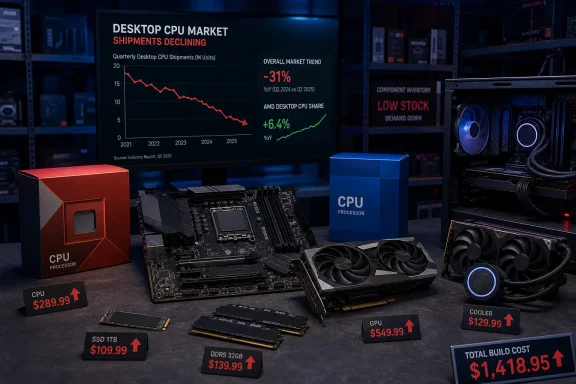 Mercury’s figures separate desktop pain from a healthier CPU market
Mercury Research characterized the desktop x86 market as “ugly” in the second quarter. Yet its wider processor picture was comparatively strong: x86 and Arm CPU shipments across all categories rose by more than 10% sequentially, well above the slight seasonal decline normally expected in the April-to-June period.
Those statements are not contradictory. Server and notebook CPUs did the lifting. Mercury says mobile processor shipments rose strongly as Intel increased supply after two constrained quarters, while server CPU shipments grew by roughly 20% year over year. Desktop chips moved in the opposite direction, declining from an already weak first quarter.
That split matters because broad processor-market headlines can obscure the part of the industry that serves the DIY Windows PC market. A laptop CPU arrives as part of a finished machine; a server CPU is bought for a data-center deployment. Desktop processors, by contrast, are much more exposed to the cost of the entire platform: memory, motherboard, storage, graphics card, cooling, power supply, and the rest of a build.
Mercury’s data measures units shipped into the supply chain, not checkout data from Newegg, Micro Center, Amazon, or a local PC shop. It therefore cannot say precisely how many consumers cancelled a particular Ryzen 7 or Core Ultra purchase. But it does show that OEMs and system builders ordered fewer desktop CPUs, which is the earlier warning signal for a softer upgrade market.
AMD gained share while shipping fewer Ryzen desktop CPUs
The central statistical trap in this report is treating AMD’s market-share increase as a volume victory. AMD’s desktop x86 unit share reached 34.9% in the second quarter, up from 33.2% in the first quarter and 32.2% a year earlier. Intel fell from 66.8% to 65.1% sequentially and from 67.8% a year ago.
Those are meaningful gains for AMD against its longtime desktop rival. Intel remains the volume leader by a wide margin, but AMD has closed some of the gap. Still, Mercury’s assessment, repeated by Tom’s Hardware and The Register, is that AMD’s own desktop shipments also declined. Intel simply declined more severely.
In practical terms, that means no vendor can credibly point to these desktop figures as evidence that gamers and home users are returning to the upgrade cycle. Intel lost more of the market in unit terms; AMD became relatively stronger. Neither outcome changes the fact that fewer desktop CPUs were being ordered than a year ago.
AMD’s August 4 financial results illustrate why revenue headlines should be handled carefully here. AMD reported that its Client business generated $3.1 billion in the second quarter, up 23% year over year, and attributed that performance to demand for Ryzen processors. But AMD’s Client segment includes more than socketed desktop chips, including notebook and commercial products. Mercury’s report indicates that mobile CPU shipments were strong while desktop shipments were weak, so AMD’s client revenue growth cannot be read as proof that DIY Ryzen demand increased.
The same distinction applies to Intel. A CPU maker’s quarterly client revenue is influenced by notebook volumes, commercial refreshes, product mix, pricing, inventory timing, and supply constraints. Shipment-share data is useful, but it is not a scorecard for retail CPU sales or installed base share.
The desktop build has become the expensive part
Mercury attributes the desktop slowdown to higher PC prices and limited graphics-card supply. Those factors hit a self-built gaming PC particularly hard because an upgrade frequently becomes a platform replacement.
A user moving from an older Intel platform may need a new motherboard and DDR5 memory alongside a current CPU. An AM4 owner can often make a less expensive final upgrade to a Ryzen 5000-series processor, but a move to AM5 also requires new memory and a board. Add a graphics card or SSD to the cart and the cost grows much faster than the price of the processor alone.
IDC’s current 2026 outlook supports the broader affordability explanation. The firm forecasts global PC shipments will decline 11.3% this year as memory shortages raise component costs, while PC average selling prices are projected to rise 18.3%. IDC expects the shortage to persist through at least the end of 2027.
That creates a problem different from a normal CPU downturn. A conventional slump can be addressed with processor discounts, bundles, or a new product launch. This time, the limiting factor is the cost and availability of adjacent components. A $250 CPU discount does little for a buyer facing expensive DDR5 kits, higher-priced SSDs, and a constrained graphics-card market.
PCWorld reported the same direction in Mercury’s first-quarter data, when desktop CPU shipments fell nearly 20% year over year. At the time, Mercury analyst Dean McCarron said the market appeared to be shifting from supply-limited to demand-limited as consumers faced higher system prices. The second-quarter result suggests that shift was not a one-quarter inventory correction.
Laptop and server growth will not rescue the desktop upgrade market
The desktop decline is taking place alongside a surprisingly healthy market for laptops and data-center hardware. Intel added millions of mobile CPU units in the second quarter as capacity improved, Mercury said, while AMD’s notebook share still increased to 28.9%. That is a different purchasing pattern from a gaming-PC refresh: OEMs can spread component costs across an entire system and use corporate contracts, financing, and volume purchasing in ways a DIY builder cannot.
Servers are stronger still. Mercury put AMD’s broad x86 server share at 34.5%, with Intel at 65.5%, while server shipments rose nearly 20% year over year. The firm’s narrower comparison of AMD EPYC and Intel Xeon server processors put AMD’s unit share at 46.4%, though that figure excludes some Intel edge and networking products included in the broader calculation.
Those markets explain why the overall CPU industry can report growth while desktop enthusiasts see fewer attractive upgrade paths. The AI-driven data-center buildout is pulling demand toward server hardware, and Windows notebooks continue to benefit from enterprise replacements and OEM refresh cycles. Neither trend makes RAM, storage, GPUs, or motherboards cheaper for someone assembling a tower at home.
Arm also complicates the long-term reading of x86 percentages. Mercury estimates Arm reached 15.3% of the broader client CPU market in the second quarter, including Apple Silicon, Qualcomm-based PCs, and Arm Chromebooks. AMD’s 30.3% client share is therefore an AMD-versus-Intel x86 comparison, not a claim that AMD powers 30% of every new personal computer.
What builders and IT buyers should take from the numbers
For home builders, the immediate lesson is to price the platform, not the CPU. A sale on a Ryzen 7 or Core Ultra chip can be real value only if the motherboard, memory, storage, and graphics options required for the intended build have not erased the savings. Owners of a stable Windows 11 system may find that a GPU-only, storage-only, or memory-only upgrade—where feasible—delivers more practical value than forcing a full platform migration in a distorted component market.
For IT buyers, the desktop shipment decline should not be mistaken for a sudden collapse in Windows endpoint demand. Notebook and commercial CPU shipments are holding up better, and Windows 10’s October 14, 2025 end of support continues to shape refresh planning. But the figures do reinforce the case for locking component allocations and validating configuration alternatives early, especially for desktop workstations that need discrete graphics and large memory configurations.
AMD can fairly claim another gain against Intel in desktop x86 share. It cannot fairly claim that the desktop market is thriving, and Intel cannot dismiss the movement as a statistical blip when its share fell both sequentially and year over year. The harder truth is that the market’s present constraint is no longer CPU performance. It is the rising cost of turning a processor into a complete PC.