
The important part is the integration boundary AMD has chosen. The X100 combines x86 CPU cores, an RDNA 3.5 integrated GPU, an XDNA 2 NPU, and unified LPDDR5X memory on one processor, while the carrier adds an FPGA for the lower-latency sensor, control, and interface work that a general-purpose processor does not handle as predictably. It is a direct effort to sell against Nvidia’s Jetson Thor family on system design and real-time control capacity, not simply headline AI throughput.
AMD calls Kria the industry’s first open, fully integrated autonomous-robotics platform. That “first” is a marketing claim, and the meaningful test will be whether its open hardware and software promises survive the move from an evaluation kit to production robots. But the underlying problem it targets is real: robotics teams routinely lose more time on carrier-board bring-up, camera and sensor drivers, timing validation, networking, motor interfaces, and ROS 2 integration than they do selecting a processor.
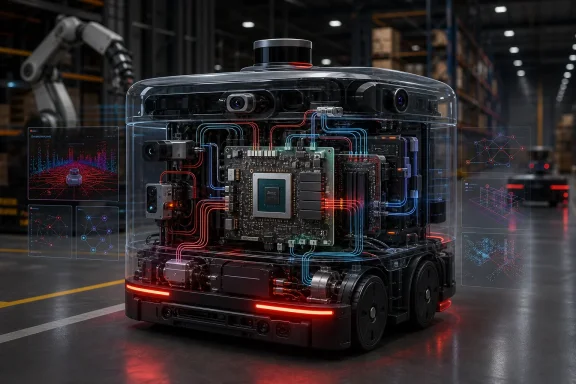 The platform is a production path, not a boxed development board
The Kria AI platform has two different products behind one name. The Kria AI Robotics Developer Platform is the early development system: an X100-based Kria AI SOM installed on a robotics carrier card with an FPGA and sensor-facing I/O. The Kria AI SOM is the production-oriented compute module intended to be bought from original design manufacturer partners and installed in a customer’s own hardware.
That distinction matters for procurement. An engineering team can evaluate the full carrier platform in the fourth quarter, but the deployed machine may use a different partner-built SOM and a tailored carrier. AMD has identified Arbor, Congatec, iBase, IEI, Sapphire, and Seavo among the expected module partners, according to All About Circuits. It has not published partner-specific configurations, prices, thermal limits, or a firm ship date beyond the Q4 2026 window.
The developer platform’s carrier is where AMD’s Xilinx acquisition becomes visible. The X100 handles the high-level software stack: perception, planning, agent orchestration, inference, and operating-system duties. The carrier-card FPGA is positioned to handle sensor fusion, custom interfaces, and deterministic I/O. In a mobile robot, those are not peripheral details; they decide whether camera frames arrive when expected, whether control loops meet their deadlines, and how much integration code must be maintained after the prototype becomes a product.
AMD says the carrier design is open, and All About Circuits reports that its schematics will be available. That can reduce the “evaluation kit cliff,” where a team proves an application on a vendor board but must discard most of the design when building a production enclosure. An open COM-HPC module and an open carrier reference design give OEMs a more plausible route to reuse the I/O architecture while changing the compute module later.
The qualification of that claim is equally practical: open schematics do not eliminate validation. A manufacturer still owns its regulatory compliance, environmental testing, safety analysis, power design, cable choice, motor-control integration, and lifecycle support. AMD is offering a starting point with fewer unknowns, not a pre-certified autonomous machine.
Unified memory addresses a real robotics bottleneck
AMD’s architecture argument rests on unified memory. A conventional robot can split compute among a host processor, a GPU accelerator, separate AI hardware, and a microcontroller or FPGA. Every boundary can require a transfer, a copy, synchronization, and a failure mode. Those costs are manageable in a server inference pipeline; they are harder to ignore when navigation, perception, mapping, safety processing, motor commands, and AI reasoning are sharing a tight power and timing budget.
The Ryzen AI Embedded X100 is designed to keep CPU, GPU, and NPU access to a common memory pool. AMD says the top configuration provides up to 16 Zen 5 CPU cores, an RDNA 3.5 iGPU, an XDNA 2 NPU, and up to 128GB of LPDDR5X unified memory. The company’s framing is that the CPU retains capacity for real-time control and orchestration while the GPU carries vision and larger AI workloads and the NPU runs lower-power, continuous inference tasks.
That division is more relevant than a single TOPS figure. A warehouse vehicle that sees an obstacle but misses its control deadline has failed a robotics workload even if its accelerator posted a strong model-inference score. AMD says the X100 can execute up to 8,000 control decisions per second, equivalent to a 125-microsecond control loop, while also running vision-language-action reasoning in under 100 milliseconds.
Those are useful targets, but they are not a guarantee of end-to-end robot behavior. AMD’s footnotes say the 8,000-decisions figure comes from a Bosch Rexroth controller workload on the X100, while the under-100ms reasoning result is based on an embedL test using a Pi0.5 vision-language-action model. Neither number tells a customer how their own camera pipeline, sensor configuration, model, safety system, or thermal envelope will behave.
Analog Devices, which is supplying sensing and connectivity technology around the platform, makes the more credible case for the product. Its July 23 account describes the carrier as including interfaces for GMSL cameras, inertial sensing, CAN-FD, RS-485, Ethernet, battery-management hooks, and motor-control expansion, with ADI drivers integrated into the platform. The benefit is not that the board makes robotics easy; it is that a known set of interfaces and software components has already been matched and characterized before the customer begins work.
AMD’s benchmark lead needs a closer reading
AMD’s biggest competitive claims are up to 3.4 times better real-time reliability, up to 1.6 times more free CPU capacity, and up to 2.3 times more concurrent agents than Nvidia’s Jetson T5000. The company is relying on the Open Navigation Robotics Workload Benchmark, which models a material-handling forklift operating in a 180,000-square-foot warehouse with lidar, RGBD cameras, an RGB camera feeding a vision-language model, an IMU, and a differential-drive controller.
Open Navigation says the benchmark is open source, reproducible, and was designed to measure a complete robotics workload rather than isolated synthetic tests. It also says its work was a collaboration with AMD, though the benchmark was executed independently and is intended to run on other platforms. That is substantially better evidence than a vendor-only slide deck, especially because teams can rerun it.
But AMD’s own fine print changes how the claims should be read. The X100 comparison did not use a shipping Kria AI SOM or the final Kria Robotics Developer Platform. It used a GMKtec EVO-X2 mini PC with a Ryzen AI Max+ 395 configured to reflect the planned Ryzen AI Embedded X199 specification: 5.1GHz CPU, 2.9GHz GPU, 120W TDP, and LPDDR5X-7500. The Nvidia side used a Jetson AGX Thor Developer Kit.
That makes the benchmark a useful architectural preview, not a finished board-versus-board purchasing result. Open Navigation lists the tested AMD Strix Halo configuration at 120W and Jetson Thor at 130W, so it is a reasonably close power-class comparison. Yet production modules can be constrained by cooling, enclosure design, peripheral power draw, memory configuration, and sustained clocks in ways a mini PC cannot replicate. AMD should be credited for publishing the test basis; customers should still wait for tests on actual X100 SOM hardware before treating the 3.4x result as a deployment forecast.
Nvidia’s Jetson Thor is also not a weak target. Nvidia lists the Thor family at 40W to 130W and rates the T5000 model at up to 2,070 FP4 sparse TFLOPS, with a Blackwell GPU and 128GB memory configurations available across the series. AMD is therefore betting that more available x86 CPU capacity, unified-memory behavior, FPGA-backed I/O, and a familiar Linux/ROS 2 environment will matter more to robot builders than CUDA continuity alone.
ROCm and ROS 2 are the adoption test
The Kria platform’s software proposition is an AMD Robotics Software Suite built around ROCm and ROS 2, with support for frameworks including PyTorch, ONNX, and MoveIt. AMD also points to a path for CUDA code to move to ROCm, claiming developers can preserve an average of 75 percent of existing CUDA code.
The claim needs to be treated carefully because retaining source code is not the same as preserving performance, kernel behavior, library compatibility, or deployment tooling. Robotics teams that have accumulated CUDA-specific TensorRT pipelines, custom GPU kernels, Nvidia container images, and JetPack-oriented build systems will still face porting and validation work. AMD has not published a component-by-component compatibility matrix for this new robotics suite, nor has it identified which CUDA workloads formed the basis of that 75 percent estimate.
For Windows-focused developers and IT administrators, there is another implication: this is predominantly an x86 Linux and ROS 2 deployment story, not a Windows robotics platform announcement. The likely Windows role is engineering workstations, simulation environments, source control, CI systems, and fleet-management tooling. The deployed Kria stack itself is being sold around Linux, ROCm, ROS 2, Docker, and edge-device interfaces.
AMD’s opportunity is to give those teams an x86-based target that is closer to their existing development and operational habits than an Arm-based embedded system. Its risk is that “open” becomes a broad description rather than a frictionless experience. The practical evidence will arrive with driver maturity, reproducible reference applications, partner SOM availability, and how much of the ROS 2 and ROCm stack works without board-specific intervention.
AMD has announced a credible platform architecture, but it has not yet delivered a retail-ready robotics product with published pricing or independently tested production configurations. The Q4 2026 release window is therefore the concrete milestone: that is when Kria must prove that its open carrier, partner SOMs, FPGA integration, and ROCm software can carry an application from an evaluation bench into a robot without recreating the integration burden it promises to remove.