
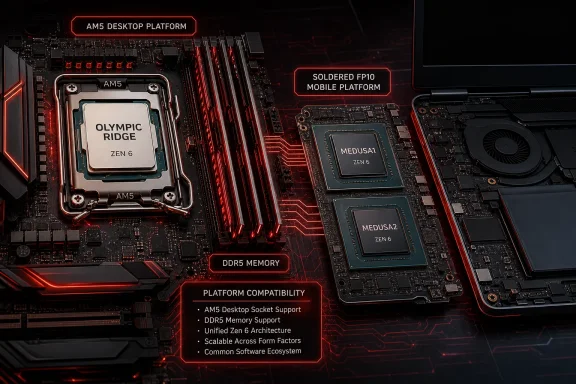
The newly exposed entries, first spotted by InstLatX64 and reported by Wccftech, were independently matched by VideoCardz, OC3D, and IT Home. They settle a narrow but important question: AMD has not abandoned AM5 for its next major Ryzen generation. For builders who bought into Ryzen 7000 or Ryzen 9000 on the expectation of a long socket life, Olympic Ridge is the relevant name; Medusa1 adds the more unusual possibility of a Zen 6 APU family appearing in both desktop and laptop packaging.
What the documentation does not provide is the part that turns a platform reference into a buying decision: processor models, clocks, cache sizes, core counts, chipset requirements, BIOS support, power limits, launch date, or price. Those details remain absent from AMD’s public product announcements, and should not be treated as confirmed merely because the codenames and package support are now in AMD’s own records.
 Olympic Ridge puts another Ryzen generation on AM5
Olympic Ridge is listed for AM5, the land-grid-array desktop socket introduced with Ryzen 7000 in 2022. Wccftech characterizes it as the successor to Ryzen 9000 desktop CPUs and identifies it as a Zen 6 family, but the official database evidence is more restrained: it confirms the codename’s association with AM5, not the eventual retail branding or specifications.
AMD’s broader platform commitment gives the entry real weight. At Computex in May 2026, AMD said Socket AM5 support would extend through 2029, replacing its earlier “through 2027 and beyond” pledge. The Olympic Ridge listing is the first direct, product-family-level indication of how AMD intends to honor that longer runway on the mainstream desktop side.
For AM5 owners, the practical message is encouraging but conditional. A future Olympic Ridge CPU may physically fit an existing AM5 motherboard, yet that does not guarantee the board will receive firmware support, run every processor tier, or deliver full performance. Motherboard vendors determine BIOS availability for each model, while VRM design, BIOS flash capacity, and memory validation can all affect the eventual upgrade experience.
AMD’s current AM5 support page says 600- and 800-series boards support the Ryzen 7000, 8000, and 9000 families, with BIOS updates required in some cases. It does not yet promise that every existing 600- or 800-series board will support Olympic Ridge. Builders considering a Ryzen 9000 system today should therefore choose a board from a vendor with a credible record of long-term BIOS maintenance rather than assume the socket alone guarantees a painless Zen 6 drop-in.
Medusa1 is the more consequential entry
The documentation places Medusa1 on both AM5 and FP10. That is a significant configuration because FP10 is a BGA mobile package soldered directly to a laptop or compact-system motherboard, whereas AM5 is a replaceable desktop socket. VideoCardz and OC3D both reported the same package mapping, with Medusa2 restricted to FP10.
That split suggests AMD is preparing a broader client design family rather than simply a conventional desktop CPU line. If Medusa1 becomes a socketed desktop APU, it could be the Zen 6-era successor to the Ryzen 8000G concept: a chip intended to combine general-purpose CPU performance with substantially more capable integrated graphics than the tiny display-focused GPU built into mainstream Ryzen desktop processors.
But that remains an inference from AMD’s package list, not a published specification. AMD has not announced that Medusa1 is an APU, disclosed its graphics architecture, or said whether a desktop version will use the same silicon as mobile systems. Wccftech’s claims about upgraded integrated graphics, up to 22 CPU cores, and its place as a Ryzen 8000G replacement are reporting and prior-roadmap interpretation, rather than details AMD has formally announced with these Technical Information Portal entries.
The distinction matters for Windows users assembling compact PCs. A genuine desktop Medusa1 APU could make low-power Windows 11 systems, home servers needing local display output, and small-form-factor gaming builds more capable without a discrete GPU. Until AMD publishes display-engine, media-codec, NPU, memory-bandwidth, and PCIe-lane specifications, however, it is impossible to say whether it would be a meaningful replacement for a discrete graphics card, an entry-level chip, or primarily an OEM-oriented part.
Medusa2 belongs to laptops and embedded-style designs
Medusa2 appears only under FP10. In plain terms, it is not a prospective CPU upgrade for an AM5 desktop; it is intended for systems where the processor is permanently mounted to the board. That includes conventional laptops, mini PCs, handheld-class devices, and potentially commercial compact systems, depending on the products AMD’s partners choose to build.
The official mapping also draws a clean boundary that some earlier Zen 6 rumor coverage blurred. Medusa1 is cross-platform in AMD’s records, but Medusa2 is not. Anyone interpreting the report as proof that all “Medusa” processors will come to desktop AM5 should separate the two codenames before making a purchase or delaying an upgrade.
Neither the Technical Information Portal entries nor AMD’s public AM5 material reveal whether Medusa2 will be a lower-power, lower-cost, smaller-die, or otherwise segmented product. Wccftech describes it as an entry-level and efficiency-tuned mobile line, but no independent official specification published alongside the package listings establishes that positioning. The same applies to reports of a separate Medusa Halo family and an RDNA graphics generation: plausible roadmap material is still not equivalent to a product disclosure.
A package listing is not a CES 2027 launch announcement
Several outlets, including Wccftech and Tom’s Hardware in earlier reporting, have pointed to CES 2027 as the likely window for consumer Zen 6 chips. AMD has not announced a CES 2027 Ryzen event, a retail availability date, or the marketing names that will replace today’s Ryzen 9000 desktop branding and Ryzen AI mobile labels.
That leaves an unusually large gap between what has now been confirmed and what remains rumor. The following claims should be treated as unconfirmed until AMD publishes a proper product announcement:
- Olympic Ridge’s reported 24-core ceiling, 12-core chiplets, 3D V-Cache variants, and 65W-to-170W power range have not been specified by AMD.
- The reported use of a 2nm manufacturing process has not been established in the Technical Information Portal entries.
- A “900-series” AM5 chipset generation has not been announced by AMD.
- The proposed CES 2027 announcement and early-2027 retail launch timing are not official.
- Intel Nova Lake and “Core Ultra 400” competitive timing does not establish AMD’s own schedule.
The reporting does fit AMD’s stated AM5 timeline. A 2027 Zen 6 desktop release would leave the company room for another generation on the socket before its support-through-2029 commitment expires. Yet AMD’s promise is a platform-support commitment, not a published guarantee that every AM5 board manufactured since 2022 will run every future processor.
The immediate implication is motherboard selection, not an upgrade date
The important news is not a benchmark figure or a launch calendar; neither exists yet. It is that AMD’s documentation puts Olympic Ridge and Medusa1 on the same AM5 path as Ryzen 7000, 8000, and 9000. That materially strengthens the case for AM5 buyers who value reuse of a motherboard and DDR5 memory across CPU generations.
It also gives motherboard makers a year or more to prepare firmware support, and gives enterprise IT teams a reason to ask OEM suppliers how long their AM5 desktop fleets will remain validated. A socketed CPU can be technically compatible while still falling outside an OEM’s supported configuration, especially in managed desktops with locked firmware and specific memory qualification lists.
For consumers, there is no reason to postpone a necessary PC purchase solely for Olympic Ridge. AMD has confirmed the family-and-socket relationship, but has disclosed none of the performance, availability, or board-support details needed to compare a future Zen 6 system with a Ryzen 9000 build available now. The next meaningful milestone will be an AMD product announcement that turns these internal codenames into processor models—and tells existing AM5 owners exactly which boards can run them.