

Overview: AMD’s True Entry Point for RDNA 4
The Radeon RX 9050 fills an obvious gap at the bottom of the Radeon RX 9000-series stack. It uses the same Navi 44 family of silicon found in the Radeon RX 9060 and Radeon RX 9060 XT, but AMD has configured it far more conservatively. That approach should allow the company and its board partners to serve prebuilt systems, economical gaming desktops, and regions where a lower-power discrete GPU has greater appeal.
The official specification is unmistakably entry-level. RX 9050 has 16 Compute Units, 1,024 stream processors, 16 ray accelerators, and 32 AI accelerators. In contrast, the RX 9060 has 28 Compute Units and 1,792 stream processors, while either RX 9060 XT version offers 32 Compute Units and 2,048 stream processors. AMD’s product data for RX 9050, RX 9060, and RX 9060 XT makes the segmentation particularly plain.
That means the RX 9050 is not a near-peer to the RX 9060, despite the proximity of its model number. It is a deliberately much smaller configuration that trades raw graphics throughput for lower power consumption and, presumably, a lower eventual system cost. The card’s defining question is therefore not whether it can outperform the 9060 series—it cannot—but whether it can deliver a consistently good 1080p gaming experience at the price AMD and its partners ultimately attach to it.
The Official RX 9050 Specifications
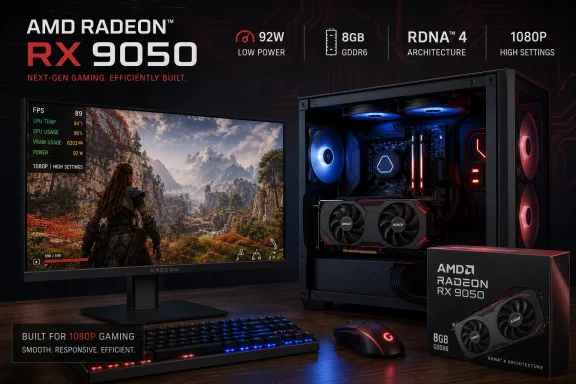
AMD’s published RX 9050 specification establishes an 8GB reference configuration with a 128-bit memory interface. The GPU runs at a 1,920MHz game clock and can boost as high as 2,600MHz, while the GDDR6 memory operates at up to 18Gbps for 288GB/s of bandwidth. It also retains 32MB of Infinity Cache, a significant inclusion for a product this far down the stack. AMD’s RX 9050 page lists these figures alongside the card’s 92W board-power rating.
| Specification | Radeon RX 9050 | Radeon RX 9060 | Radeon RX 9060 XT 8GB | Radeon RX 9060 XT 16GB |
|---|---|---|---|---|
| Architecture | RDNA 4 | RDNA 4 | RDNA 4 | RDNA 4 |
| GPU family | Navi 44 | Navi 44 | Navi 44 | Navi 44 |
| Compute Units | 16 | 28 | 32 | 32 |
| Stream Processors | 1,024 | 1,792 | 2,048 | 2,048 |
| Ray Accelerators | 16 | 28 | 32 | 32 |
| AI Accelerators | 32 | 56 | 64 | 64 |
| Game Clock | 1,920MHz | 2,400MHz | 2,530MHz | 2,530MHz |
| Boost Clock | Up to 2,600MHz | Up to 2,990MHz | Up to 3,130MHz | Up to 3,130MHz |
| Memory | 8GB GDDR6 | 8GB GDDR6 | 8GB GDDR6 | 16GB GDDR6 |
| Memory Bus | 128-bit | 128-bit | 128-bit | 128-bit |
| Memory Bandwidth | 288GB/s | 288GB/s | 320GB/s | 320GB/s |
| Infinity Cache | 32MB | 32MB | 32MB | 32MB |
| Typical Board Power | 92W | 132W | 150W | 160W |
Specifications are drawn from AMD’s official RX 9050, RX 9060, and RX 9060 XT product listings. RX 9050 · RX 9060 · RX 9060 XT
The performance cut is substantial
The raw numbers show that the RX 9050 is less a lightly cut version of the RX 9060 XT and more a radically reduced configuration of Navi 44. It has exactly half the compute units and half the stream processors of the RX 9060 XT. Even against the non-XT RX 9060, RX 9050 loses 12 Compute Units, 768 stream processors, 12 ray accelerators, and 24 AI accelerators. AMD’s official product pages place all three products in the same 9000-series family but reveal a wide hardware gulf between them.
Clock speeds widen that gap. The RX 9050’s 1,920MHz game clock is 480MHz below RX 9060 and 610MHz below RX 9060 XT. Its 2,600MHz boost ceiling is also notably lower than the 2,990MHz target listed for RX 9060 and the 3,130MHz target listed for RX 9060 XT. AMD’s RX 9050 specifications and RX 9060 specifications make clear that AMD has limited both the physical GPU configuration and operating frequencies.
This matters because gaming performance does not scale perfectly from shader count alone. Clock speed, memory pressure, game engine behavior, CPU limits, resolution, ray tracing settings, and driver maturity all influence results. But the hardware delta is large enough that prospective buyers should view RX 9050 as a lower class of graphics card rather than expect performance near the RX 9060 family.
Memory bandwidth is not the main compromise—capacity may be
One of RX 9050’s more interesting characteristics is that the official 8GB card retains the same 288GB/s memory bandwidth as RX 9060. Both use an 18Gbps GDDR6 memory configuration on a 128-bit bus, and both include 32MB of Infinity Cache. AMD’s RX 9050 page and RX 9060 page confirm that shared memory subsystem baseline.
That should help RX 9050 avoid one common pitfall of budget GPUs: pairing too little compute power with a severely constrained memory bus. AMD has instead preserved sufficient bandwidth for conventional 1080p rendering, while dramatically cutting shader resources and clocks. It is a sensible balance for esports titles and lighter games, though it does not solve the broader long-term challenge of 8GB of VRAM in graphically demanding modern releases.
The larger concern is a separate 4GB RX 9050 configuration that has appeared in OEM-oriented systems and partner reporting. ASRock’s 8GB retail board is fully documented, while outside reporting indicates that a 4GB version uses a 64-bit interface, cutting bandwidth to approximately 144GB/s. VideoCardz’s coverage of the two memory configurations details that distinction. A 4GB graphics card may still have a role in very low-cost desktops, but it is difficult to recommend for new gaming systems where texture quality and VRAM requirements increasingly dictate settings before GPU compute performance does.
AMD’s 1080p Benchmarks Need Careful Reading
AMD has positioned RX 9050 around 1080p medium settings, not 1080p Ultra and certainly not 1440p Ultra. Its official gaming panel cites:
- 60 FPS in 007 First Light
- 96 FPS in Cyberpunk 2077
- 131 FPS in Forza Horizon 6
- 85 FPS in Pragmata
- 227 FPS in Counter-Strike 2
- 116 FPS in Call of Duty: Black Ops 7
- 206 FPS in Tom Clancy’s Rainbow Six Siege
- 593 FPS in Valorant at high settings
Those figures appear on AMD’s RX 9050 product page under the explicit “1080p medium settings” target. AMD’s official benchmark panel is useful as a directional statement of where the company expects the product to land: modern 1080p gaming at sensible rather than maximum image-quality settings.
A vendor benchmark is not a direct generational showdown
The first rule in comparing these charts is simple: do not divide the frame rates from one AMD product page by the frame rates from another and call the result a reliable performance percentage. AMD uses different games and different quality targets across the pages.
RX 9050’s showcased figures use 1080p medium settings. RX 9060’s official panel, by contrast, targets native 1080p Ultra and lists results including 153 FPS in DOOM Eternal with ray tracing enabled and 100 FPS in Resident Evil 4 with ray tracing enabled. AMD’s RX 9060 page presents a substantially higher quality target for that card.
RX 9060 XT 16GB moves further up the resolution ladder. AMD markets it around 1440p Ultra, showing such results as 75 FPS in Arc Raiders, 86 FPS in Call of Duty: Black Ops 7, 61 FPS in The Last of Us Part II, and 115 FPS in Forza Horizon 5 with ray tracing. AMD’s RX 9060 XT product page therefore positions the 16GB XT model in a distinctly different usage class.
The implication is not that RX 9050’s numbers are unimportant. They show that AMD believes the card can clear 60 FPS in a demanding newer release at its intended settings, while achieving much higher frame rates in esports titles. The limitation is that the marketing panels do not isolate GPU performance under a common game suite, common test platform, common settings, and common driver version.
Independent testing will be essential before assigning an exact RX 9050-versus-RX 9060 performance gap. Until that arrives, the official specifications are a stronger basis for comparison than mismatched charts.
What the benchmarks do suggest
Even with that caveat, the benchmark selection communicates three useful things.
First, the RX 9050 is not being marketed as a 4K card or a high-refresh 1440p product. AMD’s target is plainly 1080p, and medium settings are part of the product’s intended operating envelope. AMD’s RX 9050 benchmark listing leaves little room for ambiguity.
Second, it should be well suited to competitive games where frame rates are governed less by enormous texture sets and more by CPU speed, game settings, and input-latency priorities. The Counter-Strike 2, Rainbow Six Siege, and Valorant results are far above the 60 FPS threshold, though real-world outcomes will vary sharply by processor and settings.
Third, the 60 FPS result in 007 First Light is perhaps the most meaningful number in the group. It illustrates that RX 9050 is intended to remain viable in contemporary blockbuster games, but it also signals that users should expect to make settings choices rather than simply select “Ultra” and move on.
RX 9050 Versus RX 9060: The Important Difference
The Radeon RX 9060 is the natural next step up. It carries the same 8GB memory capacity, 128-bit bus, 288GB/s bandwidth, and 32MB Infinity Cache as the official RX 9050 specification. But it has 75% more Compute Units, 75% more stream processors, a 25% higher game clock, and a 15% higher boost clock. AMD’s RX 9050 and RX 9060 pages show that much of the RX 9060 advantage is straightforwardly rooted in more active GPU hardware.
The RX 9060 also has a higher 132W typical board-power rating. That is an increase of 40W over RX 9050, or roughly 43% more power budget. In a well-designed desktop, that is not an especially demanding figure, but it shows the trade AMD is making: RX 9050 pursues lower electricity use and thermal output; RX 9060 puts substantially more power toward gaming throughput.
For buyers building a machine around 1080p Ultra settings, ray tracing experimentation, or a high-refresh monitor, RX 9060 is the better technical fit. It is also the card more likely to have performance reserves when a new game proves unexpectedly demanding. Its 8GB VRAM allocation remains a constraint in some usage scenarios, but the greater shader and clock budget should translate into more flexibility with graphics settings.
RX 9050 Versus RX 9060 XT: A Different Tier Entirely
The RX 9060 XT is more than a mildly upgraded RX 9050. It is a different class of RDNA 4 card, particularly in its 16GB configuration. It doubles RX 9050’s Compute Units, stream processors, ray accelerators, and AI accelerators, while operating at considerably higher game and boost clocks. AMD’s RX 9060 XT specification page lists 32 Compute Units, 2,048 stream processors, a 2,530MHz game clock, and up to a 3,130MHz boost clock.
Memory also divides the product line. The RX 9060 XT 8GB has the same capacity as RX 9050 but runs memory at up to 20Gbps, producing 320GB/s of bandwidth. The RX 9060 XT 16GB preserves that bandwidth but doubles capacity, giving it a much better foundation for games that need larger texture allocations, higher settings, ray tracing, and 1440p use. AMD’s launch announcement listed the RX 9060 XT 8GB at a $299 suggested e-tailer price and the 16GB model at $349.
AMD’s own product positioning reinforces the technical distinction. The company frames RX 9050 around 1080p medium settings, RX 9060 around 1080p Ultra, and RX 9060 XT 16GB around 1440p Ultra. RX 9050 · RX 9060 · RX 9060 XT
That makes the buying logic relatively clean:
- RX 9050 8GB: Budget-conscious 1080p gaming, esports, compact or efficient systems, and buyers comfortable selecting medium settings in demanding releases.
- RX 9060 8GB: A stronger 1080p card for higher-quality presets, higher refresh rates, and greater room for demanding games.
- RX 9060 XT 8GB: Higher compute performance for 1080p users who value frame rate and settings, while accepting the same long-term capacity limitation.
- RX 9060 XT 16GB: The sensible choice for users targeting 1440p, heavier texture loads, and better resilience as new PC games raise their memory demands.
Efficiency Is the RX 9050’s Most Compelling Advantage
At 92W typical board power, RX 9050 is unusually restrained for a current desktop gaming GPU. That is 40W lower than RX 9060, 58W below RX 9060 XT 8GB, and 68W lower than RX 9060 XT 16GB. AMD’s product specifications show the progression clearly across the RX 9000-series lineup.
In practical terms, lower power can matter in several ways:
- Less heat dumped into a small chassis.
- Lower fan speeds and potentially quieter operation.
- Reduced demands on a system power supply.
- Better fit for prebuilt systems designed with modest thermal headroom.
- Lower energy consumption during extended gaming sessions.
ASRock’s first standalone board suggests that RX 9050 can still arrive in a conventional desktop-card form factor rather than only as a bare OEM component. The RX 9050 Challenger 8GB uses a dual-fan cooler, a metal backplate, a single 8-pin power connector, and a recommended 450W power supply. It measures 249 × 132 × 41mm and provides two DisplayPort 2.1a outputs plus HDMI 2.1b. ASRock’s official product page confirms those details.
There is one caveat: a 92W official typical-board-power figure does not guarantee that every partner card will consume exactly 92W in every scenario. Board vendors can make different cooling, firmware, and clock decisions. Still, RX 9050 is decisively designed around low power compared with the rest of the RX 9060 family.
Availability and Pricing Remain the Decisive Unknowns
The hardware specification is now official, but the most important consumer details remain unsettled: where the RX 9050 will be sold and what a standalone 8GB board will cost.
ASRock explicitly warns that its RX 9050 Challenger 8GB “may not be sold worldwide,” which is a material qualification for North American buyers. ASRock’s product listing confirms the board exists but does not establish broad retail availability. Separate reporting has indicated an initial emphasis on Asia-Pacific and Latin American markets, with no announced standalone U.S. launch plan. ComputerBase’s report notes those regional limitations.
The absence of a confirmed broad retail price is more consequential than it may appear. RX 9050’s low power draw and current RDNA 4 features are genuine strengths, but a card with half the compute resources of RX 9060 XT needs aggressive pricing to make sense. The card cannot rely on specification novelty alone because more powerful alternatives—new and used—will compete fiercely in this part of the market.
A reported $279 figure should be treated cautiously rather than as an official MSRP. ComputerBase noted that the price had not been confirmed by AMD. Its updated coverage specifically characterizes that number as unverified. If an 8GB RX 9050 approaches the $299 starting price AMD set for RX 9060 XT 8GB, its value proposition would be difficult to defend on raw gaming performance.
Windows Gaming Features Still Matter
Although RX 9050 is AMD’s lowest-tier RDNA 4 desktop GPU, it does not lose the platform-level features that distinguish the Radeon RX 9000 series. AMD lists support for Windows 10 64-bit, Windows 11 64-bit, DirectX 12 Ultimate, DisplayPort 2.1a, HDMI 2.1b, AV1 encode and decode, FidelityFX Super Resolution technologies, AMD Fluid Motion Frames, Radeon Anti-Lag 2, HYPR-RX, and the Adrenalin software stack. AMD’s RX 9050 listing and ASRock’s board specification outline that feature set.
That is important for Windows PC users because a low-end GPU should not feel like an obsolete GPU. Modern display connectivity gives RX 9050 a viable role in multi-monitor desktops and contemporary displays, while AV1 support adds practical value for media playback, streaming workflows, and content creation.
AMD’s new Adrenalin driver also gives the card immediate software support rather than leaving early buyers to depend on a generic launch driver. The release notes identify RX 9050 as a new-product addition and include fixes for applications and games across newer Radeon generations. AMD Software: Adrenalin Edition 26.7.1 is therefore the essential starting point for any RX 9050 deployment on Windows.
The important qualification is that frame generation is not a substitute for baseline GPU performance. Technologies such as FSR and AMD Fluid Motion Frames can improve perceived smoothness and help users target higher displayed frame rates, but they do not remove VRAM limitations or transform an entry-level GPU into a native 1440p Ultra card. RX 9050 buyers should treat these tools as valuable options, not as a reason to ignore the card’s very clear hardware limits.
The Bottom Line
The official Radeon RX 9050 specification resolves the largest uncertainty surrounding AMD’s entry-level RDNA 4 GPU: it is a true low-power 1080p product, not an oddly configured RX 9060 alternative with near-XT shader counts. With 16 Compute Units, 1,024 stream processors, 8GB of GDDR6, 32MB of Infinity Cache, and 92W board power, it sits well below RX 9060 and RX 9060 XT in gaming resources while preserving the current Radeon feature set. AMD’s RX 9050 product page makes that positioning official.
Its strengths are tangible: modern RDNA 4 capabilities, a credible 1080p medium-settings target, esports-friendly benchmark claims, modern display output, AV1 support, and a notably efficient power envelope. The ASRock Challenger 8GB also proves that RX 9050 is not confined exclusively to prebuilt PCs. ASRock’s listing confirms a conventional partner card with an 8-pin connector, dual-fan cooling, and an 8GB 128-bit memory configuration.
Its risks are equally clear. The GPU’s large compute deficit versus RX 9060 and RX 9060 XT will limit high-setting performance, 8GB of memory constrains long-term ambitions, the 4GB variant is difficult to justify as a modern gaming purchase, and regional availability plus standalone pricing remain unresolved. RX 9050 can become an appealing budget graphics card only if its actual retail price reflects those compromises.
For Windows gamers who prioritize low power, 1080p play, and modern features over maximum image quality, RX 9050 has a coherent place in the Radeon lineup. But until retail availability and pricing are fully established—and independent RX 9050 reviews put it through a consistent test suite—the RX 9060 and especially the RX 9060 XT 16GB remain the safer choices for buyers seeking more performance headroom and a longer useful life.
Update: AMD confirms $279 RX 9050 launch in select regions (July 30, 2026)
AMD has now set a $279 suggested price for the 8GB Radeon RX 9050 in Asia-Pacific, Japan, and Latin America, according to PC Gamer. This replaces the earlier unverified $279 figure with a stated regional launch price. AMD still has not announced a U.S. retail release, so availability for American DIY builders remains unresolved.
AMD also confirmed that the 4GB RX 9050 configuration is intended for OEM systems and will not be sold as a standalone retail card. Buyers considering prebuilt PCs should therefore verify the listed VRAM capacity: the retail-focused model carries 8GB, while some low-cost OEM systems may use the substantially more constrained 4GB version.
Update: Gigabyte and PowerColor expand RX 9050 partner-card lineup (August 2, 2026)
According to VideoCardz, Gigabyte and PowerColor have introduced 8GB Radeon RX 9050 models, extending the partner lineup beyond the previously documented ASRock card. Gigabyte’s Radeon RX 9050 Gaming OC 8G reportedly uses a 2,260MHz game clock and 2,760MHz boost clock—well above AMD’s 1,920MHz and 2,600MHz reference targets—along with a WINDFORCE cooler, fan-stop support, and a reinforced backplate.
PowerColor’s RX9050 8G-A Reaper, by contrast, reportedly retains AMD’s 1,920MHz reference game clock. It uses a dual-fan cooler and the standard 8GB, 128-bit, 18Gbps GDDR6 configuration, rather than changing the underlying memory capacity or bandwidth limits.
These launches reinforce that AMD’s 8GB RX 9050 is receiving a broader conventional add-in-board rollout in its supported regions, not merely limited OEM deployment. However, neither Gigabyte nor PowerColor has confirmed pricing or retail availability in North America or Europe, so the practical purchasing picture for U.S. Windows gamers remains unchanged.