
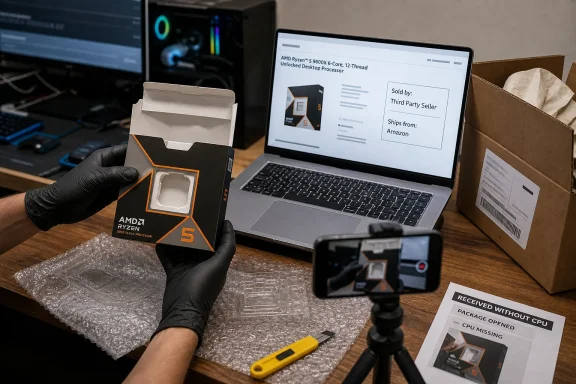
The incident was first documented by the Reddit user No-Yak9976 in r/PcBuild on August 20, then reported by Wccftech and other hardware sites. The shop says it recorded both unboxings, obtained a refund after the first missing CPU, reordered the part, and received another box without the processor inside. The original Reddit posts identify the seller as “The Tech Group,” with Amazon handling fulfillment.
There is also a basic factual error in Wccftech’s headline: the part named in the reporting and the original posts is the six-core Ryzen 5 9600X, not a Ryzen 7 9600X. That may look minor, but PC buyers searching a specific SKU need to know whether they are dealing with an actual product listing issue or a broad claim about a processor family.
 What the posts establish — and what they do not
The buyer’s account establishes a documented complaint, not a proven explanation. The shop says the CPU was missing from two sealed retail packages and says it has videos of the unboxings. It also says an inventory manager inadvertently selected a marketplace offer from The Tech Group rather than purchasing an Amazon-sold item or a direct manufacturer listing.
Neither the Reddit posts nor Wccftech’s report establishes where the processors disappeared. They could have been removed before inventory reached Amazon, during handling, or through a returned-item failure further up the chain. The posts do not provide order numbers, box serial-number comparisons, package weights, Amazon’s internal investigation, or a public response from the seller.
That distinction matters for buyers tempted to call this a confirmed seller scam. The empty boxes are the reported event; responsibility is unresolved. No independent outlet has published evidence tying the missing CPUs directly to The Tech Group, and Amazon had not publicly explained the incident at the time of publication.
The shop’s own account does, however, identify a failure that matters operationally: the first refund did not prevent a second order from reproducing the same risk. A refund repairs the payment problem. It does not automatically remove the marketplace offer, quarantine inventory, or ensure a replacement comes from a different stock source.
“Fulfilled by Amazon” is not the same as “Sold by Amazon”
Amazon’s own seller guidance draws a line many buyers overlook. “Sold by Amazon” means Amazon bought the stock and is the merchant selling it to the customer. “Shipped by Amazon” means a third-party seller’s inventory is stored in an Amazon fulfillment center and Amazon handles picking, packing, and delivery.
The Reddit post describes the disputed Ryzen 5 9600X orders as sold by The Tech Group and fulfilled by Amazon. That means Amazon’s name on the delivery experience did not mean Amazon was the retailer of record for the processor. For expensive components, that merchant field deserves the same scrutiny as the listed price, delivery date, and return window.
This is especially relevant with CPUs because the product is compact, valuable, and easily resold. A missing processor may be difficult to prove after the package has been opened, while a returned processor can be swapped, damaged, or replaced with unrelated contents before it re-enters a retail channel. None of that proves it happened here; it explains why the buyer’s unboxing video is more useful evidence than a photograph taken after the fact.
The post also undercuts a common assumption about Amazon Business accounts. A business account can provide purchasing controls, invoices, approval workflows, and volume-order features, but it does not turn every marketplace listing into Amazon-owned inventory. Procurement teams still need a defined rule for approved merchants and for exceptions when a marketplace offer looks cheaper or faster.
The retailer’s rating is not enough due diligence
The shop said The Tech Group appeared to have decent ratings but speculated that the reviews might be fake. That claim is unsupported by evidence in the posts, and it should not be repeated as fact. Ratings can be incomplete signals even when they are genuine: they may combine feedback from low-value items, reflect a short time window, or fail to expose a recent fulfillment problem quickly enough for the next buyer.
For a single CPU purchase, the practical fix is simple: inspect both the “Sold by” and “Ships from” fields immediately before checkout. Do not rely on the product title, Prime badge, or the Amazon logo in the page header. Marketplace offers can change, and a listing page may present several merchants for the same nominal product.
For a PC shop, the control needs to be more deliberate:
- Require CPU, GPU, SSD, and memory purchases to come from an approved seller list, even if another offer is lower-priced.
- Preserve the order page, merchant name, invoice, shipping label, and box serial number with the receiving record.
- Record the condition of tamper seals and the entire opening process before the component leaves the receiving area.
- Stop using a listing after a missing-item claim until the replacement source and seller identity have been checked, rather than simply pressing “buy again.”
The first two items provide a paper trail. The latter two reduce the chance that a disputed shipment turns into an argument over whether the product was missing on arrival or lost after delivery.
A refund is not the end of the incident
Amazon provides buyer protections for marketplace transactions, including processes for items that are materially different from their description or for refunds that a seller does not provide. In this case, the retailer says Amazon issued the first refund promptly. That is a useful outcome, but it should be treated as the first step in handling a missing high-value component, not a final resolution.
A buyer who receives an empty box should avoid treating it as routine return merchandise. Document the outer package before opening if it appears damaged; photograph labels and seals; retain all packing materials; and report the issue through the order itself while the delivery scan, carrier record, and listing details are readily available. If a replacement is necessary, verify whether it will be supplied by a different seller or a different inventory source.
For a business, repeat failures should also trigger an internal receiving review. The immediate cost of a Ryzen 5 9600X is modest compared with flagship CPUs and graphics cards, but staff time, build delays, customer commitments, and chargeback or account-review risk can turn a missing $100-to-$200 part into a much larger operational expense.
The most useful lesson from the PC Plug posts is therefore narrower than “never buy PC parts from Amazon.” Marketplace purchases can work, and this single incident does not establish a platform-wide pattern. But a replacement order placed through the same third-party offer can repeat the same exposure, even when Amazon itself fulfills the package.
For anyone ordering a Ryzen 5 9600X or another compact, expensive component, the concrete next step is to check the merchant of record before paying — and to keep the camera running until the processor is visible, intact, and matched to the box.