
For Windows laptop buyers, that removes a key assumption created by the current naming scheme: a recent AMD mobile chip using the same basic generation as Ryzen AI 400 parts is not automatically a Copilot+ PC platform. Microsoft’s hardware guidance still places the Copilot+ threshold at a dedicated NPU capable of more than 40 TOPS. A Ryzen 7 449 or Ryzen 5 439 notebook may run Windows 11 and ordinary GPU-accelerated AI software perfectly well, but it should not be sold as a machine with the local NPU hardware required for the full Copilot+ feature class.
The submitted TechPowerUp records contain the central outlines of both CPUs—8 cores for the Ryzen 7 449, 6 for the Ryzen 5 439, 28 W default TDP, Socket FP8, DDR5 support and Radeon 860M or 840M graphics. But they also blur AMD’s product segmentation and, in the Ryzen 7 entry, substantially understate cache. The correction changes how these parts should be compared with nearby Ryzen AI models.
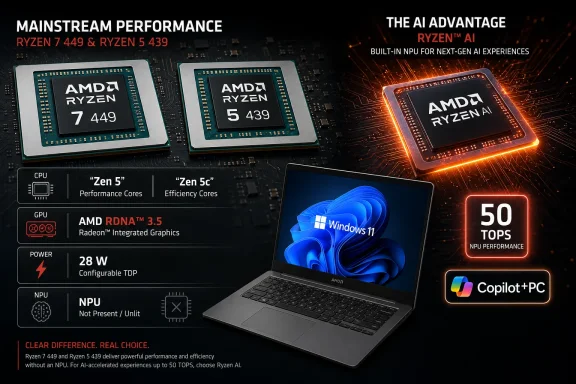 Ryzen 7 449: eight cores, 16 MB of L3 cache, no stated NPU
The Ryzen 7 449 combines four standard Zen 5 cores with four denser Zen 5c cores, giving it eight cores and 16 threads. Notebookcheck, VideoCardz and Igor’sLAB agree on a 2.0 GHz base clock, up-to-5.0 GHz peak boost on the Zen 5 cluster, 3.4 GHz maximum on the Zen 5c cluster, and Radeon 860M graphics with eight RDNA 3.5 compute units at up to 2.8 GHz.
The important specification correction is cache. TechPowerUp’s submitted Ryzen 7 449 page lists 8 MB of L3 cache, but Notebookcheck and several independent reports based on AMD’s product listing put the part at 16 MB of L3 cache, alongside 8 MB of L2. That makes sense relative to the chip’s four-plus-four CPU layout and places it much closer to AMD’s Ryzen AI 7 450 and Ryzen AI 7 PRO 450 in conventional CPU resources than the TechPowerUp entry implies.
Its nearest branded counterpart is the Ryzen AI 7 PRO 450. The PRO chip reaches 5.1 GHz on its larger Zen 5 cores and 3.6 GHz on Zen 5c, while the Ryzen 7 449 stops at 5.0 GHz and 3.4 GHz. The more consequential difference is that AMD specifies a 50 TOPS XDNA NPU on the AI-branded PRO model, while no NPU performance figure—or Ryzen AI label—appears on the Ryzen 7 449 listing.
That is not proof that the physical NPU block has been removed from the silicon. AMD has not publicly explained whether these are dies with defective NPU hardware, fully working blocks disabled for product segmentation, or a different configuration. Calling them “NPU-free” goes beyond what AMD’s own specifications establish. The confirmed fact is narrower and more useful: AMD does not list an available NPU or AI TOPS rating for the Ryzen 7 449.
Ryzen 5 439 cuts cache as well as clocks
The Ryzen 5 439 is the lower-tier sibling, with three Zen 5 cores and three Zen 5c cores for six cores and 12 threads. Its primary cores can boost to 4.6 GHz, the Zen 5c cluster tops out at 3.3 GHz, and it carries 6 MB of L2 cache and 8 MB of L3 cache. The submitted TechPowerUp record is consistent with the 8 MB L3 figure for this chip.
Graphics are supplied by Radeon 840M, a four-compute-unit RDNA 3.5 integrated GPU reportedly clocked as high as 2.8 GHz. The CPU supports DDR5-5600, but OEMs can use higher-bandwidth LPDDR5X configurations; Notebookcheck reports support up to LPDDR5X-7500 on the Ryzen 5 439, rather than treating DDR5-5600 as the universal ceiling. As always with soldered mobile memory, the finished laptop’s RAM configuration—not the processor’s broad capability—will determine the actual bandwidth and capacity buyers receive.
The better direct comparison is AMD’s Ryzen AI 5 PRO 440. Both use the same three-Zen-5 plus three-Zen-5c CPU layout and the same Radeon 840M class of graphics. But the AI 5 PRO 440 is specified at up to 4.8 GHz, has 16 MB of L3 cache rather than 8 MB, and carries the advertised 50 TOPS NPU absent from the 439’s specification page.
This makes the Ryzen 5 439 more than a Ryzen AI 5 PRO 440 with a different sticker. Its CPU peak clock is lower, its L3 cache is halved, and its published feature set excludes the dedicated accelerator that Windows increasingly treats as a platform capability. It could still be a sensible mainstream laptop processor if an OEM prices it accordingly, but it should not be evaluated as a minor frequency-bin variation of the AI-branded part.
The 15–54 W range will matter more than the 28 W label
Both processors have a nominal 28 W TDP, but independent reporting based on AMD’s data lists a configurable operating range of 15 W to 54 W. That range is routine for modern laptop APUs, but it makes a single processor name a poor predictor of laptop performance.
A thin 14-inch notebook configured near 15 W will prioritize noise, heat and battery life, and it may sustain substantially lower CPU and graphics clocks in long workloads. A larger machine with a more aggressive 45 W or 54 W tuning can deliver considerably better sustained compilation, rendering and gaming performance, provided its cooling system and memory configuration keep up. The Ryzen 7 449’s Radeon 860M has twice the compute-unit count of the Ryzen 5 439’s 840M, but a poorly cooled 449 laptop can still disappoint against a well-tuned 439 system in short real-world use.
For IT buyers, the absence of announced designs is a practical gap. AMD has not disclosed pricing, availability dates, laptop partners, or whether these chips will appear mainly in consumer systems, commercial fleets or regional configurations. Until OEMs publish complete model specifications, there is no basis for assuming that a laptop with either CPU will offer particular Wi-Fi hardware, memory capacity, USB4 ports, display outputs, battery size, Windows edition or management features.
Windows AI branding needs a closer read
Microsoft’s Copilot+ PC definition centers on a dedicated 40+ TOPS NPU. That matters for Windows features built around local neural acceleration, including parts of Windows AI APIs and the Copilot+ experience set. A GPU can accelerate many AI workloads, and Microsoft has expanded some Windows AI software to work on non-Copilot+ hardware through GPU execution, but that is not the same qualification path as a dedicated NPU-equipped Copilot+ PC.
The Ryzen 7 449 and Ryzen 5 439 could therefore appeal to organizations that want current Zen 5-era x86 performance without paying for an AI category they do not intend to use. Developers running local models through a discrete GPU, conventional CPU workloads, virtual machines and mainstream productivity applications do not suddenly require an NPU. The trade-off becomes material when a procurement requirement names Copilot+ PCs, when an application targets NPU execution specifically, or when buyers expect the battery-life and low-power inference advantages associated with dedicated neural hardware.
AMD’s naming is likely to create avoidable confusion. “Ryzen 400” and “Ryzen AI 400” sound adjacent because they are, and both families are associated with Gorgon Point-class designs. Yet a Windows buyer comparing two laptops by tier number alone could miss the difference between a Ryzen 7 449 and a Ryzen AI 7 450, especially when retail listings reduce processor information to a model name and core count.
The purchasing rule is straightforward: treat the Ryzen 7 449 and Ryzen 5 439 as conventional modern laptop APUs until the actual notebook specification proves otherwise. Check the CPU’s cache and power configuration, verify the installed memory, and require an explicit Copilot+ designation or NPU rating before counting on Windows features that depend on dedicated local AI acceleration.