
Notebookcheck first flagged the new no-storage option, while Chinese outlet IT Home independently reported the 11,999-yuan bare-storage configuration and a 12,999-yuan model with a 1TB SSD on August 28. Buyers should treat this as a China retail relaunch, not a globally announced price cut. Aoostar has not announced U.S. pricing, international availability, or whether owners of earlier NEX395 units will see any change in support or warranty terms.
The bare-storage model is only 1,000 yuan less than the 1TB version, so this is not a conventional barebones bargain. Its practical appeal is narrower: it lets buyers choose their own PCIe 4.0 NVMe drive and avoid paying for an included SSD they would immediately replace.
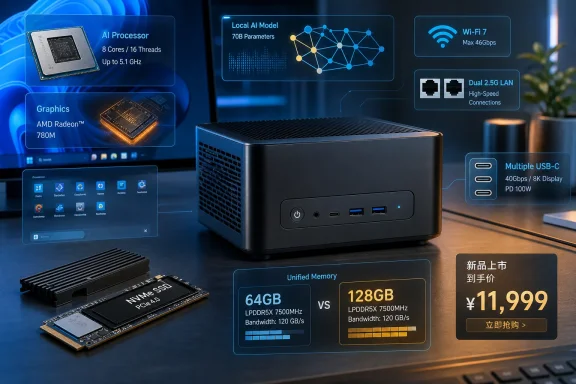 The price cut comes with a far larger memory compromise
Aoostar’s revised NEX395 drops from 128GB to 64GB of LPDDR5X-8533 memory while retaining the Ryzen AI Max+ 395. IT Home lists the original machine’s other essentials as unchanged: a 140W performance mode, Wi-Fi 7, dual 2.5GbE Ethernet, two 40Gbps USB-C ports, HDMI, DisplayPort, and three M.2 2280 PCIe 4.0 slots.
The unchanged processor means CPU performance and the Radeon 8060S’s basic gaming capability should remain in the same class as the earlier NEX395. AMD specifies the Ryzen AI Max+ 395 as a 16-core, 32-thread processor with 40 Radeon graphics compute units and a configurable power range up to 120W. Aoostar’s claimed 140W platform figure therefore describes the system’s power design rather than a guarantee that the APU itself runs above AMD’s published operating range.
For Windows gaming, 64GB remains a generous allocation. Few games need anything close to that amount, even allowing for the integrated GPU to reserve part of system memory. The loss is much more significant for the NEX395’s other audience: people who bought Strix Halo systems to run large language models, image-generation workloads, or GPU-heavy development tools locally.
AMD’s own guidance illustrates the divide. The company says a 64GB Ryzen AI Max+ system can expose up to 48GB as graphics memory and is suitable for models such as Gemma 3 27B in a 4-bit quantized format. But AMD positions the 128GB configuration differently, with up to 96GB of graphics memory and enough capacity for substantially larger local models, including some 128-billion-parameter workloads under suitable quantization and software conditions.
The NEX395 has therefore become a different kind of product at 64GB. It is still a high-end mini PC with unusually strong integrated graphics and substantial RAM by mainstream PC standards. It is no longer the comparatively compact 128GB local-AI workstation that the first configuration represented.
Storage is optional; memory capacity is the lasting choice
The headline “no storage” configuration risks obscuring which compromise buyers can undo. The NEX395 reportedly retains three M.2 2280 slots, so leaving out an SSD is a manageable setup task for an experienced Windows user. Install an NVMe drive, create Windows installation media, load the operating system, and the machine should be usable without depending on Aoostar’s bundled drive image.
The reduced memory deserves more scrutiny. Ryzen AI Max+ systems use unified LPDDR5X memory shared by the CPU and Radeon 8060S graphics rather than a discrete GPU with its own dedicated VRAM. This design is why Strix Halo can give an integrated GPU access to much more memory than a typical laptop iGPU, but it also means memory capacity is central to both graphics allocation and local AI model size.
Aoostar has not described the 64GB NEX395 as an upgradeable-memory model. Prospective buyers should assume the supplied memory capacity is the configuration they will live with unless Aoostar explicitly documents a supported upgrade path for the exact retail unit. The three SSD slots do not solve a workload that runs out of unified memory.
That makes the 1,000-yuan spread between storage-free and 1TB versions look modest beside the 64GB-to-128GB difference. An SSD can be replaced or expanded later; the platform’s memory ceiling determines which models can fit locally, how much context they can use, and how much RAM remains available to Windows after graphics memory is reserved.
The reported pricing needs more context than a dollar conversion
Notebookcheck converts 11,999 yuan to roughly $1,785 and 12,999 yuan to around $1,930. Those figures are useful exchange-rate snapshots, but they should not be read as expected U.S. retail prices. Chinese list prices can reflect domestic tax treatment, retailer promotions, regional subsidy programs, and different warranty arrangements. Importing a NEX395 would add shipping, duties, payment fees, and potentially complicated after-sales support.
The original-price comparison is also less clean than it first appears. Notebookcheck describes an earlier 128GB-and-2TB NEX395 price of around $2,100, while earlier Chinese coverage cited a 14,999-yuan promotional price for that configuration and other reports referenced a 19,999-yuan list price. Those are not necessarily contradictory: a launch promotion, a retailer price, and a full list price can all coexist. But they mean the claimed savings depend on which earlier number a buyer uses.
What can be stated plainly is that the new 64GB/1TB model is advertised at 12,999 yuan and the no-SSD configuration at 11,999 yuan. IT Home also noted a 13,599-yuan retail listing for the 64GB/1TB configuration, suggesting the advertised price may be promotional rather than a stable street price. No other outlet has reported how many units are available at the lower figures or how long they will remain available.
Aoostar has not publicly attributed the redesign to DRAM or SSD pricing. Notebookcheck suggested rising component costs as the likely reason, and that explanation is plausible given the scale of the memory reduction, but it remains an inference rather than a confirmed company statement. The company has not said whether supply constraints, demand, a planned product repositioning, or a combination of those factors drove the new configurations.
A mini PC for Windows power users, with a narrower buying case
For a Windows enthusiast who wants a compact gaming PC, a dual-2.5GbE workstation, or a machine with room for several fast NVMe drives, the revised NEX395 remains technically distinctive. The Ryzen AI Max+ 395 combines a full 16-core Zen 5 CPU with Radeon 8060S graphics in a system much smaller than a conventional desktop tower with a discrete graphics card. Dual 40Gbps USB-C ports and three internal M.2 slots also give it more expansion flexibility than many mini PCs.
For a local-AI buyer, however, this model should be evaluated as a 64GB machine first and a Ryzen AI Max+ 395 machine second. The processor’s large integrated GPU remains capable, but the memory pool is the constraint that decides whether a model runs at all, whether it must be more aggressively quantized, and whether Windows has enough headroom during inference.
The SSD-less NEX395 is sensible only for buyers who already have a compatible NVMe drive or have a specific storage layout in mind. Everyone else should price a quality 1TB or 2TB PCIe 4.0 SSD, a Windows license if needed, installation time, and the loss of any vendor-provided recovery image before treating 11,999 yuan as the final cost.
Aoostar’s new option lowers the advertised entry point for its flagship mini PC, but it does so by halving the resource that differentiated the original model. The storage-free NEX395 offers flexibility; the 64GB ceiling defines its limits.