
The supplied Tech Revolutionist report describes the card as a new launch published on August 23, but independent coverage from VideoCardz and IT Home places the product’s first public appearance on August 14. That timing discrepancy does not change the hardware, though it does suggest this is a regional press-release pickup rather than a fresh global retail launch. As of August 24, GIGABYTE has still not disclosed a U.S. price, U.S. store availability, or a specific on-sale date.
For PC builders, that leaves a simple conclusion: the ARI is a design-led RTX 5060 variant, not a new performance tier. Its value will depend entirely on how much GIGABYTE charges above the technically similar AORUS ELITE model—and whether the card is actually sold in the buyer’s region.
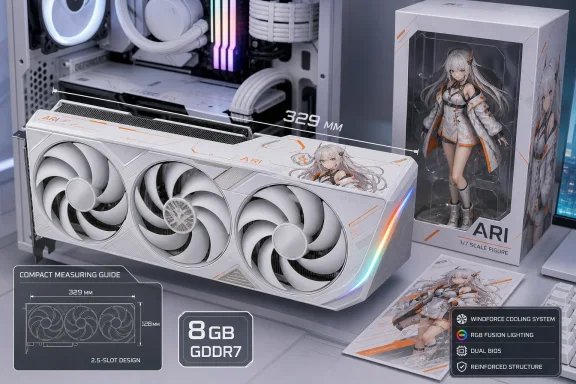 The ARI Card Carries ELITE-Class Hardware
VideoCardz identified the product as model GV-N5060AORUS ARI-8GD and compared it closely with GIGABYTE’s AORUS GeForce RTX 5060 ELITE 8G. The comparison is more than superficial. Both cards are reported with a 2,722 MHz boost clock, 8 GB of 28 Gbps GDDR7 memory on a 128-bit bus, three DisplayPort 2.1b outputs, one HDMI 2.1b port, PCIe 5.0 connectivity, and a single 8-pin PCIe power connector.
NVIDIA lists the standard GeForce RTX 5060 with 3,840 CUDA cores, 8 GB of GDDR7, a 128-bit memory interface, and a 2.50 GHz reference boost clock. The ARI’s 2,722 MHz specification is therefore a 225 MHz factory overclock, roughly 9 percent above NVIDIA’s nominal boost figure. That number should not be mistaken for a guaranteed 9 percent frame-rate increase: real-world gains vary by game, resolution, CPU limits, thermals, and power behavior.
GIGABYTE’s existing AORUS RTX 5060 ELITE 8G has the same 2,722 MHz listed clock and the same 329 × 128 × 40 mm dimensions. VideoCardz’ side-by-side visual comparison also found that the shroud and cooler layout are essentially the same, with the ARI replacing the darker ELITE styling with a white-and-gray finish, orange accents, side RGB illumination, and extensive character artwork on the metal backplate.
That makes the ARI a special-edition treatment of a known design rather than a card built around a redesigned PCB, higher memory capacity, different power delivery, or a higher-end RTX 5060 GPU bin. Builders choosing between the two should expect comparable performance before any driver, BIOS, or cooler-noise differences are independently tested.
The Cooler Claims Need Their Proper Context
GIGABYTE says the ARI uses its WINDFORCE cooling system, comprising three Hawk Fans, alternate fan rotation, a direct-contact copper plate, composite heat pipes, Screen Cooling, and thermal conductive gel applied to VRAM and MOSFETs. Those are credible, familiar components of a modern triple-fan board-partner cooler, especially for a GPU with the RTX 5060’s relatively modest power envelope.
The company’s more eye-catching numbers—up to 53.6 percent higher air pressure and 12.5 percent more air volume—are claims about its Hawk Fan design, not published temperatures or acoustics for this card against competing RTX 5060 models. GIGABYTE has not supplied independent thermal results, noise measurements, fan curves, or a stated board power figure for the ARI edition.
That omission matters more than the marketing percentages. A 329 mm, three-fan RTX 5060 should have ample physical cooling capacity, but whether it runs quietly depends on its BIOS tuning, fan-stop behavior, ambient temperature, case airflow, and the chosen Performance or Silent BIOS. GIGABYTE includes a Dual BIOS switch, so prospective owners will have two operating profiles, but the company has not published the clock, power, or acoustic tradeoffs between them.
The claimed structural improvements are also more practical than glamorous. GIGABYTE says the metal backplate is tied into the I/O bracket and reinforced with a bent-edge structure, while the PCB uses an aerospace-grade coating intended to resist dust, moisture, and corrosion. Those details may help with durability, but they do not replace basic case support: at 329 mm long, the ARI is not a compact two-fan card that can simply be assumed to fit every mid-tower build.
The 8 GB Question Has Not Changed
The ARI branding does not alter the fundamental RTX 5060 memory configuration. This remains an 8 GB GDDR7 graphics card on a 128-bit bus, with 448 GB/s of stated memory bandwidth in NVIDIA’s reference specifications.
For Windows PC gaming, that is broadly aligned with the RTX 5060’s intended role as a high-refresh 1080p card and an entry point into NVIDIA’s current Blackwell feature set, including DLSS 4 and Multi Frame Generation. It can also support creative applications that benefit from CUDA acceleration, newer NVENC and NVDEC media engines, and RTX-accelerated effects.
But the more demanding a buyer’s target becomes—native 1440p with high texture settings, heavily modded games, ray tracing without aggressive upscaling, or GPU-assisted creative workloads involving large assets—the less forgiving 8 GB becomes. A factory overclock and a premium cooler do not add VRAM. The ARI’s potential surcharge therefore deserves unusually close attention, because it could move the total cost closer to graphics cards with more memory or a more substantial performance advantage.
ComputerBase likewise reports that the ARI has 8 GB of GDDR7, the 2,722 MHz boost specification, the 329 mm length, and a recommended 550 W power supply. It also noted that comparable GIGABYTE RTX 5060 cards in Europe started around €320 at the time of publication, while warning that the themed design could command a premium. That is a useful price reference, but it is not a U.S. MSRP and should not be treated as one.
The Collectible Is Part of the Product Strategy
GIGABYTE ships an ARI doll in every box, randomly selected from one of five color variations. The company has already used this blind-box approach with its ARI-branded B850 motherboards, so the graphics card extends an established product line rather than launching a one-off mascot project.
For collectors, the included figure may be a legitimate reason to choose the ARI model. For buyers focused on frame rates, cooling, or Windows workstation performance, it is effectively bundled merchandise whose value should be separated from the card’s technical value. A higher retail price may be easier to justify to a collector, but it will not make the GPU faster than the similarly clocked AORUS ELITE.
There is another practical complication: GIGABYTE has not said whether all regions will receive the same doll bundle, whether all five variants will be distributed evenly, or whether the graphics card will reach North American retail at all. The August 14 reports establish that the product exists and has been announced; they do not establish a worldwide release schedule.
Buy on Price and Fit, Not the Backplate
The AORUS GeForce RTX 5060 ARI 8G is a legitimate new entry in GIGABYTE’s lineup, and it gives anime-themed PC builders an unusually cohesive way to match a graphics card with the company’s ARI motherboards. It also retains the useful basics expected of an AORUS RTX 5060: triple-fan cooling, a physical Dual BIOS switch, a conventional 8-pin power input, and four modern display outputs.
The missing information is the information that decides whether it is a sensible purchase: final regional price, retail date, warranty terms by market, and independent testing of noise and thermals. Until those arrive, buyers should treat the ARI as an AORUS RTX 5060 ELITE-class card with a different exterior and a collectible in the box—and make sure their case has room for its 329 mm length before paying a character-edition premium.