
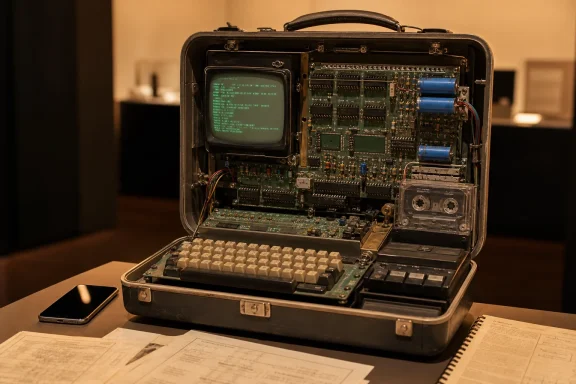
The lot, known as the “Neumark” Apple-1, is not merely an exposed circuit board placed behind glass. It is presented as an operational system housed in a modified Smith-Corona typewriter case, accompanied by period components and documentation. With bidding scheduled to close in August, the computer leads a broader sale of early Apple machines, development hardware, company records, and personal artifacts linked to Steve Jobs and his family.
For Windows enthusiasts, the auction is a reminder that the modern PC industry was not built by a single company or platform. The Apple-1 arrived during the formative years of the microcomputer revolution, before IBM-compatible PCs, before Windows, and before the polished, appliance-like devices that now define consumer technology. It represents a world where ownership of a computer often meant understanding its circuitry, adding its missing peripherals, and accepting that software, storage, and display hardware were separate challenges.
The estimated price may seem irrational when measured against contemporary hardware capability. A base iPhone 17 Pro starts at $1,099, and its computing, storage, graphics, connectivity, camera, and display capabilities leave a 1970s single-board system in another universe. But the Apple-1 is no longer valued as a practical computer. It is valued as a rare survivor from the moment personal computing became commercially real.
 A $300,000 Computer That Was Once a Bare Board
The Apple-1’s modern reputation can make it easy to forget what buyers originally received. Apple did not sell the machine as a finished desktop computer in the familiar sense. The product was essentially a fully assembled logic board, with customers responsible for sourcing and integrating much of the rest of the system.
A purchaser still needed several essential components:
- A power supply
- A keyboard
- A display or television connection
- A suitable case or enclosure
- Optional storage hardware, including cassette-based loading equipment
- The technical confidence to configure and use the machine
That distinction matters to the Neumark Apple-1’s appeal. Its modified Smith-Corona typewriter case is not an incidental decorative feature; it reflects the improvised, enthusiast-driven nature of personal computing in the mid-1970s. Before the Apple II, Commodore PET, TRS-80, and later IBM PC helped establish expectations for ready-to-use systems, a microcomputer could be a project as much as a product.
Apple’s first commercial machine originally sold for $666.66 with 4KB of RAM. The repeating-number price became part of Apple folklore, but the far more consequential detail was the machine’s degree of integration. Steve Wozniak’s design combined processing, memory, keyboard input support, and video output in a compact board. That reduced the amount of assembly required compared with earlier hobbyist systems, even if buyers still had considerable work ahead of them.
The Apple-1 was therefore an important bridge. It did not fully democratize computing in the way the Apple II, IBM PC, Macintosh, Windows PCs, and smartphones eventually would. But it helped establish the idea that an individual could own a personal computer that was more than a front-panel programming experiment.
The iPhone Comparison Is Close—but It Is Still a Shortcut
At Apple’s current U.S. starting price of $1,099 for the iPhone 17 Pro, $300,000 works out to just over 273 phones. The “275 iPhone 17 Pros” line is a reasonable rounded comparison, particularly because the Apple-1’s estimate is described as at least $300,000 rather than a final valuation.
A bidder should not mistake the estimate for the final cost, however. Estimates are not sale prices. Competitive bidding can push a notable Apple-1 far higher, especially when a machine has a compelling ownership history, a verified component set, original documentation, and demonstrated operational status.
The arithmetic is useful because it makes the scale accessible. Yet the comparison also exposes the difference between technology as a tool and technology as a collectible. A new iPhone is a mass-produced device designed to become obsolete over a relatively short ownership cycle. A surviving Apple-1 is a finite historical artifact, with value shaped by scarcity, provenance, originality, condition, and the mythology attached to Apple’s founding era.
Why the Neumark Apple-1 Stands Apart
The Neumark system’s strongest selling point is that it has reportedly been restored to working condition by Apple-1 specialist Corey Cohen. A functioning vintage computer is inherently more compelling than a static board because it can demonstrate the original design’s behavior: screen output, keyboard input, memory operation, and basic program execution.
That said, “working” should always be interpreted carefully in vintage-computing auctions. A system can be functional at the time of testing without being suitable for regular operation. Components more than four decades old may be electrically fragile, and powering them on repeatedly can create risks for irreplaceable chips, capacitors, connectors, and circuit traces.
The machine is also notable for its case. Apple-1 systems were frequently fitted into enclosures assembled by their owners, and those enclosures can range from basic wooden boxes to highly improvised custom solutions. The modified typewriter case gives this particular system a distinctive physical identity that separates it from an Apple-1 board displayed with generic peripherals.
Provenance Remains the Central Question
In collectible computing, provenance can be as valuable as technical originality. The Neumark Apple-1 has been associated with the Neumark family and with its use as a household computer after being acquired in 1977. Surviving correspondence, ownership history, and matching period peripherals all potentially strengthen the narrative around the lot.
There is, however, a meaningful detail that collectors should examine closely: public descriptions of this machine have not always aligned perfectly on its production-batch history. The auction reporting describes it as coming from Apple’s second batch of 50 machines, while registry information associated with the system identifies it as a first-batch board with a specific serial marking.
That discrepancy does not automatically undermine the computer’s authenticity. Early Apple production history is complicated, and terminology around batches, board revisions, distributors, and completed systems is often used inconsistently. Still, it reinforces an important rule for anyone considering a high-value vintage computer: read the catalog documentation, restoration records, component inventory, and provenance material in detail before treating an estimate as a verdict.
The most valuable Apple-1 sales are rarely driven by a single attribute. They typically combine several factors:
- Authentic Apple-era board production
- Documented ownership history
- Original processors, memory, and support chips
- Period-correct peripherals
- Original manuals or correspondence
- Functional demonstration
- A historically distinctive enclosure
- A credible restoration and authentication trail
The Neumark system appears designed to appeal across several of these categories. It has the technical object, the visual identity, the story, and the working demonstration that make an auction lot memorable.
Restoration: Essential Preservation or a Collectibility Risk?
Restoration is one of the most debated subjects in vintage computing. A restored system can be easier to understand, safer to demonstrate, and more useful for educational display. At the same time, restoration can reduce originality if it involves replacing visible components, reworking circuit traces, cleaning surfaces too aggressively, or introducing modern substitutes that obscure the system’s original state.
The June 2026 restoration of the Neumark Apple-1 increases its appeal as a functional object, but it should also put documentation under the spotlight. Serious collectors will want to know exactly what work was performed.
The Details That Matter in a Restoration Report
A strong restoration record should clarify:
- Which components were original when the system arrived
- Whether any chips, capacitors, sockets, connectors, or wiring were replaced
- How the board was cleaned and stabilized
- Whether repairs were reversible
- How operational testing was performed
- Whether modern equipment was used only for safe testing or incorporated permanently
- What was done to protect the system from electrical damage
For a machine of this age, a professional restoration is not necessarily a negative. In fact, preservation-minded work may be the only reason a rare computer remains demonstrable. The concern is not that restoration happened; the concern is whether it was transparent, technically sound, and respectful of the surviving original material.
A collector buying a $300,000-plus Apple-1 is not purchasing a device for daily BASIC programming sessions. The buyer is acquiring a physical record of early personal computing. The computer’s ability to boot is valuable, but so are the solder joints, parts markings, board traces, period accessories, and evidence of its life before it became an auction centerpiece.
The Apple-1’s Place in Personal Computing History
The Apple-1 is routinely described as Apple’s first product, but its importance deserves more nuance than that simple label suggests. It was not the first microcomputer. It was not the first computer kit. It was not even the first machine to invite hobbyists to imagine computing as a personal activity.
Its importance lies in execution.
Steve Wozniak’s design made practical choices that reduced complexity for the end user. The integrated video output was particularly significant. Many early systems expected users to communicate through lights, switches, teletypes, or add-on terminals. The Apple-1 offered a more direct pathway to a keyboard-and-screen experience, an approach that would soon become fundamental to personal computing.
The machine also demonstrates a tension at the heart of Apple history. It was accessible enough to sell through a computer retailer, but still technical enough that it demanded substantial knowledge from its owner. The Apple II would resolve much of that tension by offering a more polished, expandable, consumer-ready package. The Apple-1 remains valuable precisely because it preserves the rougher, more experimental stage before that transition.
Before the IBM PC and Windows
For a Windows-focused audience, the Apple-1 is part of the longer prehistory of the PC ecosystem rather than a direct ancestor of modern Windows hardware. Microsoft was founded in 1975, initially focused on software for emerging microcomputers. The IBM PC would not arrive until 1981, and Windows would not debut until 1985.
Yet the same forces visible in the Apple-1 era shaped the environment that allowed the Windows PC platform to dominate later:
- Falling microprocessor costs
- Rapid expansion of hobbyist and home computing
- Demand for practical software tools
- Development of affordable storage and display technology
- Standardization around keyboards, monitors, and expansion hardware
- Growing interest in computers as personal productivity devices
The Apple-1 reminds us that the industry’s earliest breakthroughs were often hardware-led. The software revolution that followed—operating systems, productivity applications, programming languages, games, networking tools, and graphical interfaces—required machines that individuals and small businesses could actually afford to own.
Beyond the Apple-1: A Sale Built Around Apple’s Formative Years
The auction’s wider catalog gives the Apple-1 additional context. Rather than presenting one famous board in isolation, the sale traces a line through Apple’s formative hardware eras and the personal artifacts surrounding Steve Jobs.
Among the most notable lots are:
- A factory-sealed 4GB first-generation iPhone, estimated around $50,000
- The P68 “Stealth iPod”, an oversized development enclosure used to conceal the original iPod’s eventual dimensions
- An early Apple II with a Rev. 0 logic board and no ventilation openings
- An Apple Lisa-1 with original Twiggy drives
- A Steve Jobs-signed Apple business card graded PSA GEM MT 10
- A 1976 Apple check signed by Jobs and payable to Elizabeth Holmes, identified as Apple’s first bookkeeper
- Steve Jobs’s eighth-grade science project on the silicon-controlled rectifier
- A Macintosh 512K and Apple II reportedly given by Jobs to his father
- Personal and household artifacts connected to the Jobs family’s Los Altos home
This mixture is revealing because it does not treat Apple history as a straight line from the Apple-1 to the iPhone. It shows a company moving through multiple technical ambitions, including the Apple II’s mass-market success, the Lisa’s costly graphical-computing experiment, the Macintosh’s redefinition of the consumer interface, the iPod’s transition into digital media, and the iPhone’s merger of computing and communications.
The Lisa’s Twiggy Drives Are a Particularly Important Detail
The Apple Lisa-1 is one of the sale’s more historically meaningful machines because it reflects a different kind of risk: the danger of a highly ambitious product reaching the market with storage technology that did not live up to expectations.
The original Lisa used 5.25-inch Twiggy floppy drives, a format that was ultimately problematic and short-lived. Apple later revised the Lisa platform around Sony’s more reliable 3.5-inch disk technology. A surviving Lisa-1 with its original Twiggy drives is therefore not just a rare Apple computer—it is a snapshot of a strategic misstep at a pivotal point in graphical-interface history.
For collectors, that makes it fascinating. For users, it was a warning that innovation without reliability can become a liability. The Lisa’s commercial struggles did not erase its technical influence, but they demonstrated that advanced ideas alone do not guarantee a successful product.
The same lesson still applies to modern Windows PCs, mobile devices, AI hardware, and software platforms. New technology succeeds when it balances ambition with reliability, compatibility, cost, and a clear reason for ordinary people to use it.
Steve Jobs Memorabilia and the Value of Personal Narrative
The sale’s Jobs family items extend the auction beyond machinery. A signed business card, a childhood science project, framed magazine covers, electronic components, and a stained-glass Apple logo from Jobs’s childhood bedroom may lack the technical importance of an Apple-1 or Lisa. They nevertheless carry a different kind of market power: intimacy.
Collectors frequently pay premiums for artifacts that connect a public figure to ordinary life. A personal computer can show what a company built; a school project can suggest where an interest began; a household object can make a corporate legend feel more human.
That emotional appeal has limits. Historical significance is not always proportional to auction value, and the market for celebrity-associated items can be volatile. A machine with clear technical provenance may remain desirable across generations because it represents a documented engineering milestone. A personal object’s value can depend more heavily on changing collector tastes and the perceived strength of its connection to a famous individual.
The Jobs-signed business card is a good illustration. Its value is supported by the rarity of Jobs signatures, the Apple association, and its high third-party grading. But a buyer is still purchasing collectible paper, not a piece of engineering history. The premium is attached to authorship and association rather than function.
What Bidders Should Watch Before the August Deadline
RR Auction’s bidding schedule requires an initial bid before 6 p.m. Eastern on August 20 for continued participation after the deadline. The sale then moves into extended bidding beginning at 7 p.m. Eastern, using a 30-minute extension rule designed to prevent last-second bid sniping.
That structure can produce volatile results. A lot that appears to be nearing its estimate can remain open well beyond the scheduled close if bidders continue placing qualifying offers. For a high-profile Apple-1, the final minutes may be the least useful indicator of the eventual outcome.
Auction Estimates Are Not Price Ceilings
The $300,000 figure is best understood as a threshold of expectation, not a cap. Apple-1 values have varied dramatically because each surviving system differs in completeness, condition, provenance, restoration status, and historical distinctiveness.
A rare early Apple artifact can exceed expectations when several bidders view it as irreplaceable. Conversely, an item with a compelling headline may underperform if bidders identify unanswered questions about documentation, parts originality, or condition.
The key risks for any potential buyer include:
- Treating a promotional estimate as an assured market value
- Failing to account for auction fees, shipping, insurance, and potential taxes
- Assuming a restored computer is suitable for frequent operation
- Overlooking inconsistencies in production history or provenance claims
- Confusing an unusual enclosure with an original Apple-supplied case
- Assuming rarity alone guarantees long-term appreciation
- Underestimating the cost of climate-controlled preservation and specialist support
For institutional buyers, the equation is broader. Museums, archives, and technology-history collections may view a functioning Apple-1 as an educational asset capable of demonstrating the early microcomputer experience. Private collectors may see it as an investment, a prestige object, or a centerpiece for a broader Apple collection. Those motivations can collide in the auction room, driving prices far beyond what a purely technical appraisal might suggest.
The Deeper Meaning Behind the Apple-1’s Price
The Apple-1 is not worth hundreds of thousands of dollars because it can outperform modern hardware. It cannot. A modern entry-level smartphone offers vastly greater computing power, storage, networking, graphics, battery technology, and software capability than the Apple-1’s original buyers could have imagined.
Its value comes from a different category of scarcity: historical scarcity.
Only a limited number of Apple-1 boards were made, far fewer survived, and fewer still can be credibly documented, assembled with period-correct components, and shown operating. Every surviving system also tells a slightly different story about the early home-computing market, from the buyer who first brought it home to the choices made to preserve, modify, repair, or restore it.
The Neumark Apple-1 is especially compelling because it retains the personality of a machine that was once used, housed, and adapted rather than simply stored away. Its typewriter-case enclosure looks strange beside today’s minimalist notebooks, all-in-one PCs, and phones. That oddity is not a weakness. It is evidence of an era when the boundaries of a personal computer had not yet been standardized.
The auction therefore offers more than expensive Apple memorabilia. It offers a concentrated history of personal technology: from hand-built logic boards and unreliable floppy drives to secretive product prototypes and the smartphone era. The $300,000 estimate may be framed in iPhone 17 Pro equivalents, but the Apple-1’s real value lies in showing just how far personal computing has traveled—and how much of that journey began with a board, a keyboard, a screen, and a willingness to build the rest yourself.
