
The publication’s July 28 roundup identifies AngelSense for younger children who need closer monitoring, Garmin Bounce 2 for elementary-school users, Apple Watch For Your Kids for families already invested in iPhone, and built-in phone location sharing for teens. That is a more practical framework than treating every Bluetooth tag as a safety device.
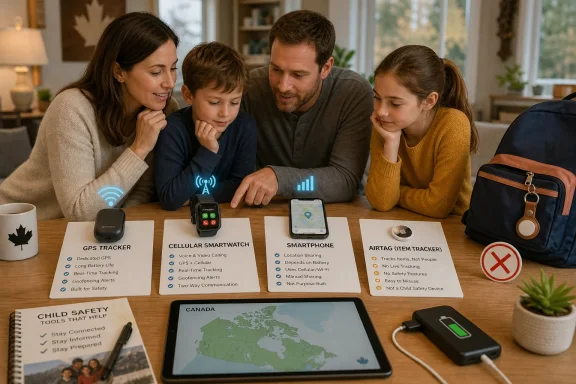 The network matters more than the device category
A dedicated GPS tracker such as AngelSense is the most specialized option. Its Canadian service runs on Rogers’ 4G network and requires a subscription, but it is built around frequent location updates and two-way voice features rather than apps, games or a miniature phone interface.
That makes it most relevant to families dealing with wandering risk or children who cannot reliably manage a watch. It also makes deployment more complicated: school, transportation and care providers may have rules governing attached devices and audio features, while the device’s usefulness remains dependent on coverage, battery state and where it is worn.
Today’s Parent correctly cautions that no location technology replaces supervision or an emergency plan. Indoor positioning can be imprecise, GPS can be delayed, and a cellular device cannot report a position when it has no usable connection.
Garmin Bounce 2 occupies the middle ground
For children who need a way to contact parents without receiving a full smartphone, Garmin Bounce 2 is a more constrained alternative. Garmin says the Canadian model uses LTE for parent-managed calling, messages and location features, with a separate subscription required for every watch; it does not require the household to change mobile providers.
The benefit is administrative as much as technical. Parents can limit communications to approved contacts, while the child gets a wearable that can place a call or send a message without opening the door to unrestricted app stores, social feeds and web browsing.
For Windows and Android households, that carrier independence is important. The Garmin Jr. app is the management plane, not an extension of an iPhone-only family setup. The trade-off is another recurring subscription and another device that must be charged, worn and maintained.
Apple Watch remains the polished option — with a Canadian carrier check
Apple Watch For Your Kids, previously known as Family Setup, lets a parent use an iPhone to configure a cellular Apple Watch for a child who does not own an iPhone. Apple currently lists Bell, Rogers, SaskTel and Telus as Canadian providers supporting the feature.
The watch receives its own number and service plan, enabling calls, messages and Find My location sharing away from the parent’s iPhone. Schooltime can restrict apps and notifications during class, making it a stronger communications device than a simple tracker without automatically becoming a smartphone.
But this is the most ecosystem-dependent route. It requires the parent to use an iPhone, a compatible GPS + Cellular Apple Watch, carrier support and a monthly plan. For a household centered on Windows PCs and Android phones, that dependency can outweigh Apple Watch’s polish.
AirTags belong on bags, not on children
Apple’s own guidance says AirTag and comparable Bluetooth tags should not be used to track people. They are designed to help recover personal items through nearby devices participating in a finding network, not to provide continuous, dedicated child location monitoring.
An AirTag in a backpack or lunch bag can be a sensible low-cost recovery tool. It is not a substitute for a GPS tracker because its updates depend on nearby participating devices, and it lacks live safety functions such as direct calling or a dedicated cellular connection.
Android families have more choices than they did a few years ago. Chipolo POP can work with either Apple Find My or Google Find Hub — one network at a time — and uses a replaceable CR2032 battery. Pebblebee Clip uses USB-C recharging and supports Google’s Find Hub, while Samsung SmartTag2 is most useful inside Samsung’s Galaxy and Samsung Find ecosystem.
For teens who already carry a phone, however, Apple Find My, Google location sharing or Samsung Find is usually the lower-friction answer. The remaining problem is not technical: a phone cannot share its location when it is uncharged, switched off or left behind.
The buying decision, then, is not about finding the most precise-looking pin on a map. It is about choosing the least intrusive device that gives a child a reliable way to reach a trusted adult — and making sure the family has a plan for the times when every networked gadget fails.