
That combination is the story. CarPlay Ultra finally delivers on Apple’s long-promised ambition to make its software feel native to the car rather than confined to a single rectangle in the middle of the dashboard. Yet its limited rollout also reveals why this approach remains controversial. The system creates a cleaner experience for iPhone owners, but it asks manufacturers to surrender meaningful control over the most valuable screens in their vehicles.
For Windows users and technology enthusiasts, the comparison is easy to understand. Traditional CarPlay was closer to an app running in a contained window. CarPlay Ultra is more like allowing an external platform to define the shell, navigation, and presentation layer across an entire desktop—while the underlying hardware, sensors, and core vehicle systems remain under the manufacturer’s control.
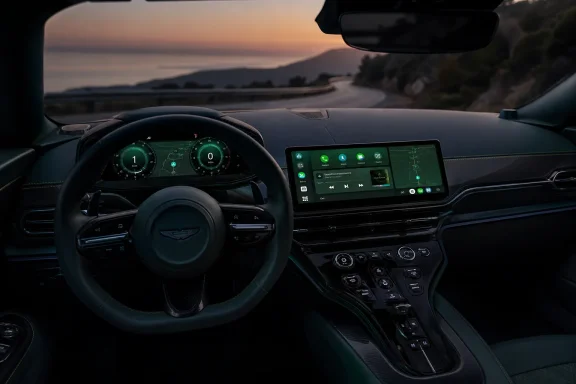
In the Aston Martin Vantage, that experiment works better than expected.
 From Phone Projection to a Shared Automotive Interface
The original Apple CarPlay model was straightforward. The iPhone handled the apps, data, and most of the processing, while the car supplied a display, microphone, speakers, physical controls, and an input mechanism. It was useful precisely because it avoided the weak points of many factory infotainment systems: clumsy menus, slow navigation, outdated maps, poor voice recognition, and inconsistent media interfaces.
But it also created an obvious divide.
A driver might use CarPlay for Apple Maps, messages, podcasts, and calls, then leave the CarPlay screen entirely to adjust the temperature, look at tyre pressures, change drive settings, or access the vehicle’s own radio controls. In vehicles with digital instrument clusters, the split could be even more conspicuous: a modern Apple interface on the center display, surrounded by native manufacturer graphics elsewhere.
CarPlay Ultra removes much of that seam.
Rather than treating the car as a passive display surface, the platform combines three different interface approaches:
- Mirrored iPhone content, including familiar CarPlay applications such as navigation, messaging, phone functions, and media.
- Local vehicle interface elements, which use information supplied directly by the car, including speed, fuel level, temperatures, warning data, and other driving metrics.
- Integrated manufacturer pages, where a carmaker’s own software can appear within the broader CarPlay Ultra environment when a specialized vehicle function requires it.
This architecture matters because it avoids a simplistic “Apple replaces the car” narrative. Apple does not become the vehicle’s engine-control system, safety controller, or diagnostic authority. The carmaker remains responsible for the underlying systems. What changes is the visual and interaction layer through which many of those systems are presented to the driver.
That is a subtler proposition than a full takeover, but it is still a significant one.
The Instrument Cluster Is the Defining Upgrade
The central screen is not where CarPlay Ultra becomes truly different. The major shift happens directly in front of the driver.
In the Aston Martin Vantage, CarPlay Ultra takes responsibility for the digital instrument cluster and offers multiple visual arrangements. The experience is designed around the steering-wheel controls, allowing the driver to move through layouts without reaching for the center touchscreen or disappearing into a stack of menus.
The available displays include:
- A more traditional twin-dial layout, styled with Aston Martin-specific color and visual cues.
- A modern Apple-like layout using bolder horizontal graphical elements.
- A navigation-led arrangement with a large map and smaller driving information positioned lower in the cluster.
- Configurable center-panel content for information such as media, trip details, maps, and tyre-pressure data.
The interaction is intentionally familiar to anyone accustomed to changing a watch face or cycling through dashboard display modes. Lateral inputs move among broad cluster layouts, while vertical inputs change the content shown in the central information area.
This is a smarter design decision than it may initially appear. Digital dashboards often fail because they offer too much flexibility without enough consistency. Drivers end up with a maze of widgets, menus, submenus, and partially customizable panels. CarPlay Ultra instead favors a smaller set of coherent, carefully designed arrangements.
That restraint has advantages.
The Vantage cluster does not become an endlessly configurable tablet screen. It remains a driving display first. Speed, revs, navigation cues, warning information, and critical vehicle data maintain clear hierarchy. Even in the map-heavy view, the essential driving information stays visible rather than being pushed aside by an oversized app interface.
Aston Martin Character Survives the Apple Treatment
The surprising part is that the Aston Martin Vantage does not look as though an iPhone has simply been pasted across the dashboard.
Apple provides the underlying framework, but the manufacturer can apply its own identity through color, typography choices, dial treatments, layout emphasis, and vehicle-specific graphics. In Aston Martin’s case, that includes visual references to the brand’s sporting heritage and a deep green presentation that feels appropriate for the Vantage rather than generic luxury-car software.
This is important because automotive interface design has become part of brand design. A Porsche dashboard, a Mercedes-Benz dashboard, a BMW dashboard, and an Aston Martin dashboard are expected to communicate different values even before the engine starts.
CarPlay Ultra gives Aston Martin enough room to preserve that distinction. The interface has Apple’s cleanliness and consistency, but it does not completely erase the personality of the vehicle around it.
That may be the strongest argument in favor of the platform. If a manufacturer can retain its own design language while gaining Apple’s software discipline, the result could be better than either company working alone.
Vehicle Controls No Longer Live Outside CarPlay
The most practical benefit of CarPlay Ultra is its treatment of vehicle functions.
With ordinary CarPlay, drivers regularly encounter the familiar handoff problem. A navigation route may be active in CarPlay, but climate adjustments require switching back to the vehicle interface. A podcast is playing through CarPlay, but radio controls, heated-seat settings, and certain driving information remain elsewhere. Each system has its own visual design, touch behavior, and hierarchy.
CarPlay Ultra is intended to make those transitions largely disappear.
In the Vantage, common car functions are available within the integrated Apple-style environment, including controls related to climate, audio, and driving information. The interface places those functions in a consistent visual system rather than requiring the driver to remember which screen owns which capability.
There are still multiple ways to perform an action:
- Use the CarPlay Ultra touchscreen interface.
- Use the car’s physical buttons and switches where they are available.
- Use Siri through the steering-wheel voice-control button.
That three-way approach is one of the platform’s more sensible choices. Touch controls are useful when parked or making occasional adjustments. Physical controls remain faster for certain tasks while driving. Voice control provides a third path when the driver wants to keep both hands on the wheel.
The best in-car interfaces are not those that insist on one input method. They are those that let drivers choose the least distracting method for the moment.
Siri Becomes More Relevant in the Cabin
Siri has long been part of conventional CarPlay, but its role becomes more meaningful when it can reach beyond messages and navigation.
With CarPlay Ultra, voice commands can cover a broader range of tasks, including supported vehicle functions such as climate changes as well as familiar requests involving calls, media, and directions. This is the promise of a better automotive voice assistant: not a novelty feature hidden behind a steering-wheel button, but a practical alternative to menu navigation.
The caveat is that voice control in a moving car still has limits. Road noise, accents, ambiguous commands, passenger conversation, and connectivity can all make voice interactions frustrating. A driver may also prefer the certainty of pressing a physical button for a simple temperature adjustment rather than phrasing a request aloud.
CarPlay Ultra does not eliminate those limitations. What it does is make Siri more logically connected to the environment in which it is being used.
The Hardware and Software Requirements Matter
CarPlay Ultra is not a universal upgrade for every vehicle that already supports Apple CarPlay. The expanded system requires more than an infotainment screen and a USB connection.
The vehicle needs:
- A compatible digital instrument cluster.
- The necessary infotainment and display hardware.
- Manufacturer support for CarPlay Ultra integration.
- The correct vehicle software configuration.
- A compatible iPhone connected through the supported wireless setup.
On the iPhone side, the requirement is an iPhone 12 or later running iOS 18.5 or newer. That is a notably higher threshold than standard CarPlay support, which can work with a much broader range of Apple hardware.
For Aston Martin owners, availability depends on the specific vehicle, model year, market, and infotainment configuration. The system is available across the brand’s current core range in supported markets, including the DBX, DB12, Vantage, and Vanquish. Some existing vehicles with Aston Martin’s newer infotainment platform can receive the capability through a dealer-installed software update rather than requiring an entirely new car.
That upgrade path is significant. Automotive technology has often been treated as fixed at delivery, leaving even recent cars with software that looks dated within a few years. The ability to add a major interface upgrade after purchase is a meaningful improvement, even if it remains limited to the latest compatible hardware.
Drivers also retain the option to use conventional CarPlay instead of Ultra. That flexibility is welcome. Some owners may prefer the familiar old arrangement, particularly if they want the vehicle’s native instrument displays to remain untouched or regularly share the car with Android users.
Why Aston Martin Became the First Mover
At first glance, Aston Martin may seem like an unusual launch partner for Apple’s most ambitious automotive software initiative. It is a low-volume luxury sports-car manufacturer, not a global mass-market giant with millions of vehicles on the road.
In practice, the pairing makes considerable sense.
Aston Martin has strong incentives to deliver an interface that feels contemporary, premium, and intuitive without having to fund the kind of enormous long-term software operation required to build every layer internally. Modern cars demand constant software maintenance, cybersecurity work, interface redesign, connected-service development, phone compatibility testing, and over-the-air update infrastructure.
That is a costly challenge for any manufacturer. It is particularly demanding for a specialist company whose identity is built around performance, craftsmanship, design, and exclusivity rather than an in-house consumer-software ecosystem.
Apple, meanwhile, benefits from a manufacturer willing to let the company demonstrate its vision in a real production vehicle. Aston Martin gains an interface that is immediately recognizable to iPhone users, while Apple gets a showcase installation in one of the world’s most aspirational performance brands.
The Vantage is a particularly effective demonstration vehicle because it makes the software feel emotional rather than purely functional. The car’s physical design, driving position, steering wheel, dashboard architecture, and instrument cluster already create a strong sense of occasion. CarPlay Ultra adds to that atmosphere rather than looking like a cost-saving tablet bolted onto the dash.
A Different Calculation for Larger Automakers
The same logic does not apply equally to every manufacturer.
For a company that has invested heavily in proprietary software, connected services, digital commerce, driver-assistance systems, navigation, subscription features, and a signature interface, handing over the primary dashboard presentation is a much more difficult strategic choice.
The digital cockpit is no longer merely a convenience feature. It is a key point of contact between the customer and the manufacturer. It is also a potential source of future revenue, data, customer loyalty, and service engagement.
That is why the debate around CarPlay Ultra is not really about whether Apple can make a prettier screen. It can. The issue is whether carmakers want Apple to become the organizing layer for their entire in-car experience.
The Slow Rollout Reveals the Industry’s Anxiety
CarPlay Ultra was announced as a major next step for automotive software, with a long list of interested brands associated with the broader concept. Yet its real-world rollout has remained narrow.
Aston Martin is still effectively the only manufacturer delivering the system in production vehicles at scale across a defined range. Hyundai, Kia, and Genesis have indicated future support, with the first non-Aston implementation expected in the second half of 2026. A new Hyundai model, potentially the IONIQ 3, has been widely viewed as the likely candidate for that next phase.
That would be an important expansion. The technology needs to reach a more attainable vehicle segment before it can be judged as a mainstream interface strategy rather than a luxury-car experiment.
At the same time, several prominent manufacturers have stepped away from the concept or stated that they do not plan to adopt it. BMW, Audi, Volvo, Polestar, Mercedes-Benz, and Renault are among the brands that have been associated with resistance to CarPlay Ultra’s deeper integration model.
That resistance is understandable.
The Dashboard Is a Strategic Asset
The manufacturer that controls the primary digital interface can decide:
- Which services are presented first.
- How navigation, charging, media, and driver-assistance information are displayed.
- How customer accounts and connected services are integrated.
- Which subscription features are promoted.
- How data flows between the vehicle, the driver, and external platforms.
- How Android and iPhone users are treated across the ownership experience.
A CarPlay Ultra vehicle remains usable without the iPhone present, but the Apple experience is naturally at its best when the appropriate phone is connected. This raises a reasonable concern for manufacturers: how much of the vehicle’s premium interface should depend on a customer’s choice of mobile ecosystem?
For an iPhone owner, CarPlay Ultra can feel like the ideal answer. For an Android user, a shared family vehicle, or a second-hand buyer who does not use Apple hardware, the equation is less clear.
Automakers therefore face a difficult balancing act. They need to meet customer demand for CarPlay and Android Auto while avoiding a situation in which their own systems feel like inferior fallback options.
The Advantages Are Clear
In the Aston Martin Vantage, CarPlay Ultra demonstrates why drivers may find the proposition compelling.
Better continuity
The largest benefit is the removal of interface fragmentation. Maps, media, messages, climate controls, driving data, and vehicle information are presented with greater visual consistency.
Stronger navigation integration
Navigation can become part of the instrument-cluster experience rather than remaining isolated on the central screen. This reduces the need to glance away from the road and makes route guidance feel more naturally embedded in the driving environment.
More familiar software
For iPhone owners, the visual language, interaction logic, contact handling, media controls, and voice assistant behavior are already familiar. That can shorten the learning curve dramatically.
Higher perceived quality
Apple’s strength is not necessarily that every design decision is revolutionary. It is that interactions tend to be cohesive. Buttons look related, menus behave predictably, and typography is usually readable. In a premium car, that polish matters.
Manufacturer-specific presentation
The Aston Martin execution shows that CarPlay Ultra does not have to erase brand identity. A well-designed implementation can preserve a carmaker’s visual character while benefiting from Apple’s framework.
The Risks Are Just as Real
The Vantage test also exposes the questions that will determine whether CarPlay Ultra becomes a major industry standard or a niche feature.
Platform dependency
A car has a far longer useful life than a phone. A vehicle may remain on the road for 10, 15, or 20 years, while mobile operating systems, device requirements, app ecosystems, and connectivity standards change constantly.
CarPlay Ultra depends on Apple continuing to support the platform, the relevant iPhone hardware, and the necessary compatibility layers. That is not inherently a problem—Apple has historically supported CarPlay broadly—but it remains an important ownership consideration.
Ecosystem imbalance
Apple’s system naturally serves Apple customers best. Manufacturers that fully embrace it must ensure that their own native interface remains strong enough for Android users and for drivers who simply do not want their car’s experience tied closely to a personal device.
Update complexity
A dashboard-wide interface is more consequential than a media app on the center display. Any update affecting cluster layouts, vehicle-control integration, display behavior, or voice-control capabilities must be rigorously tested.
The more deeply software reaches into the driving environment, the less tolerance there is for glitches, lag, confusing warnings, or inconsistent handoffs between systems.
Brand dilution
Aston Martin has shown that tasteful customization is possible. Not every manufacturer will achieve that result. There is a legitimate risk that widespread adoption could make different vehicle interiors feel increasingly similar, particularly if brands rely too heavily on Apple’s default visual language.
Data and customer ownership
Modern vehicle software is increasingly linked to data collection, digital services, maintenance, route planning, charging, payments, media, and personalization. Carmakers will remain cautious about any platform that changes who owns the primary customer relationship inside the car.
What CarPlay Ultra Means for the Future of In-Car Software
The Aston Martin Vantage proves that Apple CarPlay Ultra is not vaporware, nor is it merely an elaborate concept demo. It is real, polished, and capable of making a complicated cockpit feel simpler.
It also demonstrates that the future of automotive interfaces will not be decided solely by usability. If that were the only consideration, many drivers would quickly choose Apple’s integrated approach over a patchwork of manufacturer software. The strategic stakes are much larger.
Carmakers are trying to become software companies while preserving their distinct identities. Apple is trying to extend the iPhone ecosystem into one of the most important remaining screens in daily life. Google is pursuing a parallel strategy through Android Automotive and Android Auto. Drivers, meanwhile, mostly want the same thing they have wanted for years: reliable navigation, responsive controls, good voice assistance, clear displays, and fewer distractions.
CarPlay Ultra delivers much of that in the Vantage. The cluster integration is excellent, the controls feel coherent, the design looks appropriately premium, and Aston Martin’s own character remains visible beneath Apple’s software layer.
The platform’s real challenge is not whether it works. It plainly does.
The challenge is whether enough major manufacturers are willing to accept Apple as a central partner in the digital cockpit. For Aston Martin, the trade-off is favorable: it gains a sophisticated interface without needing to build an Apple-scale software platform from scratch. For larger automakers with extensive digital ambitions, the same arrangement may look less like collaboration and more like surrender.
That tension explains why CarPlay Ultra currently feels both impressive and unfinished as an industry story. In the Aston Martin Vantage, it may be the best in-car Apple experience yet. Outside a small group of compatible luxury cars, however, it remains a glimpse of a possible automotive future rather than the new default.
