
This is not merely a scoreboard update between two mega-cap technology companies. It is an early verdict—albeit a highly provisional one—on two radically different approaches to the AI era. Nvidia has become the crucial supplier to the data-center arms race, while Apple is trying to make artificial intelligence a feature of its devices and operating systems without adopting the same capital-intensive infrastructure model as the cloud hyperscalers.
For Windows users, PC builders, developers, and enterprise IT decision-makers, the Apple-Nvidia market-cap crossover has wider relevance. It highlights the central strategic tension now shaping the broader technology sector: whether the greatest long-term value will accrue to the companies building massive AI infrastructure, or to those that turn AI into dependable, private, and broadly distributed everyday computing experiences.
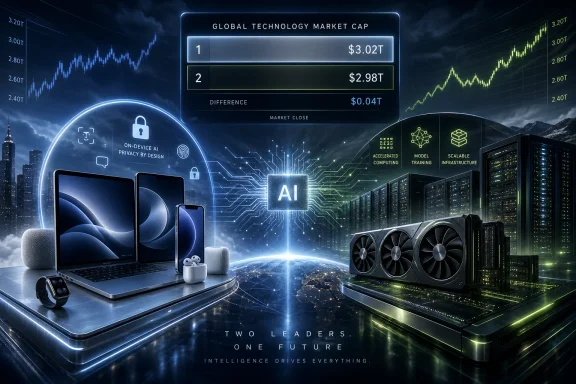 A new leader, but not a settled contest
Apple’s move back to the top was driven by a little more than a 1% gain in its shares, while Nvidia’s decline widened the separation. Apple shares reportedly closed at a record $336.91, and the company’s stock had risen more than 22% year to date by the time of the leadership change. NDTV Profit
The difference between the two valuations is enormous in absolute dollars but small relative to the scale of each company. At nearly $5 trillion, a single sharp trading day can move either Apple or Nvidia by sums that would make many Fortune 500 companies look small. That matters because the “world’s most valuable company” distinction is inherently fluid, especially when the top two firms are separated by only a few percentage points.
Apple’s advance also follows a period in which Nvidia had appeared nearly unassailable. Nvidia’s GPUs became a core building block for training and serving generative AI models, making the chip designer one of the largest beneficiaries of spending by Microsoft, Amazon, Alphabet, Meta, sovereign AI initiatives, and a growing universe of specialist infrastructure providers.
Yet markets do not price technological importance alone. They price expectations, risk, cash flow, margins, competition, and the probability that today’s spending will produce tomorrow’s durable revenue. Apple’s re-emergence at the top suggests investors have begun assigning greater value to financial discipline at precisely the moment that the bill for AI infrastructure is becoming impossible to ignore.
Market capitalization is not an AI benchmark
It would be a mistake to treat Apple’s market-cap lead as definitive proof that it has won the AI race. Market value is not a direct measure of model quality, GPU performance, cloud capacity, developer traction, or user satisfaction.
Instead, it reflects the market’s collective assessment of future earnings. In Apple’s case, that assessment rests on the company’s ability to keep monetizing a vast installed base of premium devices and services while layering AI capabilities into the products people already use. Nvidia’s valuation, meanwhile, reflects continued confidence that AI compute demand will remain extraordinarily high—but also growing questions about the economic sustainability of the infrastructure buildout.
The immediate lesson is more nuanced: AI investment discipline is becoming investable in its own right.
Apple’s capital-light AI thesis
For much of the generative AI boom, Apple was criticized for appearing less aggressive than rivals. Microsoft and Alphabet were visibly competing to put increasingly capable AI into consumer and enterprise software. Meta was spending aggressively on model development and data-center capacity. Amazon was scaling AI infrastructure through AWS.
Apple, by contrast, often seemed to be moving more cautiously. It had a clear AI story in machine learning and custom silicon, but its strategy was less centered on giant public models and hyperscale cloud infrastructure. In a market conditioned to reward conspicuous AI spending, restraint was often interpreted as hesitation.
That interpretation is now changing.
Reporting around Apple’s market-cap resurgence emphasized that the company’s capital expenditure has declined over the past three quarters, even while peers have committed escalating sums to data centers, AI chips, networking, energy, and supporting infrastructure. NDTV Profit The strategic appeal is straightforward: Apple may be able to offer meaningful AI features without accepting the same up-front capital burden as companies whose AI businesses depend on operating huge cloud platforms.
Apple’s own financial disclosures illustrate the contrast. In the six months ended March 28, 2026, Apple recorded $4.344 billion in payments for property, plant, and equipment, compared with $6.011 billion in the comparable prior-year period. Apple’s Q2 2026 Form 10-Q That single accounting line does not capture every AI-related cost—research and development, supplier commitments, and third-party services matter too—but it helps explain why investors see Apple as comparatively capital-light.
Capex avoidance is not the same as AI avoidance
Apple’s strategy should not be mistaken for opting out of artificial intelligence. Rather, the company is pursuing a different division of labor between hardware, software, and cloud services.
The core of the approach is on-device AI. Apple wants compatible iPhones, iPads, Macs, and other products to perform many intelligence tasks locally, taking advantage of Apple silicon and reducing the need to send every request to a remote data center. For more demanding workloads, Apple uses Private Cloud Compute, an architecture the company says extends its device-centric privacy model into server-side processing. Apple
That model has several potential advantages:
- Lower centralized infrastructure requirements than a cloud-first AI service.
- Better responsiveness for tasks that can run locally.
- Privacy differentiation, because certain data can remain on the user’s device.
- Tighter hardware-software integration, particularly across iPhone, iPad, and Mac.
- A clearer upgrade incentive for customers using older devices that lack the necessary neural-processing capabilities.
The formula is familiar to anyone who has followed Apple for decades. The company has repeatedly used vertical integration—not necessarily being first to a technology category—to make an experience feel more cohesive, manageable, and commercially significant.
For Windows ecosystem participants, the parallel is obvious. The most consequential AI contest may not be a single benchmark between cloud models. It may be the ability to turn AI acceleration, operating-system integration, developer tools, security, and user trust into a stable platform advantage across hundreds of millions of endpoints.
The infrastructure bill confronting Nvidia and the hyperscalers
Nvidia remains at the center of the AI economy. Its chips are not simply another component in a server; they are a major bottleneck in the creation and operation of modern AI systems. The company’s extraordinary valuation reflected the premise that AI demand would keep forcing cloud providers and enterprises to purchase more accelerated computing capacity.
That premise is still powerful. But the stock market is increasingly asking a more difficult follow-up question: how much spending is too much before returns become uncertain?
The scale involved is striking. Reporting based on first-quarter corporate guidance indicated that Google, Amazon, Microsoft, and Meta collectively planned about $725 billion in 2026 capital expenditure, up 77% from the previous year’s record level. Tom’s Hardware Those budgets are not all AI spending, but AI data centers, accelerators, memory, networking, land, power, and construction have become central drivers.
The spending is also self-reinforcing. Cloud providers buy Nvidia equipment to offer AI capacity. AI developers rent or reserve that capacity. The developers’ success encourages more infrastructure construction. Investors then expect the suppliers to grow quickly enough to justify expanded capital budgets.
That flywheel can produce enormous value. It can also become fragile if usage, pricing, or enterprise adoption fails to rise as quickly as infrastructure commitments.
Nvidia’s problem is the cost of success
Nvidia’s position is enviable, but it also makes the company highly exposed to every concern surrounding AI capital expenditure. If customers continue building at an aggressive pace, Nvidia benefits from strong accelerator demand. If customers slow down because of financing, power availability, utilization rates, margins, or uncertainty over AI monetization, Nvidia becomes one of the most visible ways for investors to express that concern.
The company’s nearly 5% share-price decline during Apple’s rise reflected this sensitivity. GeekSpin The point is not that Nvidia’s AI business suddenly became weak. Rather, expectations are now so elevated that even credible concerns over the economics of infrastructure can move the stock sharply.
There is also a broader investment distinction emerging between AI enablers and AI distributors:
- AI enablers sell chips, networking, cloud capacity, and infrastructure.
- AI distributors place capabilities into devices, productivity suites, operating systems, applications, and customer workflows.
- Some companies, notably Microsoft and Google, aim to occupy both categories.
- Apple’s strategy is weighted more toward distribution through hardware and platform integration than toward selling AI compute as a utility.
That segmentation is likely to shape how investors evaluate the largest technology companies over the next several years.
Siri AI is the practical test of Apple’s strategy
Apple’s restrained infrastructure approach only works if its AI features are genuinely useful. Investors may appreciate lower capex, but customers will not upgrade devices or deepen platform loyalty merely because Apple avoided building another giant data center.
At WWDC26 in June, Apple introduced Siri AI, describing a rebuilt assistant with more conversational interaction, personal context understanding, broader world knowledge, and onscreen awareness. Apple said the new capabilities would be available for developer testing immediately and reach users in beta later in the year. Apple
The proposed capabilities matter because they move beyond the limited, command-oriented voice assistant model that made Siri feel dated beside newer generative AI products. Apple’s stated examples include finding information in personal messages and email, surfacing relevant photos, working with app content, and handling requests that require a deeper understanding of what a user is doing on screen. Apple
Why local processing can become a competitive feature
The privacy element is particularly important to Apple’s value proposition. Apple says its system will use on-device processing where possible, while Private Cloud Compute handles requests that require larger server-side models. According to the company, personal data used through Private Cloud Compute is not stored or made accessible to Apple. Apple
That claim does not eliminate all user or enterprise security concerns. Any AI system that works across messages, mail, apps, files, and device context must earn trust through robust engineering, transparent controls, reliable permissions, and credible independent scrutiny.
Still, Apple’s model offers a potentially strong answer to a question that Windows and enterprise IT teams increasingly face: How much personal or corporate context should an AI system access, where does processing occur, and who can inspect the resulting data?
Apple’s approach is appealing because it treats local processing as both an efficiency measure and a product principle. If the company can make that principle tangible—faster responses, meaningful personalization, less unnecessary data transfer, and clear user controls—then AI could become a reason to choose Apple hardware rather than merely a feature checkbox.
The limitations are real
The strategy also carries risk. A highly distributed on-device approach is constrained by the performance, memory, battery life, and installed base of compatible hardware. The most capable frontier models still demand vast computing resources, and rivals with giant cloud footprints may be able to deploy more powerful capabilities faster.
There is also a rollout challenge. Apple confirmed that Siri AI on iOS 27 and iPadOS 27 will not initially be available in the European Union, citing unresolved Digital Markets Act issues, though Apple said the feature would be accessible in the EU on macOS 27 and visionOS 27. Apple For a company whose strength lies in offering consistent experiences across a global device ecosystem, regional feature gaps are significant.
A second concern is execution. Apple’s most ambitious Siri promises involve understanding personal context, working across applications, and reliably carrying out useful actions. Those are difficult problems. The risk is not simply that a model gives an imperfect answer; it is that a system with deep integration could misunderstand intent, retrieve irrelevant personal information, or fail to complete a task that users reasonably expect it to handle.
In other words, Apple’s AI challenge is not to demonstrate that it has an LLM. It is to demonstrate that AI can be dependable enough to become part of the operating system.
Apple’s valuation rests on more than AI
It is tempting to explain Apple’s return to the top solely through AI spending restraint, but that would oversimplify the company. Apple’s market capitalization is built on a combination of premium hardware, software integration, recurring services, global brand strength, developer economics, and an installed base that gives each new feature an unusually large distribution channel.
AI could reinforce all of those assets. A better Siri may make an iPhone more valuable. Better local AI performance may encourage upgrades to newer Apple silicon. Smarter experiences across Mac, iPad, AirPods, and wearables may make the ecosystem harder to leave. And AI-enhanced services could ultimately open new ways to deepen customer engagement.
But those benefits are prospective. The critical question for investors is whether Apple Intelligence will translate into measurable outcomes:
- More device upgrades, particularly for users whose current products cannot support advanced AI features.
- Higher retention, as cross-device intelligence makes Apple’s ecosystem more useful.
- Better service engagement, without degrading trust or user experience.
- Sustained operating margins, even as the company expands server-side AI capacity where required.
- A credible developer platform, so third-party apps can build useful intelligence experiences rather than merely add superficial chatbot features.
Apple’s next earnings report, scheduled after U.S. markets close on Thursday, will be closely watched for evidence on these points, particularly any guidance about AI deployment, costs, device demand, and margins. NDTV Profit
The leadership transition adds another layer
Apple’s reclaiming of the valuation crown arrives near the end of Tim Cook’s tenure as chief executive. Apple has announced that Cook will become executive chairman, while John Ternus, the company’s senior vice president of Hardware Engineering, will become CEO effective September 1, 2026. Apple
The timing is consequential. Cook’s leadership transformed Apple from a company often assessed mainly through iPhone cycles into a broader consumer technology platform with a vast installed base, a major services business, custom silicon, wearables, and a tightly integrated ecosystem.
Ternus inherits a company at extraordinary financial scale, but the AI era introduces a different kind of challenge. Apple must preserve the qualities that made it successful—product focus, privacy positioning, hardware-software integration, and financial discipline—while proving that it can move fast enough in a field where cloud competitors release new models and services at a relentless pace.
His hardware background may be particularly relevant. Apple’s AI strategy is inseparable from the performance and efficiency of its chips, the capabilities of its devices, and the company’s ability to persuade customers that newer hardware delivers a material improvement in day-to-day computing.
What the Apple-Nvidia crossover means for the technology industry
Apple’s rise above Nvidia should be read as a market signal, not an industry verdict. Nvidia remains deeply embedded in the AI infrastructure boom, and the demand for accelerated computing is unlikely to disappear because of one volatile trading session.
However, the crossover does reveal a significant change in investor attention. The market is no longer rewarding AI spending simply because it is large. It increasingly wants evidence that spending is economically rational, that it can be converted into revenue, and that the eventual benefits will not be consumed by ever-rising capital requirements.
Apple’s advantage is that it can present AI as an extension of an already successful computing platform. It does not need to become the world’s largest AI cloud operator to benefit from AI. It needs to make the iPhone, Mac, iPad, and its surrounding services more useful than competing products—and do so without sacrificing the margins and capital discipline investors prize.
That is a compelling thesis. It is also demanding. A low-capex AI strategy becomes a strength only if Apple’s software experiences are good enough that users perceive the difference. If Siri AI falls short, Apple could look cautious rather than efficient. If it succeeds, the company may demonstrate that the most valuable AI business is not necessarily the one that owns the most GPUs, but the one that makes intelligence feel native to the devices people trust and use every day.
Update: Nvidia retakes market-cap lead after Apple earnings (August 1, 2026)
CNN reports that Nvidia regained the title of the world’s most valuable public company after Apple’s latest earnings report, reversing the crossover described earlier. Apple shares fell more than 6% in after-hours trading following the results, allowing Nvidia to move back ahead in the rapidly changing valuation contest.
Apple still reported strong operating performance: iPhone revenue rose 22% year over year and total revenue increased 16%. However, the company warned that memory costs would rise further in the September quarter. Tim Cook described current memory pricing as a “100-year-flood,” after Apple had already increased prices for some Macs and iPads.
The development adds a new complication to Apple’s capital-light AI thesis. Avoiding hyperscale data-center spending may limit infrastructure exposure, but the AI boom is also driving component shortages that can raise costs for device makers. For Windows PC manufacturers and IT buyers, it is another indication that AI demand may affect hardware pricing well beyond GPUs and servers.
