
For Windows users with mixed-device homes, the practical point is not an imminent replacement for a PC or Xbox-based media setup. It is that Apple appears to be betting on Siri as the control plane for home automation, entertainment, cameras, and personal-context tasks—a strategy that increasingly resembles the wider push behind Microsoft Copilot, Google Home, and Amazon Alexa.
 The home hub is the missing screen
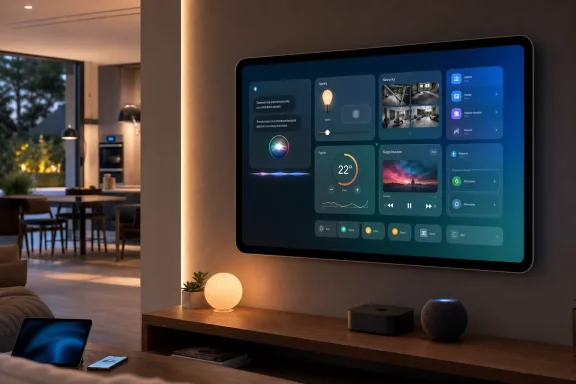
According to TechRepublic, Apple’s planned home hub would give Siri a persistent place in the home rather than leaving it distributed among iPhones, watches, speakers, and Apple TV boxes. A display-based device could make room controls, household status, video calling, camera feeds, and media controls more visible—and potentially more useful than voice-only interactions.
The report also positions the hub as an Apple Intelligence device. That matters because Apple has spent years with capable hardware but an uneven smart-home experience, particularly when Siri has to understand context, chain actions together, or work with third-party services.
A stronger Siri is the dependency. The new hardware will only feel like a serious platform if Siri can reliably distinguish between a simple command—turning off lights—and a more complicated request involving household members, schedules, cameras, and media.
Apple TV could become more than a streaming box
The reported Apple TV refresh is significant because Apple TV already occupies the living-room role that a home hub would need to complement. TechRepublic says Apple is preparing new Apple TV and HomePod mini products alongside the hub, suggesting Apple wants a coordinated product family rather than another isolated screen.
That could sharpen the contrast with Windows-centric households. Windows PCs remain excellent for configuration, content creation, game libraries, and broad device support, but they have not become a first-party ambient smart-home controller. Microsoft’s consumer smart-home ambitions have never coalesced into a dedicated Windows home platform.
Apple’s advantage is vertical integration: iPhone, Apple TV, HomePod, HomeKit, and its own assistant. Its weakness is the same one that has dogged many closed ecosystems—users expect smart-home gear to work across Android phones, Windows PCs, web dashboards, Matter controllers, and competing voice assistants.
The interoperability test is bigger than Siri
Apple’s renewed home push arrives in a market where compatibility matters more than brand loyalty. Matter has made cross-platform support a baseline expectation, while security cameras, thermostats, lighting systems, routers, and energy devices frequently depend on vendor apps and cloud accounts regardless of which hub sits in the room.
For IT-minded households, the important details will be local control, device permissions, camera-data handling, network segmentation, account recovery, and whether Apple permits meaningful administration from outside its own devices. A visually polished wall-mounted hub will not solve those problems by itself.
TechRepublic’s reporting makes clear that this is still a reported roadmap, not an Apple announcement. But if the hardware arrives with Siri that can finally execute complex household tasks consistently, Apple will be selling a new kind of home computer—one designed to disappear into the room rather than sit on a desk.
