
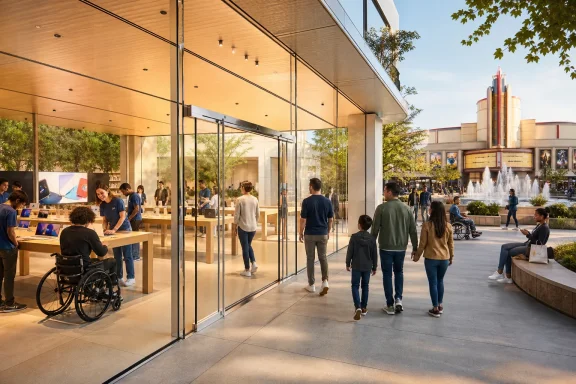
The new Apple Store sits near the fountain, across from the movie theater and Aplós, replacing the retailer’s previous mid-center location near Barnes & Noble. For local Apple customers, the practical impact is straightforward: the store has moved only a short distance, but the experience inside is intended to feel notably less constrained.
Apple closed the previous location for only one day before opening the upgraded space. That limited interruption matters for a store that serves not only product buyers, but also customers seeking device setup help, repairs, account assistance, trade-ins, accessories, and in-person technical support.
For Renaissance at Colony Park, the relocation also creates a significant domino effect. The former Apple Store is expected to become the home of a LEGO Store, bringing another high-profile retail brand to Ridgeland and reinforcing the development’s position as one of Mississippi’s most important destinations for premium shopping, dining, entertainment, and technology.
 A Larger Apple Store for Ridgeland
Apple’s new Renaissance at Colony Park store represents a relocation and expansion, not a departure from the market. That distinction is important. Rather than retreating from brick-and-mortar retail, Apple is investing in a more capable version of its existing local presence.
The original store had operated for nearly two decades, making it one of the more established Apple retail locations in the region. Over that period, the Apple Store evolved from a place primarily associated with buying Macs, iPods, and iPhones into a service hub for a much broader device ecosystem.
Today, a single customer visit may involve far more than a purchase. It can include setting up an iPhone, troubleshooting a MacBook, arranging a repair, learning how to use an Apple Watch, transferring data from an old Windows PC, or getting help with an Apple Account.
The larger showroom should help the store accommodate those overlapping needs more effectively. Apple’s retail design has increasingly favored open presentation areas, generous space around product tables, and flexible zones for consultations and learning sessions. Those choices are not merely aesthetic. They support a retail model in which customers are encouraged to spend time testing devices and receiving guidance rather than simply completing a transaction.
Why more space matters
A larger footprint can improve the everyday store experience in several practical ways:
- More product visibility for iPhone, iPad, Mac, Apple Watch, AirPods, and accessories
- Less congestion around demonstration tables during product launches or busy weekends
- Improved support flow for Genius-related appointments and device troubleshooting
- More comfortable family visits, especially when parents and children attend creative programs
- Better event potential for educational sessions and product demonstrations
- More accessible movement for wheelchair users and customers with mobility limitations
Apple has not positioned every store relocation as a radical reinvention, and that is appropriate. Sometimes the most meaningful upgrade is simply enough space to make an existing service work better. In Ridgeland, the move appears to be exactly that: a refinement of a successful location rather than a wholesale change in purpose.
Accessibility Moves From Detail to Design Principle
One of the most notable features of the relocated Apple Store is its emphasis on accessibility. The new space includes wider pathways between product tables, giving wheelchair users more room to move through the showroom comfortably.
That may sound like a modest architectural adjustment, but it reflects a larger shift in retail design. Crowded aisles are a common frustration in consumer electronics stores, where customers often gather around product displays, accessory walls, and service counters. When a store is busy, narrow circulation paths can become difficult not only for wheelchair users but also for parents with strollers, visitors using mobility aids, and customers who simply need a little more personal space.
The updated store also includes a touch-free wave-to-open entrance system. The feature reduces the need to physically handle a door and can make entering the store easier for customers with limited dexterity, those carrying bags or equipment, and people using wheelchairs or other mobility devices.
Accessibility is also a technology story
For Windows users and PC enthusiasts, accessibility features are often discussed in terms of software: screen readers, magnification, voice access, keyboard navigation, live captions, and assistive input tools. But physical accessibility is just as important.
A well-designed retail environment determines whether customers can independently access the products and services that support their digital lives. A seamless device ecosystem means little if a customer cannot comfortably enter the store, move around product displays, or speak with staff without navigating bottlenecks.
Apple’s changes in Ridgeland are therefore significant beyond the local floor plan. They underline a truth that all technology retailers should recognize: inclusive computing begins before a device is turned on.
There is also a business benefit. Accessible retail design can improve the experience for everyone, not only customers with permanent disabilities. A wider aisle is easier for a wheelchair user, but it is also easier for a parent holding a child’s hand, a shopper carrying a boxed laptop, or a staff member helping someone compare several products.
More Than a Place to Buy an iPhone
The Apple Store has long operated as a hybrid of retail shop, service center, classroom, product showroom, and community event space. The relocation at Renaissance at Colony Park reinforces that model.
Customers can visit to purchase hardware, but they also come in for personal setup assistance, repair support, software guidance, and help getting the most from the devices they already own. For many people, particularly those who are not comfortable handling technical problems alone, a physical Apple Store remains one of the few places where device support can feel approachable.
This is relevant even in an era dominated by online purchasing. Buying a laptop online is easy. Understanding whether a problem is caused by hardware, software, cloud syncing, a damaged cable, a forgotten password, or a complicated account setting is much harder.
The value of in-person technical support
The continuing importance of Apple retail is closely tied to support. A customer with a damaged iPhone screen, a Mac that will not boot, or an iPad that refuses to connect to Wi-Fi may prefer a direct conversation with a trained employee over a support article or phone call.
That in-person approach also matters for mixed-device households. Many homes use a combination of Windows PCs, iPhones, Android phones, iPads, game consoles, smart TVs, and wireless accessories. The practical challenge is often not choosing a platform; it is making everything work together.
For Windows users who own an iPhone or iPad, an Apple Store can be useful for issues involving:
- iPhone-to-PC photo transfers
- iCloud for Windows setup
- Apple Account recovery
- Device backup and migration questions
- AirPods pairing concerns
- Apple Music or Apple TV app use on Windows
- Hardware repairs and replacement options
- Trade-in evaluations before a device upgrade
Apple’s retail staff cannot replace a full Windows support desk, and customers should not expect Apple to troubleshoot every third-party PC issue. Still, the store can serve as a valuable support point when the Apple device itself is central to the problem.
Educational Sessions Keep the Store Connected to the Community
The new Ridgeland Apple Store is also expected to host educational seminars and Apple Camp programming. These sessions are a core part of Apple’s modern retail identity, designed to make the store feel less like a conventional electronics outlet and more like a place where people can learn practical creative skills.
Apple Camp is aimed at children ages six through ten and typically centers on guided activities using Apple hardware and creative software. Depending on the current program, participants may explore filmmaking, storytelling, photography, illustration, music, coding concepts, or other digital projects.
The format has particular appeal for families because it shifts the emphasis from passive screen time to structured creation. A child is not simply watching content on an iPad; they may be using it to assemble a short film, build a visual story, create sound effects, or collaborate on a project.
Why these sessions remain relevant
Technology education has become increasingly important as digital tools move deeper into classrooms, workplaces, and daily communication. But accessibility to hardware does not automatically produce confidence or creativity.
Programs such as Apple Camp can help introduce children to the idea that computers and tablets are not only consumption devices. They are also tools for making things.
That idea should resonate with the Windows community as well. Windows remains foundational to PC gaming, productivity, engineering, programming, content creation, and enterprise computing. Apple’s creative sessions occupy a different part of the technology landscape, but the underlying principle is shared: users get more value from devices when they learn how to create, customize, and solve problems.
The key caveat is availability. Apple Camp and other in-store sessions are typically scheduled in limited blocks, and specific programs may vary by location and season. Families interested in the Ridgeland store should check current event listings and registration options before making plans.
A Carefully Managed Move With Minimal Downtime
One of the more impressive details of the relocation is the limited disruption. The store closed on Thursday, July 23, then opened in its new location the following day.
For a major retail brand, a one-day interruption is a disciplined operational achievement. Moving a consumer technology store involves much more than transporting display units. It requires secure handling of high-value inventory, network setup, point-of-sale systems, device displays, fixtures, staffing coordination, accessibility checks, security systems, and the behind-the-scenes infrastructure that supports appointments and customer service.
Apple’s ability to complete the transition with a single closed day suggests that the relocation was carefully planned well in advance. The new store’s opening timing also allowed the company to retain continuity for customers who depend on local service.
Why downtime matters for repair customers
A temporary closure can be inconvenient for a shopper considering a new iPad. It can be much more disruptive for someone whose phone is damaged, whose laptop needs a repair assessment, or whose work device requires urgent support.
By limiting the closure to one day, Apple reduced the chance that local customers would need to travel farther for help or defer essential service. That is especially meaningful in a regional market, where the nearest alternative Apple Store may not be conveniently located.
The move also demonstrates why physical retail remains strategically valuable for technology companies. Online support can handle many tasks, but some problems still benefit from direct inspection, immediate replacement decisions, or hands-on assistance.
Renaissance at Colony Park Gains a Stronger Northern Anchor
The relocation changes more than Apple’s own storefront. It shifts a major technology brand toward the northern end of Renaissance at Colony Park, placing it near entertainment and dining destinations.
That positioning may increase foot traffic around the fountain, movie theater, and nearby restaurants. A customer coming to Apple for a repair appointment may browse shops, see a film, meet someone for lunch, or return later to pick up a device. Likewise, visitors arriving for dining or entertainment may discover the new Apple Store while already on the property.
This is a familiar strategy in successful lifestyle centers: place major traffic-driving tenants near complementary uses instead of isolating every retailer in its own zone.
Apple remains a high-visibility retail tenant
Apple Stores tend to create consistent foot traffic because their appeal stretches across several customer categories:
- Customers buying newly released hardware
- People seeking repair support
- Families attending events
- Shoppers browsing accessories
- Professionals comparing laptops and tablets
- Visitors receiving one-on-one setup guidance
- Existing device owners looking for help
That broad role makes Apple especially valuable in a mixed-use retail destination. It does not rely entirely on seasonal fashion demand or one-time specialty purchases. Its services create repeat reasons to visit.
For Renaissance at Colony Park, a larger Apple Store may therefore deliver value beyond its own sales floor. It can help strengthen the overall rhythm of the property, particularly around the north-end fountain and entertainment corridor.
The Former Apple Space Could Bring LEGO to Mississippi
The Apple Store’s move also opens the door for another major development: the former space is expected to become a LEGO Store.
That would be a meaningful addition for Ridgeland and for Mississippi retail. LEGO stores are more than toy shops. They are highly experiential destinations, often built around elaborate displays, hands-on activities, exclusive sets, build walls, themed merchandise, and a collector-focused shopping experience.
The contrast between Apple and LEGO is striking on the surface, but the two brands have more in common than it may first appear. Both depend on product discovery, strong visual merchandising, family appeal, passionate enthusiasts, and physical experiences that cannot be fully replicated by a basic online checkout page.
A potentially complementary transition
The shift from Apple to LEGO could create a useful continuity for the middle section of the development. Apple customers and LEGO shoppers may not be identical audiences, but both attract families, gift buyers, collectors, technology enthusiasts, and visitors looking for a destination rather than an errand.
A LEGO Store can also add a different kind of repeat traffic. New sets, limited releases, seasonal displays, and fan events encourage customers to return frequently. In that sense, the former Apple space may remain a powerful draw even after the technology retailer settles into its expanded northern storefront.
There is a potential risk, however. High-demand specialty stores must maintain enough inventory and staff capacity to manage event days, launch periods, and holiday crowds. If the location becomes a major regional draw, parking, pedestrian flow, and wait times may become more visible operational challenges for the center.
Those are manageable problems, but they are real considerations whenever a destination retailer arrives in a market that has not previously had one.
Apple’s Retail Strategy Still Prioritizes Physical Experience
Apple operates more than 250 retail stores in the United States and more than 500 worldwide. In an age when many retailers are shrinking their physical footprints, Apple continues to treat its stores as strategically important.
That does not mean every Apple Store is expanding. Retail decisions vary widely by market, lease terms, customer traffic, location quality, and the age of a particular store design. But the Ridgeland relocation fits a recognizable pattern: when Apple sees a better location or an opportunity for a larger, more modern space, it is willing to refresh an existing store rather than simply leave it unchanged.
The company’s stores serve several functions at once:
- They provide a premium product showroom.
- They offer face-to-face support and repairs.
- They build familiarity with Apple’s ecosystem.
- They host education and community programming.
- They create a visible local brand presence.
That combination helps explain why an Apple Store is rarely just another electronics retailer. It functions as a physical extension of Apple’s software, services, support network, and customer experience strategy.
The risks of the retail model
There are limitations to this approach. Apple Stores can become crowded, particularly during product launches, back-to-school periods, holidays, and peak repair seasons. A larger showroom can ease some of that pressure, but space alone does not guarantee shorter service times or easier appointment availability.
The high-touch retail model also creates customer expectations that may be difficult to meet during busy periods. Customers often arrive hoping for immediate help, only to find that repairs, account issues, or specialist consultations require appointments or waiting.
In addition, a polished store environment does not remove the complexity of modern device ownership. Cloud accounts, subscription services, security settings, backups, warranties, trade-in conditions, and cross-platform compatibility can still frustrate users. The expanded Ridgeland location may improve the setting for those conversations, but it cannot make every technical problem simple.
Still, the investment in a larger and more accessible store suggests Apple recognizes that the local retail experience must continue to evolve alongside the technology itself.
What the New Store Means for Local Customers
For customers in Ridgeland, Madison County, and the wider Jackson-area market, the Apple Store relocation is a practical upgrade rather than a disruptive change. The familiar store remains at Renaissance at Colony Park, but in a more prominent and spacious north-end location.
The immediate benefits are likely to be felt in the small moments that shape a retail visit: more room around display tables, easier access through the entrance, improved circulation during busy periods, and a larger setting for support and learning activities.
For families, the prospect of Apple Camp and creative programming adds another reason to visit. For professionals and students, the larger showroom may make it easier to compare Macs, iPads, accessories, and related services in person. For existing device owners, the streamlined move means local help remains close at hand.
The larger picture is equally important. Renaissance at Colony Park is not simply replacing one tenant with another. It is repositioning two highly recognizable brands in ways that could strengthen both ends of the property: Apple in an upgraded, accessible setting near the fountain and entertainment district, and LEGO in the former Apple space near Barnes & Noble.
Apple’s new Ridgeland store is therefore more than a refreshed address. It is a reminder that physical technology retail still has value when it combines product access, support, education, accessibility, and a reason for people to return.
