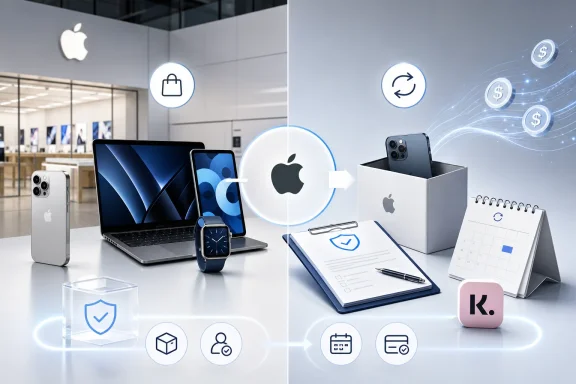
Apple has turned its long-running iPhone upgrade pitch into something much broader—and much more explicitly rental-like. Apple Upgrade, now available in the United States, lets eligible customers lease selected iPhones, iPads, Macs, and Apple Watches through monthly payments backed by Klarna, then return the hardware, purchase it, or roll into a newer model when the term ends. The program makes premium Apple hardware appear substantially more affordable at checkout, but the lower monthly figure comes with conditions that Windows PC buyers and Apple loyalists alike should examine closely. The Verge Engadget
The key distinction is simple: Apple Upgrade is a lease program, not conventional device financing. A buyer who finances a laptop or phone usually works toward owning it after the last payment. Under this new arrangement, the monthly payments buy the use of the device for a set period; ownership remains an optional, additional decision at the end.
That model is familiar in the automotive industry, but it is a meaningful shift for consumer electronics. Apple has always made hardware central to its business, yet the company increasingly packages that hardware around recurring payments, services, trade-in cycles, insurance, and ecosystem retention. Apple Upgrade extends that approach from the iPhone to much of the company’s premium product lineup. AppleInsider
The program replaces the established iPhone Upgrade Program for new customers. That earlier offering was a 24-month, 0% APR installment loan with AppleCare+ included and a defined annual upgrade path after enough payments were made. Apple’s published terms for that legacy program make clear that it was financing rather than leasing: participants took out a loan for the full retail price of the iPhone and AppleCare+ coverage. Apple’s iPhone Upgrade Program terms
Apple Upgrade changes several of those fundamentals:
Those options give Apple considerable flexibility in presenting low monthly prices. A 36-month Mac lease can make a costly notebook appear attainable, but it also keeps the customer in a payment arrangement for three years unless they decide to buy out, return, or upgrade under the program’s rules. AppleInsider 9to5Mac
Apple’s advertised entry pricing underscores that strategy. Reporting on the launch lists lease payments starting at $17.99 per month for the iPhone 17e, $11.99 for an Apple Watch Series 11, and $24.99 for a MacBook Air. iPad pricing depends on the specific device and term selected; published examples include entry points for both the iPad mini and iPad Air configurations. The Verge 9to5Mac
The exact payment changes with storage, display size, connectivity, model, and term. One example cited at launch puts a 256GB iPhone 17 at $32.99 monthly over 12 months or $22.99 over 24 months. The comparison is a useful reminder that a lower monthly payment is often the product of a longer obligation, rather than a lower total cost. Macworld
But a trade-in should not be confused with ownership equity. A customer using an existing device to reduce a lease payment is exchanging an asset they own for a lower cost of accessing another device that they may not own at lease maturity. That can still be a rational choice, particularly for users who prioritize predictable upgrades, but it is not economically equivalent to applying a trade-in toward a traditional purchase.
This is where terminology matters. A customer who makes every payment during a lease term has paid for the right to use the product over that period. They still must take an affirmative step—and potentially make a final payment—to own the device outright. That differs sharply from the psychological expectation many shoppers bring to a “monthly payment” transaction.
Macworld similarly reports that Apple gives customers a period after becoming eligible to make an end-of-term choice, but continued monthly payments remain due while they decide. That is a consumer-protection concern not because leasing is inherently unfair, but because inaction can be expensive in a product category where users often hold on to devices for years after the initial purchase impulse has passed. Macworld
Macworld’s assessment is even blunter: early termination requires payment of the remaining monthly obligations, apart from the standard initial return window. That means a shopper who leases a MacBook and then changes jobs, changes platforms, or simply decides the configuration was wrong could find themselves financially committed much like they would be under a conventional installment agreement. Macworld
Reported exclusions include:
The product selection reveals Apple’s commercial objective. Apple Upgrade is not positioned as an entry-level affordability program in the broadest sense. Instead, it appears designed to pull customers toward devices with higher retail prices—and potentially higher margins—by translating their cost into smaller recurring payments.
That may make sense for a customer considering a MacBook Air or iPhone Pro anyway. It is less compelling for someone who merely wants the lowest-cost functional Apple device. A Windows shopper comparing a budget laptop with a leased Mac should therefore avoid comparing only the monthly payment. The more relevant comparison is total outlay, ownership status, repair exposure, expected usable life, and resale value.
With Apple Upgrade, AppleCare+ is optional and costs extra. A customer can add it individually or use an eligible AppleCare One bundle, but it is not part of the quoted lease price by default. 9to5Mac
That matters because returned leased hardware must meet condition standards. Macworld reports that damage can trigger additional charges when the device is returned, much as a damaged leased vehicle can result in an end-of-contract bill. A buyer who opts out of AppleCare+ to preserve the lowest possible payment may be accepting more downside risk than the monthly price suggests. Macworld
For a phone, a protective case and screen protector are sensible basics. For a Mac, the risk is broader: display damage, liquid damage, cosmetic dents, and battery wear can all become consequential if the customer plans to return the machine rather than purchase it.
This does not mean AppleCare+ is automatically the best choice. Users should calculate the added monthly cost, their existing insurance coverage, likely repair needs, and the device’s final intended disposition. But it does mean the headline lease payment is not necessarily the all-in cost of participating safely.
Launch reporting states that a missed payment can be rolled into the following month without a late fee, but three consecutive missed payments may terminate the lease and leave the customer responsible for the outstanding balance. 9to5Mac
There was also understandable concern following reports that code in an iOS beta appeared to suggest a mechanism for restricting a financed device when payments fall behind. AppleInsider, however, reports that the launched Apple Upgrade program does not include a capability to disable or limit iPhone features for nonpayment. AppleInsider
That clarification is important, but it does not eliminate the wider practical risk. Consumers should assume that nonpayment can still lead to collections activity, loss of upgrade eligibility, contract termination, and a demand for the remaining financial obligation. Leasing a computing device can reduce the upfront barrier, but it does not remove the need to budget for the complete agreement.
A useful way to compare options is to ask four questions:
But the model can also obscure the fact that many modern computing devices are durable. An M-series Mac, a capable Windows ultrabook, or a current flagship phone can often remain productive long after its successor arrives. In such cases, ownership and resale may generate more value than recurring lease payments.
The strongest customer case for Apple Upgrade is therefore not “this is cheaper.” It is “this matches my expected replacement cycle and cash-flow needs.” Those are very different propositions.
Its risks are equally clear. The attractive monthly price does not include ownership, AppleCare+ is separate, damage and end-of-term obligations require careful attention, and early exit does not provide the freedom the word “upgrade” might imply. Customers who do nothing at lease maturity may face higher month-to-month costs and an eventual purchase charge. Macworld 9to5Mac
For consumers comparing Apple hardware with Windows PCs, the lesson is straightforward: compare the complete cost and the ownership outcome, not merely the monthly payment. Apple Upgrade may make a MacBook or iPhone easier to obtain today, but buying flexibility at checkout should not mean surrendering clarity about what the device will ultimately cost—or whether it will ever truly be yours.
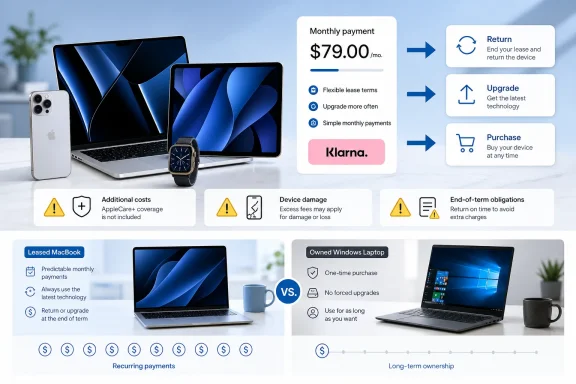 Overview: Apple Is Selling Access, Not Just Hardware
The key distinction is simple: Apple Upgrade is a lease program, not conventional device financing. A buyer who finances a laptop or phone usually works toward owning it after the last payment. Under this new arrangement, the monthly payments buy the use of the device for a set period; ownership remains an optional, additional decision at the end.That model is familiar in the automotive industry, but it is a meaningful shift for consumer electronics. Apple has always made hardware central to its business, yet the company increasingly packages that hardware around recurring payments, services, trade-in cycles, insurance, and ecosystem retention. Apple Upgrade extends that approach from the iPhone to much of the company’s premium product lineup. AppleInsider
The program replaces the established iPhone Upgrade Program for new customers. That earlier offering was a 24-month, 0% APR installment loan with AppleCare+ included and a defined annual upgrade path after enough payments were made. Apple’s published terms for that legacy program make clear that it was financing rather than leasing: participants took out a loan for the full retail price of the iPhone and AppleCare+ coverage. Apple’s iPhone Upgrade Program terms
Apple Upgrade changes several of those fundamentals:
- It covers iPhone, iPad, Mac, and Apple Watch models rather than iPhone alone.
- It uses Klarna for credit approvals and payment management.
- It offers lease terms that vary by product category.
- It does not bundle AppleCare+ into the base monthly payment.
- It gives customers an end-of-term choice to return, purchase, or upgrade—but does not automatically confer ownership.
How Apple Upgrade Works
Apple Upgrade is available online, through the Apple Store app, and in physical Apple Stores. Applicants undergo a soft credit check, which is designed not to affect a consumer’s credit score, before Klarna determines eligibility. Customers subsequently manage payment information and due dates through Klarna. 9to5MacLease terms differ by device
The available contract lengths are not uniform across Apple’s hardware portfolio:| Product category | Available lease terms |
|---|---|
| iPhone | 12 or 24 months |
| Apple Watch | 12 or 24 months |
| iPad | 24 or 36 months |
| Mac | 24 or 36 months |
Apple’s advertised entry pricing underscores that strategy. Reporting on the launch lists lease payments starting at $17.99 per month for the iPhone 17e, $11.99 for an Apple Watch Series 11, and $24.99 for a MacBook Air. iPad pricing depends on the specific device and term selected; published examples include entry points for both the iPad mini and iPad Air configurations. The Verge 9to5Mac
The exact payment changes with storage, display size, connectivity, model, and term. One example cited at launch puts a 256GB iPhone 17 at $32.99 monthly over 12 months or $22.99 over 24 months. The comparison is a useful reminder that a lower monthly payment is often the product of a longer obligation, rather than a lower total cost. Macworld
Trade-ins can lower the monthly bill
Apple permits trade-ins as part of the Apple Upgrade checkout flow, including eligible Apple devices and Android phones. The trade-in credit can reduce the lease payments, which may make the service more attractive to customers who already replace a phone, watch, or laptop regularly. 9to5MacBut a trade-in should not be confused with ownership equity. A customer using an existing device to reduce a lease payment is exchanging an asset they own for a lower cost of accessing another device that they may not own at lease maturity. That can still be a rational choice, particularly for users who prioritize predictable upgrades, but it is not economically equivalent to applying a trade-in toward a traditional purchase.
The Fine Print: What Happens at Lease End
The most consequential Apple Upgrade feature is the choice users face once their lease ends. They can do one of three things:- Return the device and leave the program.
- Upgrade by returning the current device and beginning another lease for a newer model.
- Buy the device by paying the purchase option amount.
This is where terminology matters. A customer who makes every payment during a lease term has paid for the right to use the product over that period. They still must take an affirmative step—and potentially make a final payment—to own the device outright. That differs sharply from the psychological expectation many shoppers bring to a “monthly payment” transaction.
Doing nothing is not a neutral choice
The end of the lease is not a moment to ignore emails or app notifications. Reporting on the launch indicates that, if the customer takes no action, the agreement can convert to a month-to-month lease for up to six months. Payments may increase during that period, and an eventual purchase amount can be charged if the customer remains inactive. 9to5MacMacworld similarly reports that Apple gives customers a period after becoming eligible to make an end-of-term choice, but continued monthly payments remain due while they decide. That is a consumer-protection concern not because leasing is inherently unfair, but because inaction can be expensive in a product category where users often hold on to devices for years after the initial purchase impulse has passed. Macworld
Early upgrades are possible—but not free
Apple Upgrade permits early upgrades or early exits, but customers should not mistake that option for a no-penalty annual-refresh benefit. Reports indicate that upgrading early generally requires paying the remaining scheduled lease payments. In practice, it is more financially favorable nearer to the end of the term than immediately after buying the product. AppleInsiderMacworld’s assessment is even blunter: early termination requires payment of the remaining monthly obligations, apart from the standard initial return window. That means a shopper who leases a MacBook and then changes jobs, changes platforms, or simply decides the configuration was wrong could find themselves financially committed much like they would be under a conventional installment agreement. Macworld
Eligible Products: Premium Hardware Takes Priority
Apple Upgrade is not a blanket leasing option for every item in Apple’s catalog. The program focuses on higher-end and mainstream premium devices, while leaving out several lower-cost products.Reported exclusions include:
- iPhone 16
- iPhone 16 Plus
- Apple Watch SE
- MacBook Neo
- Mac mini
- iPad (A16)
- Studio Display
The product selection reveals Apple’s commercial objective. Apple Upgrade is not positioned as an entry-level affordability program in the broadest sense. Instead, it appears designed to pull customers toward devices with higher retail prices—and potentially higher margins—by translating their cost into smaller recurring payments.
That may make sense for a customer considering a MacBook Air or iPhone Pro anyway. It is less compelling for someone who merely wants the lowest-cost functional Apple device. A Windows shopper comparing a budget laptop with a leased Mac should therefore avoid comparing only the monthly payment. The more relevant comparison is total outlay, ownership status, repair exposure, expected usable life, and resale value.
AppleCare+ Is No Longer Built In
One of the biggest differences between the retired iPhone Upgrade Program and Apple Upgrade is the treatment of device protection. The old program’s official terms required AppleCare+ coverage as part of a 24-month financed purchase. Apple’s iPhone Upgrade Program termsWith Apple Upgrade, AppleCare+ is optional and costs extra. A customer can add it individually or use an eligible AppleCare One bundle, but it is not part of the quoted lease price by default. 9to5Mac
That matters because returned leased hardware must meet condition standards. Macworld reports that damage can trigger additional charges when the device is returned, much as a damaged leased vehicle can result in an end-of-contract bill. A buyer who opts out of AppleCare+ to preserve the lowest possible payment may be accepting more downside risk than the monthly price suggests. Macworld
For a phone, a protective case and screen protector are sensible basics. For a Mac, the risk is broader: display damage, liquid damage, cosmetic dents, and battery wear can all become consequential if the customer plans to return the machine rather than purchase it.
This does not mean AppleCare+ is automatically the best choice. Users should calculate the added monthly cost, their existing insurance coverage, likely repair needs, and the device’s final intended disposition. But it does mean the headline lease payment is not necessarily the all-in cost of participating safely.
Missed Payments and Device Control Concerns
Payments are handled by Klarna, making this an Apple-branded retail experience with a third-party financial relationship beneath it. The arrangement brings the familiar benefits and risks of any credit-based acquisition: approval requirements, payment discipline, account management, and potential consequences for missed obligations. The VergeLaunch reporting states that a missed payment can be rolled into the following month without a late fee, but three consecutive missed payments may terminate the lease and leave the customer responsible for the outstanding balance. 9to5Mac
There was also understandable concern following reports that code in an iOS beta appeared to suggest a mechanism for restricting a financed device when payments fall behind. AppleInsider, however, reports that the launched Apple Upgrade program does not include a capability to disable or limit iPhone features for nonpayment. AppleInsider
That clarification is important, but it does not eliminate the wider practical risk. Consumers should assume that nonpayment can still lead to collections activity, loss of upgrade eligibility, contract termination, and a demand for the remaining financial obligation. Leasing a computing device can reduce the upfront barrier, but it does not remove the need to budget for the complete agreement.
What Apple Upgrade Means for Windows PC Buyers
For WindowsForum readers, Apple’s strategy is notable less because it changes Windows directly and more because it raises the competitive bar for how premium computers are marketed. Apple can now place a high-priced MacBook next to an apparently modest monthly payment, potentially changing the way consumers compare it with a Windows laptop.The monthly-payment comparison can be misleading
A Windows laptop purchased outright gives the owner the ability to sell it, repair it independently where practical, keep it for as long as it remains useful, or repurpose it without a lease deadline. A leased MacBook can offer a polished and predictable upgrade route, but its customer must continually account for return condition, end-of-term instructions, and whether buying it out makes more sense than returning it.A useful way to compare options is to ask four questions:
- How much will I pay before I own anything?
- What will it cost to own the device at the end?
- What happens if I need to stop paying or switch platforms early?
- Could I buy a comparable Windows PC outright, finance it at 0%, or purchase a refurbished model for less?
Apple is monetizing upgrade cadence
The program may be especially effective for users who value having the newest model more than retaining an aging device. Apple gets more predictable repeat business; Klarna handles the credit relationship; and customers receive a simpler upgrade narrative than selling a used device privately or negotiating a trade-in.But the model can also obscure the fact that many modern computing devices are durable. An M-series Mac, a capable Windows ultrabook, or a current flagship phone can often remain productive long after its successor arrives. In such cases, ownership and resale may generate more value than recurring lease payments.
The strongest customer case for Apple Upgrade is therefore not “this is cheaper.” It is “this matches my expected replacement cycle and cash-flow needs.” Those are very different propositions.
Who Should Consider Apple Upgrade—and Who Should Not
Apple Upgrade is not automatically a bad deal. It is a specialized tool, and its suitability depends on the customer’s habits.It may be a sensible fit for:
- Customers who consistently want the latest iPhone, Apple Watch, iPad, or Mac.
- Professionals who need predictable monthly expenses and refresh hardware on a fixed timetable.
- Buyers who cannot or do not wish to make a large upfront purchase.
- Users who understand they are leasing and intend to return or upgrade on schedule.
- Customers with reliable income, strong payment discipline, and a clear plan for AppleCare+ or repair risk.
It is a weaker fit for:
- Buyers who typically keep devices for many years.
- Students or households seeking the lowest total cost of ownership.
- Shoppers who might need to exit the agreement early.
- Anyone likely to overlook lease-end notices and decisions.
- Consumers who prefer buying discounted hardware from retailers rather than paying list-price-based buyout amounts.
- Buyers considering excluded entry-level products, where a straightforward purchase may remain the simpler proposition.
The Bottom Line
Apple Upgrade is a major expansion of Apple’s device-upgrade strategy, not a straightforward replacement for buying a phone or laptop. Its strengths are real: lower upfront costs, a broad range of covered Apple hardware, soft-credit-check eligibility, trade-in support, and a clean path to regular refreshes. For the right user, especially one who already treats premium devices as short-cycle tools rather than long-term possessions, the program can provide useful flexibility.Its risks are equally clear. The attractive monthly price does not include ownership, AppleCare+ is separate, damage and end-of-term obligations require careful attention, and early exit does not provide the freedom the word “upgrade” might imply. Customers who do nothing at lease maturity may face higher month-to-month costs and an eventual purchase charge. Macworld 9to5Mac
For consumers comparing Apple hardware with Windows PCs, the lesson is straightforward: compare the complete cost and the ownership outcome, not merely the monthly payment. Apple Upgrade may make a MacBook or iPhone easier to obtain today, but buying flexibility at checkout should not mean surrendering clarity about what the device will ultimately cost—or whether it will ever truly be yours.
References
- Primary source: The Verge
Published: 2026-07-28T12:23:50+00:00
Apple launches ‘Upgrade’ program to lease new devices | The Verge
Apple has introduced “Apple Upgrade,” a new leasing program aiming to make it easier to get your hands on the latest iPhone, Mac, iPad, and Apple Watch models.www.theverge.com
- Independent coverage: Macworld
Published: 2026-07-28T14:09:47+00:00
Apple's new Upgrade program is here. Just be sure to read the fine print | Macworld
It's leasing, not financing, so you'll need to pay more to keep your device or upgrade early.www.macworld.com - Independent coverage: PCMag
Published: 2026-07-28T14:39:13+00:00
New Apple Upgrade Program Lets You Lease an iPhone, Mac, iPad, Apple Watch | PCMag
Apple is rolling out this 'Buy Now, Pay Later' program in partnership with Klarna.www.pcmag.com - Independent coverage: gsmarena.com
Published: 2026-07-28T13:51:02+00:00
New Apple Upgrade leasing program is live for iPhones, Apple Watches, iPads, and Macs - GSMArena.com news
Here's how much you'll have to pay. Last week a rumor claimed Apple would be replacing the iPhone Upgrade program with a new one called Apple Upgrade. This...www.gsmarena.com
- Independent coverage: Engadget
Published: 2026-07-28T12:44:16+00:00
Apple Upgrade Is A Subscription Program For The Company's Devices
Apple's new program gives you lease options for iPhone, iPad, Apple Watch and Mac.www.engadget.com - Independent coverage: AppleInsider
Published: 2026-07-28T12:20:00+00:00
Apple Upgrade goes live as a new installment plan for iPhone, iPad, Mac, & Apple Watch | AppleInsider
Apple's new financing plan, Apple Upgrade, has launched, with consumers able to make a monthly lease payment for a higher-end iPhone, iPad, Mac, or Apple Watch.appleinsider.com