
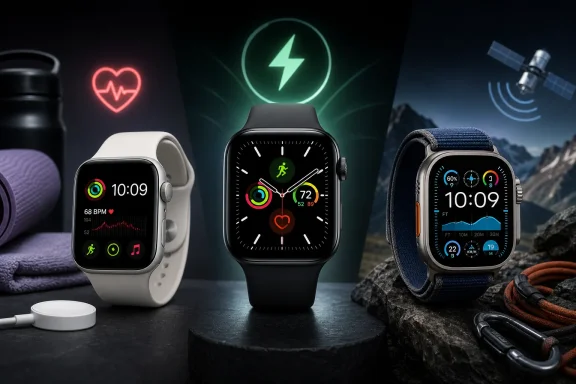
 Overview: Apple’s Three-Watch Strategy Is Easier to Understand Than It Looks
Apple’s 2026 Apple Watch lineup contains three fundamentally different products rather than three barely differentiated upgrades. That is good news for buyers, because the decision can be made around practical priorities instead of a long list of overlapping specifications.
The core choices are straightforward:
- Apple Watch Series 11: the best all-around Apple Watch for health tracking, everyday wear, workouts, messaging, and iPhone integration.
- Apple Watch SE 3: the best budget Apple Watch and the best first Apple Watch for children, casual users, and buyers who want modern essentials without premium sensors.
- Apple Watch Ultra 3: the best Apple Watch for outdoor sports, long training sessions, diving, rugged use, and off-grid emergency communication.
All three run the current Apple Watch software platform, support the same broad ecosystem of apps and Apple services, and use the S10 system-in-package. They also share important fundamentals including safety features, activity tracking, sleep tracking, Apple Pay, on-device Siri capabilities, and optional cellular connectivity.
That shared foundation matters. The cheapest new Apple Watch no longer feels like a severely compromised version of the flagship. At the same time, the Series 11 and Ultra 3 still justify their higher prices through better displays, extra health hardware, durability, battery capacity, and specialist features.
Best Apple Watch Overall: Apple Watch Series 11
The Apple Watch Series 11 is the Goldilocks model in Apple’s current lineup. It is slim enough for daily use, polished enough for work and formal settings, capable enough for demanding fitness tracking, and equipped with the health features that distinguish Apple’s premium watches from the SE line.
Starting at $399 in the United States, the Series 11 costs significantly more than the SE 3 but remains dramatically more approachable than the Ultra 3. For buyers who plan to keep their smartwatch for several years, that price difference often makes sense.
Why the Series 11 Is the Best Choice for Most iPhone Users
The Series 11’s greatest advantage is balance. It has the health tools and screen quality that many people want, but without the size, weight, styling commitment, or premium price of the Ultra.
Key Series 11 advantages include:
- 42mm and 46mm case options
- Up to 24 hours of rated battery life
- Fast charging, including enough power for overnight sleep tracking after a short charge
- ECG support
- Hypertension notifications
- Blood Oxygen support, subject to regional availability and software conditions
- Sleep apnea notifications
- Wrist temperature sensing
- Depth gauge and water temperature sensor
- Always-on display with wide-angle OLED technology
- Up to 2,000 nits of peak brightness
- 5G cellular support on cellular models
- Aluminum and titanium case choices
The 24-hour battery claim is more meaningful than it first appears. Earlier Apple Watch generations often required a careful daily charging ritual, especially for people who wanted both daytime activity tracking and nighttime sleep data. The Series 11 is better positioned for a routine where the watch remains on the wrist most of the time and receives short top-up charges while showering, getting ready, or working at a desk.
Fast charging is equally important. Apple rates the Series 11 for up to eight hours of normal use from a 15-minute charge, while a five-minute charge can provide enough energy for a night of sleep tracking. Real-world results will vary based on cellular use, workouts, screen brightness, notifications, and battery health, but the shorter charging interruptions make the device much easier to live with.
A Better Screen Without the Ultra’s Bulk
The Series 11 display is one of its most practical upgrades. The 42mm model has a 374-by-446-pixel resolution, while the 46mm model reaches 416 by 496 pixels. Both use an always-on Retina display based on LTPO3 and wide-angle OLED technology.
The wide-angle display is not merely a specification-sheet improvement. It makes the screen easier to read at a quick glance, especially when checking a workout pace, navigation direction, timer, notification, or complication without lifting the wrist directly toward the face.
Apple also claims that the aluminum Series 11 has front glass with twice the scratch resistance of the previous aluminum generation. The titanium version uses a sapphire front crystal, offering another step up for buyers who are especially concerned about cosmetic wear.
Health Features Are the Main Reason to Skip the SE 3
The Series 11 has the most complete health package outside of the Ultra 3. It includes an electrical heart sensor for the ECG app, a third-generation optical heart sensor, temperature sensing, sleep metrics, irregular rhythm notifications, and hypertension notifications.
The hypertension feature deserves careful interpretation. It does not turn the Apple Watch into a blood-pressure cuff, and it does not produce a conventional blood-pressure reading on demand. Instead, it analyzes optical heart-sensor data over time to identify patterns that may be associated with hypertension.
That distinction is crucial. The feature is intended to flag a possible concern, not diagnose high blood pressure, monitor treatment, or replace a clinician’s assessment. A notification should prompt follow-up with validated blood-pressure measurements and a healthcare professional, while the absence of a notification should never be treated as proof that blood pressure is normal.
For users who value proactive health alerts but understand their limitations, the Series 11 offers the strongest blend of preventive wellness tools and practical smartwatch convenience.
Who Should Buy the Apple Watch Series 11
The Series 11 is the right choice for:
- Owners of an iPhone who want the best everyday Apple Watch
- Buyers upgrading from a Series 7 or older model
- Users who want an ECG and hypertension notifications
- People who wear a watch for workouts, work, sleep, and social events
- Buyers who want a larger display without moving to a 49mm rugged watch
- Anyone who wants better battery flexibility but does not need expedition-level endurance
It is also the most versatile Apple Watch for people who want to customize their device. Aluminum models offer the most accessible starting prices, while titanium versions deliver a more premium finish and sapphire crystal protection. Apple’s interchangeable band system also remains a major strength, although buyers should remember that premium bands can add a surprising amount to the final purchase price.
Best Value Apple Watch: Apple Watch SE 3
The Apple Watch SE 3 is the strongest value in the lineup. Starting at $249, it brings Apple’s latest processor, an always-on display, fast charging, sleep features, temperature sensing, and optional 5G cellular connectivity to a price tier that once involved much heavier compromises.
For many buyers, the SE 3 is not simply the cheaper Apple Watch. It is the sensible Apple Watch.
The SE 3 Delivers the Features Most People Actually Use
The Apple Watch SE 3 uses the same S10 chip found in the Series 11 and Ultra 3. That does not mean every feature is identical, because the watches have different sensors and display hardware. But it does mean the entry-level model has the processing headroom for current software features, responsive day-to-day navigation, on-device Siri functions, and modern gesture controls.
The SE 3 adds several welcome upgrades over its predecessor:
- Always-on Retina display
- Fast charging
- S10 processor
- 64GB of storage
- Wrist temperature sensing
- Sleep score
- Sleep apnea notifications
- Retrospective ovulation estimates
- 5G cellular capability on cellular versions
- Four-times greater crack resistance than the prior SE generation
- Double Tap and wrist flick gestures
- Speaker media playback
The always-on display is especially significant. It allows the SE 3 to behave more like a conventional watch, keeping the time and selected information visible without requiring a wrist raise or screen tap. That feature used to be a major reason to pay extra for a Series model.
Where the SE 3 Makes Its Compromises
The SE 3 remains a value model because Apple has retained some meaningful omissions. Its optical heart sensor is a second-generation design rather than the third-generation sensor found in the Series 11 and Ultra 3. It also lacks the electrical heart sensor needed for ECG functionality.
Most notably, the SE 3 does not support:
- ECG readings
- Hypertension notifications
- Blood Oxygen measurements
- Depth gauge
- Water temperature sensing
- The larger, brighter displays offered by Series 11 and Ultra 3
- The premium titanium construction of higher-end models
Its screen peaks at 1,000 nits, compared with 2,000 nits on the Series 11 and up to 3,000 nits on the Ultra 3. Indoors, that gap is unlikely to bother most people. In direct sunlight, especially during cycling, running, skiing, or navigation, the flagship models offer a clearer view.
Battery life is also less generous. The SE 3 is rated for up to 18 hours of normal use and up to 32 hours in Low Power Mode. That should still cover a typical day and often a night of sleep tracking with sensible charging habits, but it offers less margin for users who run long GPS workouts, stream audio over cellular, or regularly forget their charging cable.
Why It Is the Best Apple Watch for Kids
The SE 3 is particularly compelling for Apple’s family-oriented watch setup. With cellular service, a parent can set up the device for a child through their own iPhone, allowing calling, messaging, location sharing, activity tracking, and emergency communication without requiring the child to own an iPhone.
That makes the Apple Watch SE 3 the best Apple Watch for kids for several reasons:
- Its price is much easier to justify than a Series 11 or Ultra 3.
- Its 40mm case is more comfortable for smaller wrists.
- Cellular access supports communication without a smartphone.
- Family controls can restrict contacts and reduce distractions during school time.
- Advanced functions that are not useful or appropriate for children are not the reason for paying more.
Parents should still account for the additional monthly cellular plan cost. The hardware price is only part of the ownership equation when the watch is used as a standalone communication device.
Who Should Buy the Apple Watch SE 3
The SE 3 is ideal for:
- First-time Apple Watch buyers
- Budget-conscious iPhone users
- Parents buying an Apple Watch for a child
- Users upgrading from a much older Apple Watch
- People who want notifications, fitness tracking, sleep tracking, Apple Pay, and safety features
- Buyers who do not need ECG, hypertension alerts, or a premium display
The SE 3 is not merely an inexpensive fallback. It is the best Apple Watch value because it offers nearly all the connected-watch features people encounter daily while avoiding the cost of advanced health sensors they may never use.
Best Apple Watch for Athletes and Adventure: Apple Watch Ultra 3
The Apple Watch Ultra 3 is Apple’s most capable smartwatch, but it is not automatically the best choice for every buyer. Its strengths are unmistakable: unmatched Apple Watch battery life, a large and bright screen, rugged titanium construction, precision GPS, diving support, and satellite communications.
It starts at $799 in the United States, placing it at roughly twice the base price of the Series 11 and more than three times the starting price of the SE 3. That premium only makes sense when its specialist hardware solves a real problem.
Battery Life Is the Ultra 3’s Most Important Advantage
The Ultra 3 is rated for up to 42 hours of normal use and up to 72 hours in Low Power Mode. It can also receive up to 12 hours of normal-use power from a 15-minute fast charge.
For Apple Watch owners accustomed to charging every day, that changes the experience considerably. The Ultra 3 is far better suited to a long weekend away from an outlet, back-to-back endurance sessions, multi-day travel, or demanding outdoor use where charging is inconvenient.
It is still not a week-long endurance watch in the way some Garmin models are. Buyers whose primary objective is days or weeks of GPS battery life should recognize that Apple’s smartwatch architecture remains more power-hungry than minimalist sports watches. The Ultra 3 is an endurance-focused Apple Watch, not a replacement for every specialist outdoor device.
Satellite Connectivity Is a Genuine Differentiator
The Ultra 3 adds built-in satellite communications for situations where cellular and Wi-Fi coverage are unavailable. It can support emergency services messaging, location sharing, and communication with contacts when the user has a clear path to a satellite.
This is a meaningful safety expansion for people who hike, trail run, ski, camp, climb, or travel in remote terrain. It should not be misunderstood as a guarantee of communication in every environment. Satellite access depends on visibility, regional availability, weather conditions, terrain, and the service’s operating constraints.
Still, for the right buyer, satellite connectivity is not a novelty. It is one of the few Apple Watch features that can materially change an emergency plan.
Built for Harder Use
The 49mm Ultra 3 has a titanium case, sapphire front crystal, water resistance to 100 meters, IP6X dust resistance, and support for recreational scuba diving to 40 meters. It also includes the customizable Action button, which provides quick access to activities such as starting a workout, marking a waypoint, turning on the flashlight, or opening a dive-related function.
The display reaches up to 3,000 nits of peak brightness, making it the best Apple Watch screen for harsh outdoor light. Its dual-frequency GPS system is also designed for improved location accuracy in challenging environments such as dense cities, forests, valleys, and mountain terrain.
These are not minor upgrades over the Series 11. They are the features that define the Ultra’s purpose.
The Risks of Buying the Ultra 3 for the Wrong Reasons
The Ultra 3 is more wearable than its rugged styling suggests, but it remains a large, heavy watch. At 49mm and 14.4mm thick, it is not discreet. Its case alone weighs 61.6 grams before a band is added.
That creates a few trade-offs:
- It can feel oversized on narrow wrists.
- It is harder to dress up for formal or professional settings.
- It may be less comfortable for sleep tracking than a smaller Series 11 or SE 3.
- Its price leaves little room for the argument that it is simply a “future-proof” purchase.
- Many casual users will never use the satellite, dive, or advanced GPS features that justify the premium.
The Ultra 3 is best understood as a purpose-built performance watch with full Apple Watch smart features, not as the default luxury model.
Health Tracking: Powerful, Useful, and Worth Interpreting Carefully
Apple Watch health features are among the strongest reasons to remain within Apple’s wearable ecosystem, but they require realistic expectations. The watches can collect useful long-term trends, identify certain irregularities, and encourage healthier routines. They cannot replace clinical testing, professional diagnosis, or medical advice.
ECG, Rhythm Alerts, and Sleep Features
The Series 11 and Ultra 3 support the ECG app, while all three current models can provide high and low heart-rate notifications, irregular rhythm notifications, sleep tracking, sleep stages, sleep scores, and sleep apnea notifications where available.
These features can be valuable because they bring data together over time. A one-off heart-rate reading might be meaningless, but a recurring trend or notification can provide a useful reason to seek appropriate care.
However, users should avoid treating a consumer wearable as a medical monitor. Smartwatch readings can be affected by fit, movement, skin contact, tattoos, environmental conditions, exercise type, and software limitations.
Blood Oxygen in the United States Remains More Complicated Than Before
Blood Oxygen functionality on Apple Watch has had an unusually complicated recent history in the United States. On supported newer watches, the feature is available in a redesigned form under specific software and device conditions, with measurement calculation performed on the paired iPhone rather than showing the final result directly on the watch.
That means buyers should confirm the exact feature status for their model, region, and software version before treating Blood Oxygen as a deciding factor. The SE 3 does not include Blood Oxygen support, while the Series 11 and Ultra 3 have the relevant sensor hardware.
More importantly, Blood Oxygen data should be treated as wellness information rather than a substitute for medical-grade pulse oximetry or professional assessment.
Buying Advice: Which Apple Watch Should You Choose?
The best Apple Watch in 2026 depends less on processor speed than on three questions: how much advanced health tracking matters, how long the watch must last between charges, and whether the watch needs to survive serious outdoor use.
Choose the Apple Watch Series 11 if You Want the Best Balance
Buy the Apple Watch Series 11 if you want the safest all-around recommendation. It delivers the flagship Apple Watch experience without imposing the Ultra’s size and price.
It is especially worth the extra money over the SE 3 if ECG, hypertension notifications, Blood Oxygen support, a brighter display, longer battery life, or titanium construction matter to you.
Choose the Apple Watch SE 3 if Value Matters Most
Buy the Apple Watch SE 3 if your priority is getting the latest Apple Watch experience at the lowest sensible price. It is an excellent choice for notifications, calls, workout tracking, sleep features, payments, location sharing, and Apple’s safety tools.
The absence of ECG and hypertension notifications is important, but not everyone needs those capabilities. For many buyers, the SE 3 provides the best mix of price, comfort, performance, and core features.
Choose the Apple Watch Ultra 3 if You Will Use Its Specialist Features
Buy the Apple Watch Ultra 3 if longer battery life, satellite communications, outdoor visibility, dual-frequency GPS, water sports, diving, rugged durability, or the Action button will become part of your routine.
Do not buy it simply because it is Apple’s most expensive watch. The Series 11 is more elegant, more comfortable for many wrists, and better value for general smartwatch use.
Previous-Generation Apple Watches Can Still Be Smart Purchases
The launch of a new Apple Watch does not make the previous generation obsolete. A discounted Apple Watch Series 10 can remain a sensible alternative when it is substantially cheaper than the Series 11.
The Series 10 shares the S10 chip and supports key premium capabilities such as ECG, temperature sensing, sleep apnea notifications, and hypertension notifications. Its main disadvantage is the shorter rated battery life compared with the Series 11, along with fewer refinements in charging and durability.
A previous-generation model is most attractive when all of the following are true:
- It is sold by a reputable retailer.
- It is meaningfully discounted rather than only marginally cheaper.
- It includes a full warranty or reliable return policy.
- Its battery condition is known if it is refurbished or used.
- Its supported software lifecycle remains acceptable for the buyer’s intended ownership period.
Refurbished Apple Watches can also offer value, but buyers should inspect whether the unit includes a new battery, what warranty applies, and whether the model has the health features they actually want.
The Bottom Line
The Apple Watch Series 11 is the best Apple Watch for 2026 because it offers the most convincing balance of price, health features, display quality, battery life, comfort, and customization. It is the model that fits the broadest range of iPhone owners without demanding the compromises of the entry-level SE or the specialized commitment of the Ultra.
The Apple Watch SE 3 is the best value Apple Watch and the best option for children, first-time smartwatch users, and buyers who prioritize essential connected features over advanced sensors. Its always-on screen, fast charging, current processor, and lower price make it far more capable than the “budget” label suggests.
The Apple Watch Ultra 3 is the best Apple Watch for athletes and adventure, delivering the longest battery life, the brightest display, advanced GPS, rugged construction, diving support, and satellite communication. It is exceptional hardware, but its value depends entirely on whether those capabilities will be used.
For most people with an iPhone, the Series 11 remains the smarter purchase: premium where it counts, practical every day, and advanced enough to serve as a long-term health, fitness, safety, and communication companion.
