
That distinction changes the practical reading of the announcement. AGI is not a speculative Neoverse design license waiting for someone else to turn it into silicon. It is Arm-designed production silicon, sold through server partners, and it marks Arm’s move into direct competition with Intel Xeon and AMD EPYC at the system level. The immediate target is AI infrastructure that needs CPUs to feed and coordinate accelerators, process retrieval and control-plane work, and serve large numbers of concurrent inference requests.
Arm says commercial shipments remain on track for the coming months. But the hardware trail shows a more precise timeline than that phrase suggests: Supermicro has said some AGI-based systems will sample during the second half of 2026, while several broader production platforms are scheduled for the first or second quarter of 2027. For IT buyers, that makes AGI a platform evaluation story today rather than a broadly deployable Xeon or EPYC replacement.
 Hot Chips filled in the chiplet design
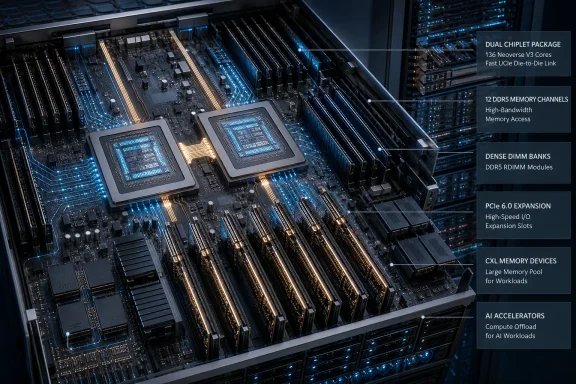
The newly disclosed design uses two largely self-contained chiplets built on TSMC’s N3P manufacturing process. Each chiplet contains 70 physical Neoverse V3 cores, its own six-channel memory subsystem, I/O, and a mesh interconnect. The top SKU exposes 136 cores, leaving four physical cores disabled across the package for yield recovery; 128-core and 64-core SKUs are also planned.
The key decision is where Arm put the memory controllers. Rather than have CPU chiplets travel across a fabric to a central I/O die for DRAM access, as in AMD’s established EPYC topology, AGI keeps memory control local to each compute-and-I/O chiplet. The two dies communicate over UCIe running at 32 GT/s, with Arm citing up to 2 TB/s of aggregate die-to-die bandwidth.
That means the UCIe link is not supposed to be the normal route for a core reaching its preferred memory. Tom’s Hardware reported that Arm’s design goal is less than 100 ns local DRAM latency, and Arm advertises the same target alongside 6 GB/s of memory throughput per core. Those are vendor targets, not independently reproduced benchmarks, but the layout explains why they are central to AGI’s pitch.
For an AI server, this is potentially more important than the headline core count. A GPU-heavy inference node still needs host CPUs to schedule workloads, prepare data, manage networking and storage, and coordinate memory movement. Large language model serving and retrieval systems can also expose latency-sensitive host-side work that does not improve simply by adding more GPU arithmetic. AGI is designed around keeping those cores fed without repeatedly crossing a package-level fabric for memory.
The trade-off is equally clear. AMD’s chiplet model is highly modular and has scaled into products with very large core counts, while Intel has several Xeon architectures optimized around its own mesh and accelerator strategy. Arm has chosen a more integrated chiplet that duplicates memory and I/O resources. That may improve locality, but it is not automatically a blanket performance win over EPYC or Xeon. The relevant comparison will depend on memory-bound service workloads, software maturity, DIMM availability, and the accelerator configuration around the CPU.
Twelve DDR5 channels are the actual headline
AGI’s memory specification is unusually aggressive for a 300 W general-purpose server processor: 12 DDR5 channels per socket, up to DDR5-8800, and up to 6 TB of memory. At the rated transfer speed, that works out to 844.8 GB/s of theoretical aggregate bandwidth, the figure Notebookcheck highlighted.
There is a timing caveat inside that specification. Tom’s Hardware noted that DDR5-8800 modules still need to reach the market at scale. Enterprise buyers should therefore avoid treating 844.8 GB/s as the baseline bandwidth of the first systems they can order. Actual capacity, speed, population rules and qualified memory lists from Lenovo, Supermicro, ASRock Rack and other system vendors will determine the configuration that ships.
Arm’s public specifications also identify an operationally useful product split. The 136-core part is the maximum-core model; the 128-core SKU is described as the TCO-oriented configuration; and the 64-core SKU is positioned for maximum memory per core. All support two sockets, which makes a 272-core server possible, while the 64-core SKU can provide substantially more capacity and memory bandwidth per worker for databases, caching tiers, virtualized services or CPU-side inference preprocessing.
The available technical documentation has one detail that needs clarification before procurement teams treat it as final. Tom’s Hardware’s Hot Chips report says AGI provides up to 272 MB of system-level cache, apparently reflecting the two-chiplet package. Arm’s current product table instead lists 128 MB of system-level cache for each of the 136-, 128- and 64-core SKUs. Arm has not publicly reconciled those figures. Buyers comparing cache-sensitive workloads should request a final product brief and platform BIOS documentation instead of assuming either number describes the shipping socket configuration.
Each Neoverse V3 core carries 2 MB of L2 cache and two 128-bit Scalable Vector Extension engines. The architecture is Armv9.2 and includes bfloat16 and INT8 instructions, but AGI is still best understood as a host processor, not a substitute for a high-end GPU or dedicated AI accelerator. Its role is to increase the useful work done around accelerators and to handle inference, orchestration and general cloud services where many energy-efficient CPU cores and fast memory can matter more than peak floating-point throughput.
PCIe 6.0 and CXL make the platform more than a CPU swap
The chip exposes 96 PCIe 6.0 lanes with CXL 3.0 Type 3 support, plus separate PCIe 4.0 control lanes. That I/O budget is a meaningful part of the Xeon-and-EPYC challenge. It gives system builders room for GPUs, networking, NVMe storage, DPUs and CXL memory devices without forcing the platform into a low-lane compromise.
CXL support is especially relevant to the stated 6 TB memory ceiling. Direct-attached DDR5 remains the performance path, but CXL Type 3 devices can add memory capacity or enable disaggregated memory configurations where the workload can tolerate the additional latency. That is useful for large retrieval indexes, data-processing jobs and multi-tenant systems, though it does not erase the difference between local DRAM and CXL-attached memory.
The physical server options are starting to take shape. Arm’s product page lists reference designs in dense OCP DC-MHS and conventional 2U dual-socket formats, alongside systems from Lenovo, Supermicro and ASRock Rack. Supermicro’s announced portfolio extends from a compact air-cooled single-socket system to a 5U platform that pairs dual AGI CPUs with up to eight double-width accelerators.
This matters for administrators because an Arm server adoption is not merely a motherboard change. Linux distributions, hypervisors, container base images, monitoring agents, backup tooling, security products, proprietary database extensions and in-house binaries all need an AArch64 validation plan. The fact that Arm identifies Red Hat and Canonical among its software partners helps, but an organization running x86-only agents or closed-source vendor packages should not assume transparent migration.
Windows Server is not the deployment story Arm is selling here. Microsoft appears among the broad supporters named in Arm’s March announcement, and Azure already operates Arm-based Cobalt infrastructure, but AGI’s announced software direction is Linux, cloud-native services and AI data-center stacks. For Windows-centric enterprises, AGI is most likely to arrive first as infrastructure behind AI services, Kubernetes clusters or appliance platforms rather than as a general Windows Server estate refresh.
Arm’s rack-performance claim still lacks the comparison readers need
Arm says AGI can deliver more than twice the performance per rack of comparable x86 CPUs and has attached an even larger claim of up to $10 billion in capital-expenditure savings per gigawatt of AI data-center capacity. Those are Arm estimates, not third-party benchmark results. The company has not published the exact Xeon and EPYC SKUs, memory populations, cooling designs, software stacks, workloads or price assumptions needed to test the claim as a like-for-like procurement comparison.
That omission is significant because AGI’s advantage, if it materializes, should be workload-specific. High-density, memory-intensive CPU services with strong Arm builds may benefit from the chip’s design. A business tied to x86-only software, a workload limited by per-core performance, or a deployment where DDR5-8800 is unavailable may see a very different result. The right yardstick is work completed per watt and per dollar in the intended system, including the cost of ports, memory, accelerators, software certification and migration.
Arm does have a credible route to market beyond the processor specifications. Its March filing named Meta as the lead partner and co-developer, while listing Oracle Cloud Infrastructure, OpenAI, SAP, Cloudflare, Cerebras, F5 and others as intended adopters or ecosystem participants. More importantly, the June Supermicro announcement provided an actual platform schedule rather than only partner logos.
AGI’s first test is therefore close at hand: server vendors must turn Arm’s reference designs into qualified, supportable systems, and customers must show that the local-memory architecture produces repeatable gains in real AI and cloud workloads. Until then, the 136-core chip is a well-defined and unusually ambitious entry into the server market — but its challenge to Xeon and EPYC remains a promise awaiting independent benchmarks and shipping configurations.