
The launch matters because it demonstrates a more ambitious model for the Apple Vision Pro entertainment ecosystem: a prominent artist curating an original, platform-specific catalog instead of simply repackaging conventional flat video for a headset display. ARR Immersive is small at launch, but its mix of classical music, Kathak dance, performance capture, and narrative experimentation gives it a clearer creative identity than many early spatial-video apps.
For Apple Vision Pro users, the release is also a reminder that the headset’s strongest entertainment experiences may not always come from feature-length films or mainstream streaming services. Carefully framed, high-resolution immersive performances can create a sense of proximity that a television, laptop, or even a giant virtual cinema screen cannot reproduce.
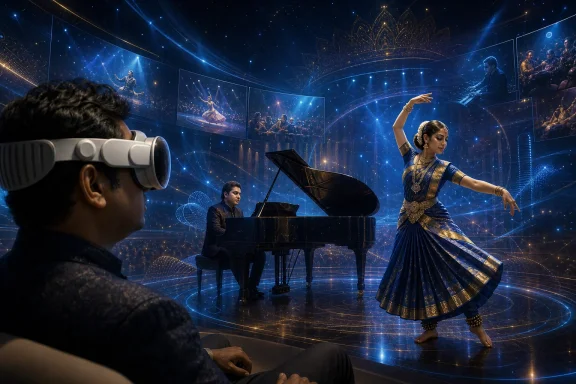 Overview: A Music Icon Moves Further Into Spatial Storytelling
A. R. Rahman is best known as a composer, producer, singer, and songwriter whose work has crossed language, geography, and genre boundaries for decades. His scores for films including Slumdog Millionaire, 127 Hours, Roja, Bombay, Lagaan, and many other productions made him one of the most internationally recognized figures in modern Indian music.
His career has never been confined to traditional soundtrack work. Rahman has consistently explored technology-driven formats, international collaborations, live orchestral performance, education, and broader audiovisual storytelling. ARR Immersive extends that instinct into the current era of Apple Vision Pro apps and spatial media.
The app is designed specifically for Apple Vision Pro and requires visionOS 2.0 or later. It is listed as a free download with optional in-app purchases, creating a familiar storefront model: audiences can sample parts of the experience without payment, then purchase individual premium works.
That choice makes ARR Immersive more accessible than a paid app with a substantial upfront barrier. Yet it also creates a major question around value, because some short immersive works are individually priced at a level that will invite close comparisons with music purchases, premium video rentals, and competing immersive-video services.
At launch, the app combines several distinct categories:
- Kathak dance performances paired with Western classical compositions.
- Concert and live-performance material through an ARR Live section.
- Immersive excerpts and re-edited content tied to Le Musk.
- Short cinematic and music-focused spatial videos.
- A 3D teaser and trailer related to the upcoming Indian film Ramayana.
- Free and premium experiences with individual purchase options.
This is not a conventional streaming catalog. It is closer to an evolving digital gallery, built around Rahman’s artistic world and intended to grow over time.
A Curated Experience, Not a Generic VR Video App
The most important aspect of ARR Immersive is not simply that it offers 180-degree and 360-degree video. Plenty of virtual reality platforms have offered those formats for years. The more interesting point is that Rahman’s team appears to be treating immersive video as a creative medium with its own grammar.
That distinction matters.
Much early VR video was built around the idea that viewers should be able to look everywhere. In practice, that freedom can become distracting. A viewer may be less focused on a singer, dancer, or dramatic moment because they are constantly checking the edges of the scene for something they might have missed.
Rahman’s preference for 180-degree stereoscopic storytelling is therefore sensible. A front-facing immersive stage preserves much of the physical presence and depth associated with VR while still allowing creators to guide attention. It can put the audience near a pianist, in front of a dancer, or inside a concert setting without forcing them to turn around every few seconds.
This approach is especially appropriate for music and dance.
A performance is not merely an environment. It is a sequence of gestures, expressions, movements, and musical cues. The director must be able to shape where attention goes, when it shifts, and how an emotional beat lands. A fully panoramic 360-degree format may be ideal for architecture, natural landscapes, travel, or documentary exploration. For choreographed storytelling, however, a carefully composed forward field can be more effective.
Apple’s own immersive-video direction increasingly supports that principle. The company’s latest production approach is focused on stereoscopic, wide-field video with spatial audio, accurate scale, high frame rates, and a field of view that can exceed conventional 180-degree limits without relying on legacy full-sphere VR conventions.
ARR Immersive fits that broader direction well, even when its individual clips use different cameras, workflows, and source formats.
The Kathak Piano Series Is the App’s Most Distinctive Idea
The most compelling material in the initial ARR Immersive lineup may be the Kathak Piano Series, which brings together Indian classical dance and familiar Western classical compositions.
The available works include interpretations of:
- “Clair de Lune”
- Rachmaninoff
- “Für Elise”
These are not merely concert recordings in a virtual theater. The concept is based on collision and connection: the formal discipline and musical language of European classical piano are paired with the rhythmic vocabulary, movement, and expressive storytelling of Kathak.
That creative combination is precisely the type of experience that benefits from Apple Vision Pro. On a flat display, a performance can still be beautiful, but physical distance remains a barrier. The audience views the musicians and dancers through a rectangular frame. Immersive video reduces that barrier by making the performance space feel more immediate.
A viewer can observe the footwork of the dancer, subtle hand gestures, the pianist’s posture, and the spatial relationship between the performers with a stronger impression of real-world scale. The result should feel less like watching a music video and more like being positioned at an unusually privileged seat inside a small, carefully staged performance.
Rahman has described the project as drawing on young musicians connected to his conservatory, turning the app into an artistic showcase as well as an entertainment product. That educational element deserves attention. Spatial media is often discussed in terms of blockbuster content, gaming, tourism, or enterprise applications. ARR Immersive suggests another viable use: presenting emerging musicians and dancers in a form that communicates their skill and physical presence more directly.
For Windows and mixed-reality enthusiasts, this is a useful reminder that the future of immersive media is not only about virtual worlds with menus, avatars, and interactive objects. It can also be about giving traditional performance art a new kind of venue.
Why Spatial Audio Is Central to the Experience
Immersive visuals are only half the proposition. Music-focused content rises or falls on audio quality, and ARR Immersive emphasizes spatial audio as a core part of its creative design.
Apple Vision Pro is particularly well suited to this kind of work because the headset can use head tracking to maintain a stable acoustic perspective. When a performer appears to be standing to the left, the sound can remain positioned accordingly as the viewer turns their head. In a carefully mixed performance, that can make an acoustic space feel significantly more believable than traditional stereo playback.
This does not mean every immersive music video automatically becomes transformative. Spatial audio can be overused, exaggerated, or mixed in a way that draws attention to itself rather than serving the song. Effects that whirl instruments around the listener may initially sound impressive but can quickly become fatiguing.
The better approach is more restrained.
For concert footage, the ideal mix should establish the placement of musicians, the depth of the room, the reflection of sound from the venue, and the energy of the audience. For a dance performance with piano, the mix should make the percussive impact of footwork feel grounded in the same physical space as the instrument.
Rahman’s team created new spatial-audio mixes for the app, rather than treating the sound as an afterthought added to existing video. That is an important production decision. Immersive video has greater potential when audio, camera placement, performance blocking, and editing are planned as parts of the same experience.
Apple’s immersive production framework similarly treats video, lens calibration, projection, motion data, and audio as closely linked parts of the final delivery pipeline.
Le Musk Finds a More Accessible Home
ARR Immersive also brings elements of Le Musk to Apple Vision Pro. This is significant because Le Musk has long represented Rahman’s most visible commitment to immersive storytelling.
The project is a 37-minute VR narrative centered on a young woman whose story involves memory, murder, and scent. It was developed over a lengthy period and premiered in the Cannes XR context before appearing in special installations. In its broader form, Le Musk was conceived as a multisensory work, combining virtual reality with motion, haptic elements, and scent.
Apple Vision Pro cannot reproduce every aspect of that physical installation model. A headset can deliver high-quality stereoscopic imagery and spatial sound, but it does not include scent cartridges, moving seats, or venue-scale environmental effects. That limitation should be acknowledged rather than ignored.
Still, Vision Pro offers a much more practical way for audiences to experience a version of the work at home. Installation-based VR can be powerful, but it is inherently difficult to scale. It requires a specific location, specialized equipment, maintenance, ticketing, and scheduling. A visionOS app trades some theatrical spectacle for reach and convenience.
The re-edited version of Le Musk also reflects an important maturity in immersive production. A work designed for a 360-degree VR environment does not necessarily translate perfectly to every headset or every viewing context. Reframing and re-editing material for a more centered, guided viewing experience can help a narrative maintain rhythm and clarity.
That does not make the Apple Vision Pro edition a replacement for the original multisensory installation. It is better understood as another version of the same creative universe—one tailored to personal spatial computing.
The Production Challenge Behind Immersive Performance Video
Rahman’s team has described a multi-camera workflow involving several specialized capture methods. These include custom Panasonic-based rigs, Blackmagic immersive cameras, and Canon and Sony systems used for close-ups and cutaway angles.
That production complexity explains why polished immersive performance content remains relatively rare.
A conventional concert recording can be made with multiple cameras, edited in a familiar timeline, color graded, mixed, and released through ordinary streaming platforms. Immersive capture adds additional complications:
- Multiple lenses must be synchronized.
- Cameras must be placed carefully to avoid breaking the viewer’s sense of space.
- Stereo depth must remain comfortable.
- Stitching and optical alignment must be managed.
- Motion and cuts must avoid causing discomfort.
- Audio must match the perspective and positioning of the image.
- High-resolution footage creates substantial storage, processing, and delivery demands.
The app itself is nearly 1 GB before accounting for future downloads or purchases. That is a modest figure by modern game standards, but it still reflects the reality that spatial media is much heavier than a typical music-streaming app.
Rahman’s method of using dedicated systems for different types of shots is particularly revealing. Immersive storytelling often requires competing priorities. A wide immersive rig may establish scale and presence, while a close camera is necessary to capture fingers on piano keys, detailed expressions, costume work, or the precision of dance movements.
Blending those perspectives without making the audience feel as if they are teleporting around the room is difficult. The success of ARR Immersive will depend heavily on how naturally those transitions are edited.
Pricing Is the App’s Biggest Immediate Risk
The app is free to download, but its premium content is sold individually. In the United States storefront, the listed purchases include $9.99 prices for Clair de Lune, Rachmaninoff, and Für Elise, along with $14.99 prices for What’s on a Man’s Mind and Scent of a Song.
Those prices are likely to be the most controversial part of the launch.
The problem is not that immersive art should be free. It should not. High-quality spatial capture requires expensive equipment, lengthy production, specialized post-production, original music work, talent, choreography, and technical expertise. Individual creators and studios need sustainable ways to finance ambitious content.
The issue is that consumers calculate value through both duration and familiarity.
If many of the individual pieces are only a few minutes long, a $9.99 purchase can feel steep even when the quality is high. A traditional music-video marketplace has conditioned audiences to expect low-cost ownership, free ad-supported playback, or subscription access. Streaming libraries have further reinforced the expectation that a modest monthly fee unlocks a vast amount of material.
ARR Immersive asks audiences to adopt a different model: pay for a premium digital art object, not merely a clip.
That model can work, but the presentation must support it. Buyers need a clear understanding of what makes each experience distinct:
- Is it an original performance unavailable anywhere else?
- How long is it?
- Does it include 3D depth and premium spatial audio?
- Is it part of a larger story or series?
- Does a purchase unlock future updates or bonus material?
- Are there bundles for the Kathak Piano Series or Le Musk collection?
At present, individual pricing without visible collection discounts risks making the app feel fragmented. A bundle, a season-pass model, or a curated album approach could make the catalog more inviting as it expands.
The core artistic idea may be premium. The purchasing experience should feel premium too.
Accessibility and Platform Exclusivity Need Attention
ARR Immersive is exclusive to Apple Vision Pro at launch, with a Meta Quest release planned for the future. That strategy is understandable. Vision Pro is designed around high-resolution spatial video, high-quality display hardware, and Apple’s tightly integrated audio and video pipeline.
However, exclusivity creates a limited early audience.
Apple Vision Pro remains a premium device, and its ownership base is far smaller than the combined audience for phones, televisions, laptops, game consoles, and mainstream VR headsets. That means the app is beginning as a niche cultural experiment rather than a mass-media launch.
This is not inherently a weakness. Niche platforms can support high-value creative work, especially when the audience is willing to seek out unusual experiences. But it means ARR Immersive cannot rely on hardware scale alone. It needs strong curation, word-of-mouth, meaningful updates, and a catalog that gives headset owners reasons to return.
There is also an accessibility concern. The current App Store listing does not indicate supported accessibility features.
For a music-centered app, accessibility should be treated as a priority rather than an optional refinement. Useful additions could include:
- Closed captions for spoken dialogue and lyrics.
- Clear text descriptions of narrative context.
- Audio descriptions where visual movement carries critical meaning.
- Comfortable playback controls for seated users.
- Options to reduce motion or minimize abrupt editing.
- Captions positioned carefully for immersive viewing.
- Adjustable audio balance and volume controls.
The art may be built around sensory immersion, but thoughtful accessibility design would allow more people to engage with it.
The Broader Lesson for Spatial Computing
ARR Immersive is not likely to become a mainstream Apple Vision Pro killer app overnight. Nor does it need to. Its real value lies in showing what happens when a major musician treats immersive media as an artistic format rather than a promotional add-on.
The app connects multiple parts of Rahman’s career:
- Film composition.
- Dance and stage performance.
- Classical music.
- Indian cultural traditions.
- Emerging artists and education.
- Narrative experimentation.
- Live concerts.
- High-end spatial capture.
That combination gives the app coherence. It is not just a folder full of assorted 3D videos. It has a recognizable authorial perspective.
For the broader mixed-reality industry, that is an encouraging development. Hardware companies can build displays, cameras, operating systems, codecs, and input systems, but immersive platforms ultimately need artists with something personal to say. The best experiences will not be defined only by pixel density, frame rate, or field of view. They will be defined by whether those technical capabilities make a performance feel more intimate, more emotionally immediate, or more memorable.
Rahman’s preference for focused 180-degree storytelling may prove particularly influential. It recognizes that immersion is not the same thing as unlimited freedom. Sometimes a creator’s ability to frame the moment is exactly what makes the audience feel present.
A Promising First Step With Clear Room to Grow
ARR Immersive arrives with genuine strengths: a distinctive artistic identity, rare access to Rahman’s experimental work, original cross-cultural performance concepts, and a production approach that takes Apple Vision Pro seriously as a premium storytelling platform.
The app also launches with obvious challenges. Its premium pricing may be difficult to justify for short experiences, the catalog is still limited, accessibility details are sparse, and Vision Pro’s high hardware cost constrains the immediate audience. Future content—including concert captures, production material, cultural experiences, and additional narrative work—will be essential to establishing long-term value.
Yet the launch should be viewed as more than a small visionOS app release. It is an example of an internationally respected composer using spatial computing to build a direct creative channel, one where music, dance, narrative, and technical experimentation can coexist without being forced into the conventions of television, cinema, or social-media video.
If ARR Immersive continues to expand with thoughtful curation, clearer value bundles, and the same attention to audiovisual craft evident in its launch material, it could become one of the more culturally meaningful entertainment apps available for Apple Vision Pro.
