
Microsoft named Sharma CEO of Xbox in February 2026, following Phil Spencer’s retirement, and her first public priorities included “the return of Xbox,” beginning with console. That is a meaningful tonal break from a strategy that often treated the Xbox console as one access point among many.
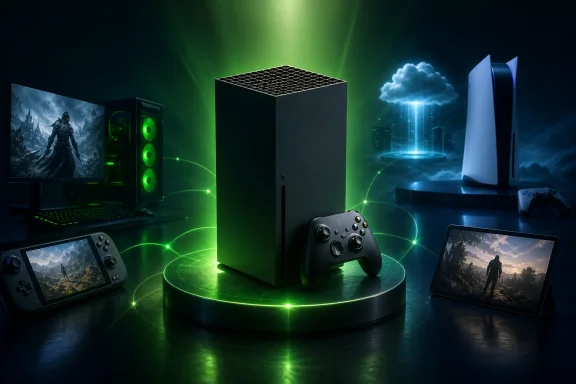 Hardware Still Needs a Clear Purpose
The original promise—play what you want, with whom you want, anywhere—remains attractive for PC players. Xbox Play Anywhere, Game Pass PC, cloud streaming, cross-play, and cross-progression reduce friction in ways traditional platform exclusivity never could.
But hardware platforms still need a differentiator. If Xbox’s biggest games arrive on competing consoles at the same time, an Xbox Series X or its successor has to compete primarily on price, performance, services, and convenience. Those can matter, but they are weaker reasons to commit to a platform than a game library competitors cannot fully match.
That tension is now visible in Microsoft’s release calendar. Halo: Campaign Evolved, the Unreal Engine 5 remake of the original Halo campaign, launched on PlayStation 5 alongside Xbox Series X|S and PC on July 28. It is a landmark expansion for Xbox publishing, but it also gives Sony’s console access to one of Microsoft’s defining franchises.
Fable Will Test the Revised Message
Microsoft has confirmed that Fable will launch on February 23, 2027, for Xbox Series X|S, PC, Steam, and PlayStation 5, with Premium Edition early access beginning February 18. Meanwhile, Sony lists God of War Laufey for PlayStation 5 on February 16, 2027.
The dates do not create the one-day head-to-head suggested by the Windows Central commentary, but the broader point remains: PlayStation owners will have access to a major Xbox-published release without leaving their established platform. Microsoft is betting that selling software across a larger audience can coexist with a compelling Xbox ecosystem.
That is possible—but only if the next Xbox offers something more tangible than another place to launch the same games.
PC Is an Asset, Not a Substitute for Xbox
For Windows users, a more PC-like Xbox could be beneficial. Microsoft has the opportunity to make console and Windows gaming feel more connected through shared libraries, handheld support, cloud saves, storefront integration, and better controller-first experiences.
Yet a console that merely resembles a locked-down PC would not automatically strengthen Xbox. Sharma’s challenge is to preserve the advantages of openness while delivering the simplicity, performance consistency, and identity that make dedicated consoles attractive.
Spencer’s vision expanded Xbox’s reach. Sharma’s task is harder: prove that Xbox can be everywhere without becoming indistinguishable from everything else.
Update: Sharma’s “Four C’s” memo sets a growth plan led by console (July 31, 2026)
A newly reported internal memo gives Asha Sharma’s Xbox strategy more structure. As reported by TweakTown, Sharma has organized the division’s plan around four priorities: Core, Content, Creation, and Connection.
“Core” explicitly calls for strengthening the Xbox platform “led by console,” reinforcing that hardware is intended to be the foundation of the revised strategy rather than simply another endpoint for Game Pass and cloud services. “Content” focuses on turning games into global franchises, while “Creation” centers on expanding Minecraft as a creator platform. “Connection” is framed as extending the worlds fans already value.
The memo also reportedly sets a multi-year timetable: Xbox aims to return to growth in fiscal 2027, put the model into operation during fiscal 2028 and 2029, and scale the most successful initiatives by fiscal 2030. For Windows gamers and IT professionals tracking Microsoft’s gaming direction, the practical implication is that PC, cloud, and creator tools appear set to remain central—but within a plan that formally restores console leadership as Xbox’s organizing principle.
