
ASRock announced the Rock Series on August 24, describing it as a practical, value-oriented liquid-cooling family with a six-year warranty. The initial lineup is comprehensive in color and radiator size but narrow in technical ambition: each model uses the same 3-phase, 6-slot pump arrangement, a copper cold plate, 27 mm-thick aluminum radiator, preinstalled unified-frame fans, and 400 mm tubing.
For builders, that makes Rock less a new performance tier than a more affordable-looking entry point into ASRock’s growing cooling catalog. The company has a higher-featured Challenger family with a 3-inch display that can report CPU temperature, frequency, and pump speed. Rock’s 1.05-inch segment LED readout is much more limited by comparison, even though the Digital cooler still needs a software and USB connection.
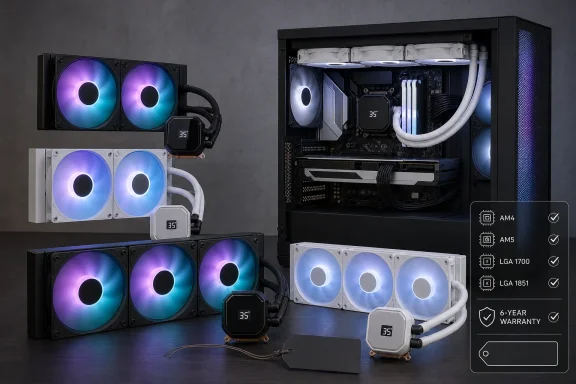 Eight SKUs, but two practical hardware choices
The formal lineup consists of Rock 240 ARGB, Rock 240 Digital, Rock 360 ARGB, and Rock 360 Digital, plus a white version of each. The color, lighting, and screen choices multiply the SKU count, but prospective buyers are really choosing between two radiator lengths and two pump-block treatments.
The 360 mm Rock Digital’s radiator measures 397 × 120 × 27 mm before fan clearance is considered. Its three-fan assembly is 24.8 mm deep, meaning a top-mounted installation needs roughly 52 mm of vertical room before accounting for the case frame, screws, motherboard heatsinks, or RAM clearance. Builders should verify a case’s actual 360 mm AIO support rather than assuming that three 120 mm fan mounts guarantee fit.
ASRock lists AM4 and AM5 support on the AMD side, plus Intel LGA 1700 and LGA 1851. That covers current mainstream desktop platforms, but it also means the Rock Series is not presented as a cooler for AMD Threadripper or Intel workstation platforms. The supported-socket list should be checked before purchase rather than inferred from the “universal bracket” marketing language.
The company rates the Rock 360 Digital’s pump from 1,200 to 3,200 RPM. Its unified three-fan frame operates from zero to 1,850 RPM and is specified at up to 52.4 CFM, 1.7 mmH2O static pressure, and 30.7 dBA. Those numbers describe components rather than system-level cooling results; ASRock has published no CPU temperature benchmarks, heat-load rating, or noise testing methodology for the Rock line.
That omission is important. A 360 mm radiator generally offers more surface area than a 240 mm unit, but a buyer cannot determine from ASRock’s launch materials how Rock compares with its own Challenger coolers, established low-cost alternatives, or a capable dual-tower air cooler. Until independent thermal and acoustic testing arrives, the decision should be based on case fit, warranty, price, and preferred aesthetics—not assumed cooling leadership.
The Digital model is a monitor, not a miniature LCD canvas
Wccftech’s launch report initially described the 1.05-inch screen as a CPU-temperature display and questioned whether it could be personalized. ASRock’s product documentation fills in part of that gap: the display is a segment LED, not a conventional color LCD, and connects to the motherboard through a 9-pin internal USB header.
ASRock also says the Digital models use a “Rock Driver” to configure display settings and monitor CPU temperature. The company does not spell out which display elements owners can customize, nor does it publish screenshots that establish whether the screen can show anything beyond the temperature-oriented presentation promoted on its product page. A segment display sharply limits what customization can mean in practice compared with the 480 × 480 LCD panel ASRock uses on its Phantom Gaming cooler or the 3-inch smart display on Challenger Digital models.
There is one Windows-specific consequence: ASRock’s support listing added Polychrome RGB version 2.0.191 for all eight Rock models on August 24, with Windows 10 64-bit and Windows 11 64-bit support. The cooler’s lighting can also connect through a standard 3-pin ARGB header, and ASRock says the AIO line has passed its SignalRGB compatibility testing for control of both display and lighting effects.
That offers useful flexibility for a mixed-vendor build. An ASRock motherboard is not required for basic lighting connectivity, although Polychrome Sync is ASRock’s native route for synchronized lighting. Conversely, buying the Digital version means reserving more than an ARGB and PWM connection: the internal USB header is part of the display’s stated hardware requirement. Small-form-factor boards and older boards can be short on those headers, so that cable requirement belongs on the compatibility checklist alongside radiator clearance.
Cleaner cabling is the Rock Series’ most concrete convenience feature
The Rock coolers’ most practical design choice may be their unified fan frames. Instead of three physically separate radiator fans with separate wiring runs, the 360 mm version uses a combined frame and a single cable path with separate PWM and ARGB connectors. ASRock says this reduces cable bulk, and that claim has a straightforward benefit for builders: fewer fan cables need routing behind the motherboard tray or connecting to splitters and hubs.
ASRock also includes tube clips, preinstalled fans, and its Therm-X1 thermal paste. The tubing uses an IIR-and-EPDM construction, materials ASRock says are intended to resist coolant evaporation and deformation. Such construction details are welcome, but they are not proof of lifetime reliability; the six-year module warranty is the more useful protection for a sealed liquid cooler, assuming the product is sold and warrantied in the buyer’s region.
The advertised 0 dB mode is similarly easy to overread. ASRock says the radiator fans stop at low load. That does not mean the complete liquid cooler is necessarily silent, because the pump can still operate, and it gives no indication of the temperature threshold or fan curve that triggers fan stop. Owners should inspect BIOS or software fan controls after installation and confirm the pump header is configured as ASRock instructs rather than relying on a marketing label.
ASRock has left the buying decision unfinished
The missing information is price and availability. ASRock’s August 24 announcement identifies the eight models and their features but does not state MSRPs, retail partners, sale dates, or regions. Each product page also carries a notice that the model may not be sold worldwide.
That is a notable change from the early Computex reporting. Tom’s Hardware, after seeing ASRock’s cooling range at the June event, reported expected prices of $69.99 for Rock 360 Digital and $59.99 for the non-Digital Rock. Those figures may have reflected an intended introductory price or pre-release positioning, but ASRock did not repeat them in its formal launch announcement. They should therefore not be treated as confirmed U.S. street prices.
The more expensive Digital version also needs to justify itself against that gap. Its advantage is a compact temperature readout and software-linked display control, not the larger informational panel offered on ASRock’s Challenger Digital coolers. If the retail premium is modest, it is a tidy way to put a basic temperature indicator at eye level. If it approaches the price of a Challenger 360 Digital—or a proven competing 360 mm cooler with independent reviews—the smaller screen and limited disclosed performance data will be harder to defend.
For now, Rock is a sensible on-paper option for an AM4, AM5, LGA 1700, or LGA 1851 build that needs a 240 mm or 360 mm AIO with simpler wiring and a long warranty. But ASRock has launched a product family before providing the two facts that determine whether it is actually a value product: where it is available and what it costs.
