
AndroidPure’s August 5 report says images of the CX9406 appeared in an iF Design award listing before being removed. The report attributes the story to 9to5Google, yet the cited 9to5Google article is a May 12 report on a leaked virtual-machine build of Google’s Android desktop environment. It contains no ASUS CX9406, no iF Design listing and no product photography. That makes the design images a one-outlet claim at present, rather than an independently established product reveal.
The more important finding is less glamorous and more useful: ASUS is not merely attached to the Googlebook program in marketing. The company’s Lapis device has been tied to ASUS in Chromium OS development work, and the CX9406 name has appeared alongside Aluminium OS and unusually high-memory Intel configurations. The hardware is on a materially more advanced track than a concept image suggests.
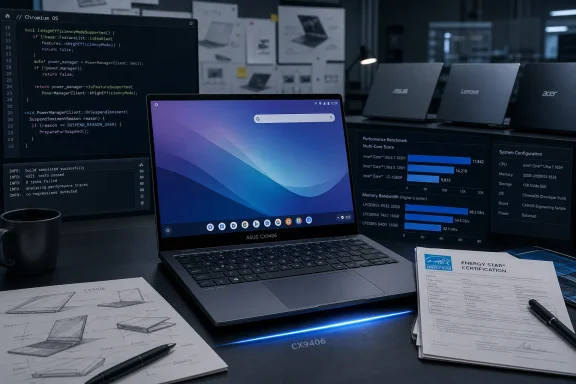 CX9406 Connects ASUS to Googlebook Development
Google publicly named ASUS, Acer, Dell, HP and Lenovo as partners for the first Googlebooks on May 12, saying the machines would arrive in fall 2026. Google also said every Googlebook would have a signature illuminated glowbar, though it stopped well short of announcing individual models, configurations, prices or markets.
Independent reporting from GbookHub and Japan’s HelenTech connected ASUS to the Googlebook development board codenamed Lapis. The linkage is not based solely on an anonymous leak: public Chromium development references to the boot-screen OEM logo identify ASUS, and earlier code pointed to a C22N battery family that ASUS uses in Zenbook and Chromebook Flip CX hardware.
That evidence supports a precise conclusion: ASUS is building an Aluminium OS-capable Googlebook. It does not prove the final retail badge, its industrial design, or that every preproduction configuration will ship. But it is far stronger than treating the appearance of ASUS’s name in Google’s partner list as evidence of a finished laptop.
The company’s proposed designation also follows a familiar ASUS pattern. “CX” has long been used in its Chromebook line, including the ASUS Chromebook CX9 CX9400. The “X9406” portion resembles the naming used by ASUS’s current ExpertBook Ultra hardware. GbookHub and HelenTech both see an ExpertBook-like premium positioning as plausible, but neither ASUS nor Google has confirmed that branding.
The Public Record Already Shows More Than the Design Listing
The original report says the alleged iF Design entry provided no processor, memory, storage or display specifications. That may be true of the design record itself, but readers should not come away believing the CX9406 has no public hardware trail.
HelenTech reported Geekbench entries for “ASUS Lapis” in July, including a Core Ultra 5 325 configuration with 32GB of RAM and a Core Ultra 7 355 configuration with 64GB. Those entries appear to be prototypes — they were running Android 16 rather than a finished commercial release — so the figures should not be confused with a final retail specification. Still, they show ASUS testing something far above the conventional Chromebook baseline.
A separate Energy Star certification entry for model CX9406CAA reportedly lists an Intel Core Ultra 7, 64GB of RAM and Aluminium OS. The public Energy Star product page is difficult to inspect directly, but GbookHub and HelenTech independently describe the same listing and connect it to the same Lapis benchmark trail.
That makes the 64GB claim credible as a preproduction configuration, though not yet as a promised SKU. Prototype systems are routinely over-provisioned for validation, debugging and performance work. A company could ship the same chassis with 16GB or 32GB configurations, particularly if Googlebook’s market ambitions run into the price realities that have kept Chromebooks attractive to schools and budget-conscious buyers.
The reported Lapis board information also conflicts with the port layout in AndroidPure’s iF Design account. Public development references tracked by GbookHub and HelenTech describe two USB-C ports, one USB-A port, potential USB4 support, a fingerprint reader, optional keyboard backlighting and up to 65W charging. AndroidPure describes two USB-C ports, two USB-A ports, HDMI and a 3.5mm audio jack. Both descriptions could apply to different variants or stages of development, but there is no independent confirmation that they describe the same finished CX9406 configuration.
That distinction matters for IT buyers. A two-USB-C, one-USB-A design with USB4 is a different docking and peripheral proposition from a device with HDMI plus dual USB-A. Until ASUS publishes a data sheet, port counts belong in the “possible” column.
ASUS Is Not the Second OEM to Surface
The “second OEM” framing does not survive a check against the broader Googlebook record.
Lenovo’s Ruby Googlebook development board was identified through public code and later associated with the Lenovo GB 15IPH12 model in TCO certification information and Geekbench results. Acer’s Moonstone was tied to the Acer Googlebook 14 GP714 through Bluetooth SIG information, alongside benchmark and code evidence. HelenTech’s reporting also tracks multiple other likely Acer machines in Google’s Intel Panther Lake-based Fatcat family.
ASUS is therefore at least the third OEM with an identifiable Googlebook device in public reporting, and possibly later than that depending on whether HP’s reported Googlebook 14c naming is counted. Dell remains the one announced launch partner whose hardware trail has been thinner in the Intel Fatcat work; reporting has suggested it may instead be associated with Qualcomm-based development.
The more telling story is that Googlebook has moved beyond a single Lenovo leak and into a multi-vendor validation phase. ASUS’s Lapis, Lenovo’s Ruby and Acer’s Moonstone all appear connected to Intel’s Panther Lake-era Googlebook work. The partner roster points to multiple silicon approaches as well, with Qualcomm-based systems also expected. Googlebook is shaping up as a broad OEM platform launch rather than a Google-designed reference laptop handed to one manufacturer.
“Aluminium OS” Remains a Codename, Not a Product Name
The iF Design entry reportedly labeled the CX9406 a Chromebook. If authentic, that is an understandable but still meaningful error: Google has announced Googlebook as a new laptop category and continues to list ChromeOS separately for developers. The company has not publicly branded the operating system as “Aluminium OS.”
“Aluminium” and “ALOS” have appeared in leaked builds, bug reports and certification-oriented reporting as the name for Google’s Android-derived desktop effort. 9to5Google’s May reporting showed an unfinished Android 17-based desktop experience with desktop folders, virtual desktops, a terminal, task management and familiar ChromeOS-like setup elements. Google’s own developer documentation now tells Android developers to prepare applications for Googlebook’s large-screen desktop environment, including multi-instance behavior, drag and drop, file handling, printing, keyboard and pointer input.
For Windows administrators and software vendors, the practical takeaway is that this is a new Android desktop target, not a routine Chromebook refresh. Native Android app availability is an advantage only if applications handle keyboard, mouse, window resizing, files and multiple app windows properly. Google has given developers a desktop emulator and has set a March 1, 2027 deadline in its Apps Experience Program guidelines for adaptive Googlebook support, an admission that the catalog will need work after the first laptops ship.
The glowbar and a Google launcher key may make the devices recognizable in a showroom. They do not answer the platform questions that will determine whether Googlebook succeeds: Windows app alternatives, browser and extension behavior, identity and device management, Linux support, offline capability, repairability, update terms and regional availability.
What ASUS Still Has Not Said
ASUS has not announced the Googlebook CX9406. Google has not named it, confirmed its processor, shown its final chassis or stated whether it will be sold in the United States. There is no confirmed price, screen size, battery capacity, display technology, storage capacity, security-chip detail, update-policy statement or enterprise-management story for this machine.
Google’s own announcement only commits the first Googlebooks to a fall 2026 launch window. If CX9406CAA is a genuine preproduction record, ASUS is well past the idea stage. But the alleged iF Design images add little to the verified case, and the “second OEM” label is already outdated.
For now, the credible read is narrower: ASUS has a premium-leaning, Intel Panther Lake Googlebook in active development under the Lapis codename, with CX9406CAA emerging as a likely model identifier and 64GB RAM visible in prototype evidence. The first test of Googlebook will arrive when ASUS and its rivals turn those development systems into retail products with prices, support commitments and management details that buyers can actually evaluate.
Update: Later report adds claimed weight and chassis-material details (August 5, 2026)
Chrome Unboxed now reports that the removed iF Design listing described the CX9406 as using an “Ultra-Ceramic” light-alloy chassis weighing under one kilogram. According to the outlet, the material is claimed to be 34% lighter and 13% stronger than conventional aluminum.
The report also describes a port layout of HDMI, two USB-C ports, one USB-A port and a 3.5mm headset jack. That differs from the earlier AndroidPure account, which listed two USB-A ports. Neither ASUS nor Google has confirmed either configuration, so IT buyers should still treat connectivity details as provisional.
Chrome Unboxed repeats the 64GB-memory and Panther Lake claims already visible in benchmark and certification reporting; those are not new retail specifications. Its material and weight claims are the substantive addition, but they remain dependent on a removed design listing rather than an ASUS product announcement.
Update: Additional details (August 13, 2026)
VideoCardz reports that newly published press renders identify the CX9406 as a 14-inch touchscreen Googlebook. The outlet also claims the prototype configurations pair Core Ultra 5 325 or Core Ultra 7 355 processors with Intel Xe3 graphics using four Xe cores and a 47-TOPS NPU. ASUS has not confirmed these specifications.
If accurate, the display detail and AI-performance figure further position Lapis as a premium, business-oriented system rather than an entry-level Chromebook replacement. Storage options, panel resolution, brightness, refresh rate and final retail memory tiers remain unconfirmed.