
That distinction is more than a lab-purity complaint. ASUS is selling the ROG Equalizer for $49.99 in the United States as an extra layer of protection for a connector family that has drawn years of scrutiny over overheating and melted plugs. The product is aimed at builders using 450W-to-600W graphics cards, particularly systems with GeForce RTX 5090-class power demand, not a roughly 200W RTX 4070. MKAU Gaming acknowledges that constraint, but still calls the cable a “no-brainer” for power-hungry systems—an endorsement the broader test record does not support without qualification.
 What ASUS Actually Changed Inside the Cable
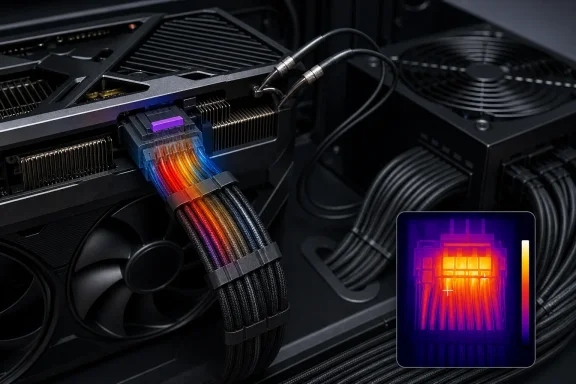
The ROG Equalizer is not simply a prettier 16-pin cable with higher-rated conductors. ASUS places a conductive bridging block close to the graphics-card connector, tying together the six 12V paths before they reach the GPU-side pins. The company’s stated purpose is to reduce the effect of uneven resistance among the individual paths, which can concentrate current and heat at one contact instead of distributing the load evenly.
ASUS says the cable is compatible with ATX 3.1 and PCIe 5.1, measures 750mm, uses tin-plated oxygen-free copper, and has enlarged gold-plated GPU-side spring contacts. It recommends use under a 600W total power limit and says the construction can tolerate short-term current peaks of up to 17A per pin, compared with 9.2A per wire for a conventional 12V-2x6 cable.
Its own thermal comparison is deliberately extreme. ASUS removed four of the six positive 12V conductors, then applied a 600W load. In that forced-fault scenario, ASUS says a normal cable reached roughly 146°C while the Equalizer reached about 87.8°C. That is evidence that a bridge can redistribute current downstream after multiple supply paths are compromised. It is not the same as proving the cable always improves ordinary, fully connected GPU-side current distribution.
MKAU Gaming’s review correctly avoids recreating this destructive test. But that means its practical verdict rests on handling, fit, appearance, and the presence of the colored seating indicator—not on validating the product’s primary electrical claim.
Independent Testing Produces a More Complicated Result
Hardware Busters tested the Equalizer using an electronic load at approximately 600W and concluded that the cable’s GPU-side busbar can improve current distribution and tolerate severe stress. Its test also found the design’s obvious architectural limitation: the busbar is only at the graphics-card end. Under extreme induced imbalance, the weakest point can shift toward the power-supply-side connector and wiring.
That is a meaningful benefit, but it is not blanket immunity from connector failure. The ROG Equalizer does not add a second balancing block at the PSU side, does not alter the GPU’s connector, and cannot repair a badly seated plug, damaged terminal, incompatible power supply, or poorly routed cable. Its role is narrower: provide more thermal margin and a path for current redistribution in some failure cases.
Igor’sLAB reached a less favorable conclusion in a separate high-load evaluation using an MSI GeForce RTX 5090 Suprim drawing about 619W. Its test method compared the same cable in its intended orientation, with the Equalizer block at the GPU side, against the cable reversed so the rigid block sat at the PSU side and the individual conductors could flex more naturally behind the graphics-card plug.
In that test, the intended GPU-side Equalizer orientation produced a wider difference between the most- and least-loaded pins. Igor’sLAB measured an average current spread of about 1.99A with the block at the GPU, versus about 0.79A when the same cable was reversed. The cable’s outer surface temperature was also modestly lower in the reversed orientation, although both arrangements stayed below an acute thermal failure point during the test.
The result does not show that the ROG Equalizer is useless. Igor’sLAB found that its rigid block can provide structural stability and fault reserve when a problem exists before the bridge. But it does challenge ASUS’s broad balanced power delivery framing in normal use. A rigid assembly immediately behind a GPU connector may limit how well the contacts and wires adapt to slight alignment differences, lateral pressure, or a case’s cable-routing geometry.
Heise Online similarly reported that early testing raised doubts about whether the cable’s bridge improves the condition it is advertised to fix during ordinary operation. The technical disagreement is not about whether a busbar can move current around. It is about where the imbalance originates. If the fault is upstream in a cable conductor or supply-side connection, the GPU-side bridge can help redistribute the remaining current. If the problem is at the GPU header or the plug’s physical contact surfaces, the bridge may not provide the expected advantage.
The $50 Cable Does Not Replace Correct Installation
The most useful feature MKAU Gaming identified may be the least glamorous one: the dual-color connector housing. ASUS uses purple coloring as a visual guide intended to show whether the 16-pin plug is fully inserted. Since poor seating and sharp bends near the connector have repeatedly been implicated in 12VHPWR and 12V-2x6 failures, a clearer installation check has practical value.
Builders should still treat that indicator as an aid, not a certification that the connection is safe. The plug should be fully seated with no visible gap, the cable should not be sharply bent immediately after the connector, and the system should be powered down before reseating or inspecting the connection. A cable that feels difficult to route may be more than a cosmetic annoyance if it places sideways force on the GPU-side plug.
Compatibility also needs a more exact reading than “works with leading manufacturers.” ASUS’s own product page specifies use with ATX 3.1 power supplies that have a native 12V-2x6 connector. That is materially different from saying the cable can be mixed freely with any modular PSU. Builders must never substitute cables that connect directly to a modular PSU’s proprietary sockets unless the PSU manufacturer explicitly approves that exact cable and pinout. The Equalizer is designed as a 12V-2x6-to-12V-2x6 cable; it is not permission to mix modular PSU cables.
The ROG Equalizer’s additional proprietary sensing leads are also relevant only with selected ASUS ROG Thor III and ROG Strix Platinum power supplies that support the related monitoring features. ASUS says only models marked with an “-E” suffix include the Equalizer package. Owners of earlier Thor III or Strix Platinum units should not assume the cable or its companion functions are included.
GPU Tweak III Protection Is Still Not a Finished Feature
MKAU Gaming describes ASUS GPU Tweak III Power Detector+ as a second protection layer working with the cable. ASUS’s own product page, however, labels ROG Equalizer mode in Power Detector+ as “Coming Soon.” That makes the current position clearer: the cable’s passive hardware design is available, while the specific software mode ASUS promotes alongside it was not yet listed as released on the vendor’s page as of August 22, 2026.
This matters because software monitoring and a passive busbar solve different problems. Monitoring may alert a user to abnormal current behavior, depending on the supported hardware and implementation. It cannot cool a bad contact on its own, and the cable cannot guarantee that software detects every fault condition. Buyers should assess the Equalizer on the passive hardware it ships with today, not on a software feature ASUS still lists as forthcoming.
There has also been at least one reported image of a scorched ROG Equalizer connector, covered by PC Gamer in June. The publication stressed that the image lacked key facts, including the connected GPU, PSU, load, installation condition, and failure sequence. It is therefore not evidence that the product is defective, but it is a timely reminder that no single cable design makes a 600W compact connector invulnerable.
A Sensible Buy for High-Power Systems, With Narrow Expectations
For an RTX 4070-class system, MKAU Gaming’s own setup illustrates the hard truth: there is little electrical reason to spend $50 on a cable engineered around 600W fault tolerance. The cleaner routing, flexible jacket, and seating marker may be attractive in a showcase build, but those are convenience features rather than a necessary reliability upgrade.
For owners of a native-connector ATX 3.1 power supply and a GPU that routinely pulls several hundred watts, the ROG Equalizer offers a plausible extra safety margin—particularly against upstream current-path faults. Hardware Busters’ testing supports that narrower claim. But Igor’sLAB shows why buyers should reject the idea that it automatically equalizes every connector condition or supersedes careful installation.
The concrete takeaway is simple: use the PSU maker’s approved native 12V-2x6 path, inspect the plug after installation, avoid tight bends at the GPU connector, and regard ASUS’s Equalizer as supplementary hardware rather than a cure for the 16-pin power connector’s remaining weak points.