
The important detail is that “T700” is the family name, not a single fixed specification. ASUS’ own Philippine specification page identifies the full-size machine as the TUF Gaming TM700TZ, with an AMD Ryzen 7 8700F, GeForce RTX 5060 Ti Dual 8GB, 16GB of DDR5 memory, and a 512GB PCIe 4.0 NVMe SSD. That gives prospective buyers a much firmer baseline than the broader launch language about “up to” configurations.
ASUS has also published a Philippine product page for the smaller TUF Gaming T700 Mini, confirming that the compact system is headed for the country. But it has not yet published a local SKU sheet, price, or confirmed ship date for that model. The Mini therefore remains a future purchase rather than an immediately comparable alternative to the TM700TZ.
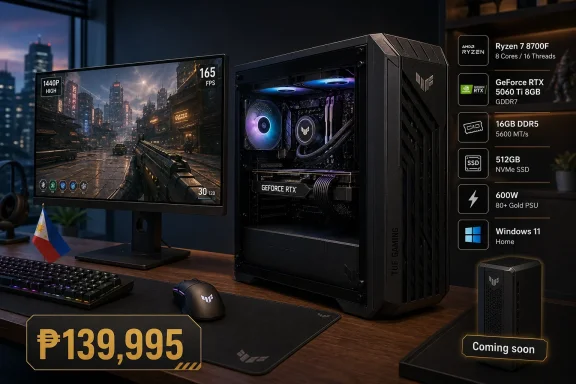 The ₱139,995 desktop is a specific configuration
The local TM700TZ specification listing makes clear what ASUS is selling in the entry configuration reported by BackendNews: Ryzen 7 8700F, RTX 5060 Ti 8GB, 16GB DDR5, and a 512GB SSD. It also lists a B650 motherboard chipset, four memory slots with support for up to 64GB, two M.2 storage connectors, four SATA ports, and a 600W 80 Plus Gold power supply.
For gamers, the RTX 5060 Ti is the component doing most of the work in the asking price. It is positioned for high-refresh 1080p gaming and usable 1440p gaming with modern upscaling features, while the eight-core, 16-thread Ryzen 7 8700F should have ample CPU capacity for current games, voice chat, background recording, and ordinary desktop workloads. The 8700F does not include integrated graphics, however, so display troubleshooting depends entirely on the discrete NVIDIA card being functional.
The less flattering number is the 512GB SSD. After Windows, recovery partitions, ASUS utilities, drivers, and several large games, that capacity can become restrictive quickly. ASUS does provide a second M.2 slot and four SATA connectors, which means storage expansion should be straightforward in principle, but buyers should confirm whether adding an SSD affects local warranty coverage and whether the installed motherboard leaves the second M.2 socket accessible without removing major components.
BackendNews also reported a ₱149,995 T700 configuration, but neither the ASUS Philippines technical page nor the company’s currently visible local product material identifies the exact processor, graphics card, memory, or storage difference that accounts for the extra ₱10,000. That makes the higher-priced listing impossible to evaluate on value alone. Buyers should insist on a full model number and parts list rather than assuming it means more RAM, a larger SSD, or a faster graphics card.
ASUS’ marketing page and local specification sheet do not say the same thing about Windows
The Philippine TM700TZ specification page lists Windows 11 Home Single Language, while ASUS’ broader TUF Gaming TM700 promotional material highlights Windows 11 Pro. This is not a small distinction for buyers who expect the advertised PC to join a work network or provide business-oriented management features.
Windows 11 Home does not include the same built-in business capabilities as Windows 11 Pro, such as BitLocker device encryption management, Remote Desktop hosting, Hyper-V, Windows Sandbox, and domain join support. A home gaming desktop does not necessarily need those functions, but a technically inclined buyer using the system for a small office, remote administration lab, virtual machines, or a home-server-adjacent workload may care a great deal.
The local specification sheet is the document that matters for a Philippine retail purchase. ASUS explicitly warns that specifications differ by country and advises customers to check with local dealers. In practical terms, the TM700TZ should be treated as a Windows 11 Home system unless the retailer’s invoice and exact SKU specification explicitly say otherwise.
That discrepancy also illustrates why buyers should be cautious with the phrase “up to.” ASUS’ global TM700 material describes configurations with up to an RTX 5070, more storage, and Windows 11 Pro. Those are family-level possibilities, not proof that the Philippine ₱139,995 configuration carries those parts or that they will be offered locally.
Cooling, expansion, and maintenance are the real prebuilt differentiators
ASUS is pitching the larger T700-family chassis as a 47-liter tower designed around airflow and maintenance rather than a tightly packed proprietary box. The TM700TZ has a quad-fan layout, a 240mm liquid CPU cooler, removable top and bottom dust filters, and tool-less access intended to simplify cleaning and basic upgrades.
Those features matter more over several years of ownership than orange lighting or the glass side panel. Dust accumulation is a routine cause of elevated temperatures and fan noise in tropical climates, and a chassis that makes filter cleaning easy can help preserve cooling performance. A standard-looking tower with four DIMM slots, a spare M.2 connector, SATA support, and PCIe expansion is also materially more serviceable than many compact branded prebuilts.
Still, “upgradeable” should not be confused with unlimited freedom. ASUS’ own memory guidance specifies a maximum DIMM height, and prebuilt systems can use custom cabling, BIOS restrictions, or physical clearance rules that do not show up in a headline specification list. The 600W supply is likely sufficient for the installed Ryzen 7 8700F and RTX 5060 Ti, but it should not be assumed to support a future upgrade to a substantially higher-tier graphics card without checking power connectors, GPU dimensions, thermal space, and recommended PSU capacity.
The system’s rear I/O is reasonably broad for a mainstream gaming prebuilt: USB-C at 10Gbps, multiple USB-A ports, Gigabit Ethernet, audio jacks, HDMI, and DisplayPort. The graphics card itself provides the monitor connections, so anyone planning a multi-monitor setup should check the exact RTX 5060 Ti model supplied in the local unit and confirm the display outputs before buying.
The T700 Mini is a different class of machine
ASUS Philippines’ TUF Gaming T700 Mini page describes a smaller desktop platform with room for up to Intel Core Ultra 7 265KF processors, RTX 5060 Ti graphics, 64GB of DDR5-5200 memory, and PCIe 4.0 storage. It also describes copper heat pipes, a 90mm fan, Wi-Fi 6, eight USB Type-A ports, and a USB-C port.
That does not establish the configuration that will arrive in Philippine stores. BackendNews reported that the local Mini will use an Intel Core Ultra 5 225F and GeForce RTX 3050, with pricing to be announced in the coming months. ASUS’ local product page describes the platform’s maximum potential, whereas BackendNews’ reported model would represent a much lower-cost, entry-level configuration.
The difference is substantial. An RTX 3050-based Mini would be aimed at competitive titles, lighter 1080p gaming, and general desktop use, while an RTX 5060 Ti-equipped Mini would be a different performance and pricing proposition altogether. The published Philippine page does not yet resolve which graphics card, memory capacity, SSD size, power supply, Windows edition, or expansion options will actually be sold locally.
Buyers looking for a small-footprint gaming system should therefore avoid treating the global “up to RTX 5060 Ti” message as a Philippine promise. ASUS has confirmed the product family’s local presence, but the exact Mini SKU remains unannounced.
What Philippine buyers should verify before ordering
The TM700TZ is a legitimate local configuration rather than a vague family announcement: ASUS’ Philippine listing confirms the Ryzen 7 8700F, RTX 5060 Ti, 16GB memory, 512GB SSD, liquid cooling, 600W Gold-rated PSU, and Windows 11 Home Single Language. For a buyer who values a single-system warranty, predictable assembly, and easier upkeep over hand-selecting every part, that is the core appeal of the ₱139,995 desktop.
But the listing also leaves several purchase-critical questions to the retailer. The ₱149,995 variant needs an exact bill of materials; the T700 Mini needs a local release date, configuration, and price; and every buyer expecting Windows 11 Pro should verify that licensing before payment.
ASUS has delivered a more conventional and expandable tower than many gaming prebuilts, but the local T700 launch is only as compelling as the exact SKU on the sales invoice. The TM700TZ’s published 512GB drive and Windows 11 Home license are the two details buyers should factor into the real cost before deciding whether the convenience premium is worth paying.