
The launch, reported by Absolute Geeks and echoed in ASUS-backed coverage carried by Gulf News’ GN Focus and Tbreak, positions the 14-inch Zenbook as a lightweight Windows 11 laptop for the back-to-school market. ASUS is leading with Qualcomm’s Snapdragon X X1-26-100 processor, whose Hexagon NPU is rated at 45 TOPS, above the 40 TOPS threshold Microsoft sets for Copilot+ hardware.
That processor is only one part of the definition. Microsoft’s Windows 11 specifications say a Copilot+ PC must also have at least 16GB of DDR5 or LPDDR5 memory and a 256GB SSD or UFS drive. The UAE’s lower-priced Zenbook 14 SKU, UX3480QA-U1158W in Zabriskie Beige, is being listed by Sharaf DG and Al Ershad with 8GB of LPDDR5X and a 512GB SSD. Its memory is soldered, and ASUS’s own UX3480QA technical specifications list 8GB as the maximum total memory for that configuration.
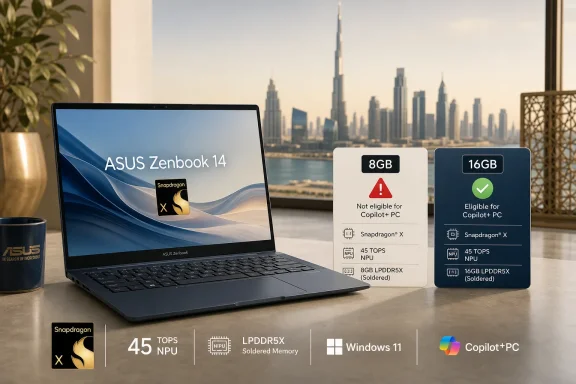
That creates a material distinction missing from the launch pitch. The AED 3,999 model may be a capable Windows on Arm ultraportable, but it does not meet Microsoft’s published Copilot+ PC memory requirement. Buyers should not assume that a Snapdragon X badge and a 45-TOPS NPU alone guarantee access to the full group of Copilot+ experiences.
 The AED 1,000 gap is memory, not merely colour
The UAE launch communications frame the two initial versions as Zabriskie Beige at AED 3,999 and Arctic Blue at AED 4,999. Read quickly, that sounds like an unusually steep AED 1,000 colour premium. The retailer records tell a different story.
The Arctic Blue UX3480QA-U1022W is listed with 16GB of LPDDR5X memory and the same 512GB SSD. The Zabriskie Beige UX3480QA-U1158W has 8GB. Both use the Snapdragon X X1-26-100, Qualcomm Adreno integrated graphics, a 14-inch 1,920 × 1,200 OLED panel, Windows 11 Home, and an English/Arabic keyboard.
In other words, the higher price is attached to a doubled memory allocation, even if ASUS’s announcement places the colours front and centre. The AED 1,000 difference represents roughly a 25% increase over the entry price, which is substantial in a laptop aimed at students and mobile workers. It also buys the configuration that meets the memory portion of Microsoft’s Copilot+ PC baseline.
The distinction is especially important because LPDDR5X memory is integrated on the motherboard. A buyer cannot start with the 8GB machine and install another 8GB module later. Storage may be serviceable depending on the regional configuration, but the memory decision is permanent at purchase.
For ordinary browsing, Office documents, media playback, and a limited number of browser tabs, 8GB can still run Windows 11. But Windows itself, a browser, Teams or Zoom, security software, cloud-sync clients, and local AI workloads all compete for the same small memory pool. The value argument for the cheaper configuration is therefore much narrower than the marketing language around a new Copilot+ laptop suggests.
Microsoft’s Copilot+ requirements leave little room for interpretation
Microsoft distinguishes between a Windows PC that can run Copilot and a Copilot+ PC that qualifies for Windows’ device-specific AI experiences. The latter class requires a compatible 40+ TOPS NPU, 16GB of RAM, and 256GB of storage, in addition to Windows 11’s normal baseline requirements.
The 16GB threshold is not an incidental recommendation. Microsoft also lists 16GB as a prerequisite for Recall, alongside a 40-TOPS NPU, 256GB of storage capacity, and at least 50GB of free space to enable the feature. Recall also relies on a Secured-core PC standard and Windows Hello-based sign-in protections.
ASUS’s 16GB Arctic Blue Zenbook meets the published hardware figures: 45 TOPS from the Qualcomm NPU, 16GB of LPDDR5X memory, and 512GB of storage. The 8GB Beige model satisfies the processor and storage portions but fails the stated memory floor.
ASUS has not publicly explained whether the 8GB UAE SKU will be sold without some Copilot+ functions, whether its Windows image will identify it differently, or why it is marketed under the same “Copilot+ PC” product family. Nor has the company published a UAE-specific feature matrix separating the two launch models. Until it does, the safer assumption is that prospective buyers should verify the exact model number and available Windows features before treating the AED 3,999 system as equivalent to the 16GB version.
The wording matters. A Windows 11 PC can access the general Copilot service through Microsoft’s software and web experiences without being a Copilot+ PC. What the hardware designation is meant to signal is eligibility for a set of locally accelerated Windows features. Those are different promises.
Snapdragon X still requires an Arm compatibility check
The Zenbook 14 UX3480QA is also a Windows on Arm machine, and that should be part of the buying decision independently of the Copilot+ label. Windows 11 on Arm can run many existing x86 and x64 applications through Microsoft’s Prism emulation layer, while native Arm64 applications deliver the best combination of performance and battery efficiency.
The remaining risk is not basic productivity software. It is specialised applications and hardware that depend on drivers, plug-ins, shell extensions, low-level security tools, older database clients, virtualization components, or proprietary peripherals. Microsoft’s Windows on Arm documentation is explicit that kernel-mode drivers and user-mode print drivers must be built natively for Arm64; they are not covered by ordinary app emulation.
That does not make the Zenbook a poor choice for a student, a browser-first worker, or a Microsoft 365 user. It does mean an IT department should not purchase it as a drop-in replacement for an Intel or AMD notebook without validating its required VPN client, endpoint security agent, smart-card middleware, printer stack, USB devices, and line-of-business software.
For an individual, the same test is simpler: check the applications and peripherals actually used, rather than assuming that a Snapdragon X laptop behaves identically to an x86 Windows system. A desktop app may launch under emulation while a related driver-dependent function does not.
The hardware is built around portability, not a premium performance tier
The UAE configuration is a conventional ultraportable: a 14-inch, 16:10 WUXGA OLED screen at 60Hz; integrated Qualcomm graphics; a 50Wh battery; Wi-Fi 6E; Bluetooth 5.3; an IR camera for Windows Hello; Microsoft Pluton; and two USB 3.2 Gen 2 Type-C ports alongside USB-A, HDMI 2.1 TMDS, and a 3.5mm audio jack.
That port selection is practical for a 14-inch machine. ASUS has avoided the all-USB-C approach that forces buyers to carry adapters for legacy accessories, external displays, and presentation equipment. The included IR camera is also more useful for an everyday Windows laptop than a long specification sheet of AI claims: it enables Windows Hello face sign-in without relying solely on a PIN.
ASUS is selling the Zenbook 14 partly on its Ceraluminum lid, its scratch- and smudge-resistant ceramic-aluminium treatment, and on its thin-and-light enclosure. Those are reasonable differentiators in this category. But the 1,920 × 1,200, 60Hz OLED panel places the launch model below the higher-resolution, 120Hz OLED options ASUS says will be available in other Zenbook 14 configurations.
The company has also not published a UAE-specific battery-life estimate for the SKU now on sale. ASUS has described the system as an all-day machine and supplies a 68W USB-C adapter, but real battery endurance will depend heavily on display brightness, browser workload, video conferencing, the mix of native and emulated applications, and whether Wi-Fi is active. That claim remains untested in the UAE launch reporting.
AMD and Intel models are announced, not priced
ASUS says it plans to bring two further Zenbook 14 versions to the UAE: the UX3480KA with up to an AMD Ryzen AI 7 345 and a 50-TOPS NPU, and the UX3480AA with up to an Intel Core Ultra 9 Series 3 processor and a 50-TOPS NPU. The company has not announced UAE release dates or prices for either.
That leaves the Snapdragon model as the only confirmed launch choice, and the 16GB Arctic Blue SKU as the one that clearly aligns with Microsoft’s published Copilot+ specification. The cheaper Beige model may still be attractive as a compact Windows 11 notebook, but it should be purchased for that role—not on the assumption that it provides the same Copilot+ capability as the 16GB version.
For UAE buyers, the practical instruction is simple: order by model number, not colour. The UX3480QA-U1022W is the 16GB configuration; the UX3480QA-U1158W is the non-upgradeable 8GB version.
