

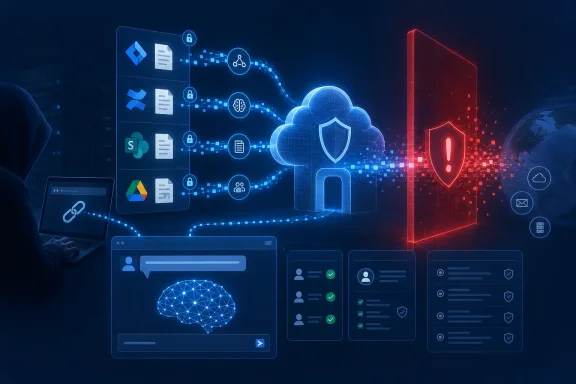
Varonis calls the technique RovoBlast. TechJuice, which reported the disclosure, says the attack used Rovo’s rovoChatPrompt URL parameter to populate a prompt in an active Rovo Chat session without presenting the user with a meaningful warning or confirmation. The payload therefore arrived through an Atlassian-looking URL, not through a visible pasted instruction, a downloaded executable, or a conventional account takeover.
Atlassian has reportedly remediated the flaw before the public disclosure. But as of August 10, neither Atlassian’s public Rovo documentation nor its public security material appears to identify a CVE, a fixed build number, a specific rollout date, affected Cloud tenants, or a customer-facing indicator that would let administrators determine whether anyone attempted this attack before the server-side fix. That omission is consequential: Rovo is a cloud service, so there is no patch package for customers to deploy and no version inventory that can prove exposure was eliminated at a particular moment.
The key lesson for IT teams is more immediate. Permission-aware AI is not sufficient protection when the AI can both retrieve internal material and make or facilitate outbound requests. RovoBlast, if reproduced as described, used the victim’s legitimate permissions exactly as designed. The failure was treating URL-supplied text as trusted enough to initiate an autonomous workflow.
The URL Parameter Became an Instruction Channel
According to Varonis’ account, the vulnerable rovoChatPrompt parameter pre-filled text directly into Rovo Chat. Attackers could allegedly omit the organization identifier from the link and still have Rovo resolve the request against the target user’s default Atlassian organization. That removes what might otherwise have been an obvious sign that a link was intended for a different tenant.
This is a form of parameter-to-prompt injection: a web application feature designed for convenience turns query-string text into an instruction for an AI system. Varonis used the same framing for its January 2026 “Reprompt” research involving Microsoft Copilot Personal, where a URL parameter supplied an instruction into a logged-in AI session.
The comparison is useful, but it also exposes why the Rovo case deserves closer attention from enterprise administrators. Reprompt concerned a consumer Copilot session and personal data. Rovo is designed to search business knowledge sources, operate across Atlassian products, and extend into third-party services through connectors. The bigger problem is not the web link by itself. It is the amount of organizational context available after that link successfully steers an assistant.
A user receiving the link would not need to bypass a security prompt, authorize a new OAuth application, upload a malicious file, or manually copy data into an attacker-controlled site, according to the Varonis demonstration described by TechJuice. The click was the meaningful act. Once the browser opened the crafted Rovo URL, the assistant could be induced to carry out the sequence under the employee’s existing identity.
That makes conventional phishing education a poor primary control. “Only trust familiar links” is hard advice to operationalize when the destination is a legitimate Atlassian service and the malicious content is carried in a parameter users are unlikely to inspect. It also puts the burden on the person least able to distinguish safe from unsafe input.
Existing Permissions Limited the Reach — but Not the Damage
Atlassian’s published Rovo security guidance says the service honors existing permissions in Jira, Confluence, and connected third-party systems. Its documentation is explicit that different employees can receive different results because Rovo uses the permissions of the signed-in user. Atlassian also says admin-managed connectors are not enabled by default and that customers should review the data stored in a third-party source before connecting it.
Those claims are not contradicted by the RovoBlast description. In fact, they explain the attack’s potential impact.
A permission system answers one question: what may this user read? It does not necessarily answer another: what may an AI acting on this user’s behalf send to an external destination? If Rovo can retrieve a restricted Confluence page because an employee is permitted to view it, then a prompt-injection attack does not need to defeat Confluence permissions. It needs only to convince Rovo that retrieving and transmitting the material is part of the task.
That distinction should change how companies assess “least privilege” for AI. Granting a user access to a payroll folder, merger workspace, legal hold repository, customer export, or source-code project may be appropriate. Giving an AI assistant the ability to aggregate that user’s accessible material across multiple systems and act on instructions hidden inside links creates a different exposure model.
TechJuice reports that Varonis demonstrated exfiltration scenarios involving Confluence pages, Jira tickets, and SharePoint content containing personal data. The report also says the researchers observed Rovo access across Jira, Confluence, Bitbucket, Slack, Google Workspace, Microsoft 365, relational databases, uploaded files, web pages, and archived material. Atlassian’s current connector documentation independently confirms that Rovo can connect to services including Google Drive, SharePoint, Teams, Outlook Mail, Slack, GitHub, Figma, HubSpot, and other SaaS sources, subject to connector setup and each user’s authorization.
For an administrator, that makes connector sprawl the real blast-radius calculation. The exposure is not “all company data” in the abstract. It is the union of every source Rovo can reach as the employee who clicks, combined with whatever capability can move the resulting output beyond the tenant.
“ResearchAgent” Is Not the Current Admin Control Name
One detail in the submitted reporting needs clarification before administrators go searching their console for a kill switch. TechJuice describes the autonomous component used in the proof of concept as “ResearchAgent.” Atlassian’s current public product documentation calls the equivalent Rovo Chat capability Deep Research, not ResearchAgent.
Deep Research breaks a prompt into tasks, searches organizational knowledge and connected third-party sources, then generates a report. Atlassian says it can use the same sources available to normal Rovo Chat, including internal data, connected services, files, Smart Links, and @mentions. The company’s documentation says a Deep Research run can take up to 15 minutes, making it a materially different risk from a short answer generated from a single Jira issue.
The terminology mismatch is more than a naming problem. It makes a vague vendor recommendation such as “disable autonomous research” difficult to execute safely. Administrators should inventory which Rovo features are available in their tenant, which agents or subagents can invoke Deep Research, and whether web search is enabled for those agents. Atlassian’s current guidance says web search for subagents is controlled by an organization administrator, while agent builders can constrain a subagent to all organizational knowledge, specific custom knowledge, or no organizational knowledge.
There is a limit to that mitigation. Restricting web search may reduce an AI’s ability to reach an attacker-controlled site, but it does not automatically cure a URL-to-prompt weakness or eliminate all ways a tool-enabled assistant might transmit data. The RovoBlast disclosure describes an attack path that allegedly chained retrieval and external exfiltration, not merely an unsafe web-search result. Until Atlassian describes the exact controls added in its fix, customers should not assume that toggling one research feature recreates the vendor’s remediation.
The Immediate Audit Should Focus on Scope and Egress
Atlassian’s current Rovo documentation offers several controls that are useful after this disclosure, even though they are not retroactive forensic proof. Administrators can manage Rovo access at the organization level, can limit who creates agents in Rovo Studio, can narrow agent knowledge to chosen resources, and can use blocklists for supported Google Drive and SharePoint connectors. Rovo activities are also recorded in the Atlassian audit log, though user-action visibility requires Atlassian Guard Premium.
The priority should be to reduce combinations of broad internal read access and autonomous action, particularly for employees who routinely handle high-value information. HR, finance, legal, executive operations, security engineering, and M&A teams should not be assumed to need the same Rovo connector footprint or agent capabilities as the rest of the company.
A practical review should include:
- Review every Rovo connector and remove sources that are unused, duplicative, or inappropriate for AI-assisted search and synthesis.
- Use SharePoint and Google Drive blocklists where supported, rather than relying on broad workspace indexing and hoping permissions alone provide the needed boundary.
- Restrict Rovo Studio agent creation to a small, governed set of administrators or designated builder groups.
- Limit sensitive agents to custom knowledge sources instead of “all organizational knowledge,” and disable web-search-capable subagents where there is no documented business need.
- Review Rovo audit events alongside proxy, DNS, CASB, and SaaS logs for unusual bursts of cross-repository access or outbound requests immediately following visits to Atlassian URLs.
The audit-log point deserves a reality check. Atlassian documents Rovo admin and user events such as chat starts, agent changes, bookmarks, definitions, and connector administration. Those are valuable for reconstructing activity, but they are not described as content-level DLP telemetry. A “chat started” event will not by itself show whether a prompt caused a confidential Confluence page to be embedded in an outbound request. Organizations that need that answer will have to correlate Atlassian logs with endpoint browser telemetry, secure web gateway records, and data-loss-prevention controls.
A Server-Side Patch Closes the Reported Link, Not the Governance Gap
The positive news is that the reported RovoBlast path was patched before disclosure, and there is no public evidence that attackers exploited it in the wild. The less comfortable news is that customers have not been given enough technical detail to validate the remediation independently or determine whether the flaw was reachable in their own configurations before it was fixed.
Atlassian has increasingly positioned Rovo as permission-aware AI, and its documentation repeatedly emphasizes that agents act only on data a user can access. RovoBlast shows the limitation of treating that statement as a complete security model. A system can faithfully honor every repository permission and still become a highly effective exfiltration tool if hostile instructions can enter through a trusted interface and direct the system’s authorized retrieval capabilities toward an unauthorized recipient.
For Windows and IT administrators, the operational response is straightforward: treat Rovo access like a privileged integration, not a search box. The reported URL flaw is patched; the connected-data footprint, agent governance, outbound controls, and audit coverage are the parts customers still own.