

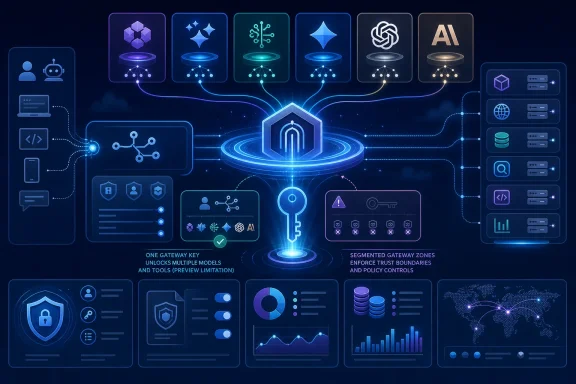
InfoQ first reported the launch, and Microsoft’s accompanying Community Hub announcement and Learn documentation confirm that this is a dedicated Azure API Management tier, available initially in East US 2 and Sweden Central. Microsoft positions it as a way for platform teams to centralize provider credentials, token controls, safety policies, and telemetry while application teams consume a catalog of approved models and tools.
The useful distinction for APIM administrators is that Microsoft has delivered a new operating experience for AI governance, not a clean replacement for the AI gateway features already present in Standard v2, Premium v2, and classic API Management deployments. The new tier lowers the setup burden substantially, but the company has not published a migration or coexistence path for organizations that already run AI traffic through a conventional APIM instance.
A dedicated resource exposes an unresolved coexistence problem
The AI Gateway tier is created as its own Azure resource, managed through a separate AI Gateway portal rather than the Azure portal’s conventional APIM interface. Microsoft says provisioning usually takes about a minute, requires no scale-unit planning, and gives the gateway a dedicated hostname under the normal azure-api.net domain.
That approach is materially different from configuring an API Management service with APIs, products, subscription keys, XML policies, diagnostics, and an existing developer portal. The new portal organizes its control plane around published models, MCP servers, tools, runtime keys, and policy cards. For teams that need to onboard several model providers quickly, that is a much more direct interface than treating each provider deployment as another API import.
But Microsoft’s own documentation still says that the broader AI gateway, including its MCP capabilities, extends the existing API Management gateway and is “not a separate offering.” Both descriptions are technically true, but they describe different layers of the product: APIM’s established tiers retain AI gateway capabilities, while the new AI Gateway tier packages a selected set of them into a separate resource and workflow.
That creates a practical planning gap. Existing APIM customers may already have Azure OpenAI token limits, content filtering, caching, load balancing, API products, subscriptions, private networking, named values, custom policies, and MCP endpoints in production. Microsoft has not published guidance explaining whether those configurations can migrate into the AI Gateway tier, whether they should operate side by side, or whether the new tier will eventually acquire the policy and access-control depth of established APIM tiers.
For now, the new tier should be treated as a greenfield AI gateway for controlled pilots, not as an assumed successor to an enterprise APIM estate.
One OpenAI-compatible endpoint reduces client rewrites
The most useful technical feature is the unified endpoint for OpenAI-compatible providers. Applications point their OpenAI SDK or compatible client at the gateway, supply the gateway runtime key, and select a published backend using the request’s model field. Microsoft documents support for Foundry and Azure OpenAI deployments as well as AWS Bedrock, Google Vertex AI, OpenAI, and other compatible endpoints.
This makes multi-provider routing much less invasive for application teams. A developer can change from a Foundry-hosted model to an approved Bedrock or Vertex model by changing the model name, rather than adding another provider SDK, provider credential, endpoint format, and observability integration to the application.
The tradeoff is centralized naming discipline. Routing is an exact match on the model field, and every published model name must be unique across the gateway. Two teams cannot independently publish an identically named deployment and expect the platform to disambiguate it by provider. Platform owners will need a naming convention before self-service becomes widespread—one that distinguishes provider, model family, environment, and possibly cost or data-residency class.
Anthropic is handled separately through Messages API passthrough rather than the shared OpenAI-compatible route. That is sensible because Anthropic’s API contract differs, but it means “one gateway” does not mean one universal client protocol. Teams using a mixed OpenAI and Anthropic estate still need to preserve the appropriate request format at the application layer.
Microsoft holds backend credentials at the gateway, using managed identity where possible or provider keys where required. That reduces the number of applications handling high-value cloud and model-provider secrets. It also turns the gateway configuration into a more sensitive asset: compromise or overly broad administration rights can expose the credentials and access paths for multiple providers at once.
MCP federation is powerful, but tool selection remains governance work
The tier can turn three kinds of backend into MCP-accessible tools: an existing remote MCP server, operations selected from an OpenAPI definition, or actions exposed through Microsoft’s built-in connector catalog. Microsoft says the connector option covers more than 1,000 SaaS applications and removes the need for a customer to host an MCP server for those integrations.
For an agent platform team, this can eliminate a common integration bottleneck. Instead of asking every internal API owner to build and operate a custom MCP server, the team can publish selected REST operations from an OpenAPI document and expose them through a governed MCP endpoint. Existing remote MCP services can also be federated behind the same gateway boundary.
The word selected matters. An OpenAPI specification can describe safe read operations alongside irreversible changes such as account deletion, ticket closure, payment actions, or production deployment triggers. The gateway can make those operations available as agent tools, but it does not remove the need to decide which operations should be published, which identity calls the backend, and what approval or authorization model governs consequential actions.
Microsoft lets administrators configure no authentication, API key authentication, OAuth 2.0, or managed identity for each backend. That is a useful set of transport choices. It is not, by itself, a declaration that every tool call carries end-user identity or satisfies a business workflow’s authorization requirements. A managed identity can be the right answer for a tightly bounded service operation and the wrong answer for an agent acting on behalf of many users with different entitlements.
Existing APIM MCP documentation also illustrates the difference in maturity between the new streamlined experience and the older service. API Management can expose managed REST APIs as MCP tools, but Microsoft documents no support for MCP resources or prompts in that scenario, and MCP server capabilities are unavailable in APIM workspaces. Teams evaluating the dedicated tier should verify those boundaries in their own region and workflow rather than assume that “MCP support” means full coverage of every MCP capability.
Gateway-scoped keys are the preview’s sharpest limitation
Microsoft’s documentation is unusually explicit: every runtime access key in the AI Gateway tier is gateway-scoped, granting access to all published models and tools. Per-asset key scoping is not available in the preview.
Policies can still be applied to selected assets. Token rate limits apply to models, while content safety, IP filtering, and request-rate controls can cover both models and MCP tools. That lets a platform team limit or protect particular backends after a caller reaches the gateway. It does not make the runtime key itself a least-privilege entitlement to one model, one tool server, or one product bundle.
That is a significant departure for organizations that use conventional API Management subscriptions as a consumer-access boundary. In established APIM, subscription keys can be scoped to a product, a single API, all APIs, or the service-wide all-access subscription. Products allow administrators to group APIs and issue consumer keys only for that bundle. The AI Gateway tier currently has a simpler model: one application key per gateway, with every asset on that gateway reachable in principle.
Microsoft recommends one key per application and environment. That is good operational hygiene for rotation, attribution, and revocation. It does not reduce the asset-level blast radius of a leaked key. If a gateway contains a low-risk summarization model, a premium reasoning model, an internal HR tool, and a production ticketing connector, the same application credential can address all four.
The immediate mitigation is architectural rather than configurational: separate gateways by trust boundary. A gateway for developer experimentation should not automatically share a keyspace with regulated customer-data tools or production change-management actions. Organizations that require product-style entitlements should retain conventional APIM controls, layer their own authorization upstream, or wait for per-asset runtime access controls before consolidating sensitive tools into one AI Gateway resource.
Cost governance is promised before pricing exists
Microsoft’s pitch emphasizes token metrics, rate limits, and centralized visibility. The gateway emits OpenTelemetry data including token counts and latency, and customers can export telemetry to Application Insights or other OpenTelemetry-compatible destinations such as Datadog and Grafana.
That is useful for chargeback analysis and detecting runaway applications, particularly when requests are split across Foundry, Bedrock, Vertex, OpenAI, and Anthropic. It does not yet establish a cost-control product. Provider billing remains external to the gateway, and Microsoft says pricing and the business model for the AI Gateway tier will be announced later in the preview.
The preview documentation also says that quotas can limit models, tools, runtime keys, request throughput, and token throughput, while withholding the specific limits until before general availability. Availability is best effort with no SLA, and Microsoft warns that APIs, portal workflows, telemetry, regions, limits, and pricing may all change.
Those conditions make the appropriate first deployment narrow: a noncritical model catalog, a small number of approved tool operations, per-application keys, and telemetry routed to an existing monitoring system. The tier is a credible simplification for multi-model pilots, but its access model and unknown price structure make it premature as the sole control point for a broad production agent platform.