

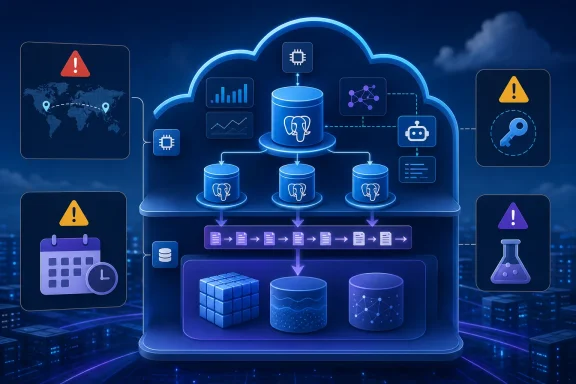
InfoWorld frames the question as whether enterprises should keep waiting after nine months of HorizonDB preview status. The underlying timeline is more complicated. Microsoft first announced HorizonDB at Ignite 2025, roughly nine months ago, but its public preview did not begin until Microsoft Build on June 2, 2026. As of August 10, the service has been publicly available for about two months, not nine.
That correction does not make the general-availability question disappear. Microsoft has not announced a GA date, and its own Azure product page continues to label HorizonDB as Preview. But it changes the judgment: HorizonDB is not a public-preview service that has sat unchanged for three quarters. It is a new service whose first broadly accessible release arrived this summer, with the ordinary—but still consequential—limitations of an early cloud database offering.
HorizonDB is PostgreSQL, not a replacement for it
Calling HorizonDB a “PostgreSQL alternative” risks obscuring what Microsoft has actually built. Microsoft describes Azure HorizonDB as a fully managed, cloud-native service built on PostgreSQL and explicitly promises PostgreSQL compatibility for existing applications. The intended alternative is self-managed PostgreSQL running on virtual machines or an enterprise’s own infrastructure—not PostgreSQL’s SQL dialect, extension model, or developer ecosystem.
The design is also different from Azure Database for PostgreSQL Flexible Server, Microsoft’s established managed PostgreSQL offering. Flexible Server remains the general-purpose option for conventional application databases. HorizonDB is aimed at larger or more volatile operational workloads where compute and storage must scale independently, read replicas need to come online quickly, and infrastructure teams do not want to shard data manually.
Microsoft’s architecture uses disaggregated compute and storage plus a database-as-a-log design. Compute replicas run the PostgreSQL engine, while the service writes transaction log data—PostgreSQL’s write-ahead log, or WAL—to separate durable storage. Storage nodes reconstruct database pages from that log. In theory, that eliminates several familiar pain points in large PostgreSQL deployments: checkpoint pressure, data-copying delays for replicas, and an increasingly awkward coupling between database size, IOPS, and compute capacity.
That is a meaningful technical direction, but customers should distinguish architecture from demonstrated outcomes. Microsoft advertises support for up to 128 TB of storage and 3,072 vCores across primary and replica nodes, as well as substantial transactional-performance improvements over self-managed PostgreSQL. The company has not published enough independent benchmark material to let buyers translate those numbers into a sizing decision against their own Aurora PostgreSQL, AlloyDB, Flexible Server, or self-hosted PostgreSQL deployment.
For now, HorizonDB’s strongest case is organizational rather than universal: an Azure-standardized company with an existing PostgreSQL application, an Azure AI Foundry investment, and a credible forecast for high read scale may be able to reduce operational complexity. That is a narrower proposition than “the database for agentic AI.”
The preview limitations collide with enterprise requirements
Microsoft’s documentation is unusually direct about several capabilities HorizonDB does not yet offer. The omissions are the practical reason an enterprise should not plan a production migration around a future GA date.
HorizonDB currently has seven days of backup retention. Configurable retention from one to 35 days is listed as forthcoming, while long-term retention is unavailable. It also lacks cross-region read replicas, which means the service does not presently provide a native cross-region replication path for disaster recovery. There is no customer-managed key option for data at rest, no configurable maintenance window, no built-in PgBouncer connection pooling, and no virtual-network injection; Microsoft currently supports Private Link instead.
Each limitation has a different operational consequence:
- A seven-day retention ceiling can be inadequate for recovery procedures that must cover monthly close, delayed discovery of corruption, or retention rules imposed by a regulated business.
- No cross-region read replicas rules HorizonDB out for organizations whose recovery objectives require a warm standby outside the primary Azure region.
- Service-managed encryption keys may be unacceptable for customers whose key-management controls require customer control, rotation, or revocation through Azure Key Vault.
- System-managed maintenance timing introduces a change-control risk that many production database teams will not accept without a defined window.
- The lack of a managed connection pooler matters for serverless applications, API tiers, and agent frameworks that can create bursts of short-lived PostgreSQL sessions.
Microsoft does provide high availability within a region. The architecture uses zone-resilient storage, and a cluster can use multiple compute replicas, with one writable primary and readable standbys that can take over after a failure. That is useful availability engineering. It is not the same as a disaster-recovery design spanning regions.
The service’s region footprint is also smaller than the launch messaging suggested it would soon become. At public-preview launch, Microsoft said HorizonDB was available in Australia East, Central US, Sweden Central, West US 2, and West US 3, with East US, Canada Central, Indonesia Central, Italy North, Japan East, Korea Central, and Poland Central expected in the following weeks. Microsoft Learn now lists six available regions: Australia East, Central US, East US, West US 2, West US 3, and Sweden Central.
East US has joined the initial set, but the other six regions cited in the June announcement do not appear in the current documentation. Two months is not a dramatic delay for a new distributed database service, yet the difference is relevant for global organizations: regional availability remains an active rollout, not a completed launch.
AI integration is convenient, but it is not a reason to pause a project
Microsoft’s pitch joins vector embeddings, vector search, AI model management, AI pipelines, Azure AI Foundry tooling, Microsoft Entra ID, and Fabric mirroring around the operational PostgreSQL database. The attraction is clear. A team could keep transactional data, application metadata, embeddings, retrieval queries, authentication, and downstream analytics closer together instead of assembling a patchwork of database extensions, vector stores, identity policies, and ETL jobs.
That integration can reduce time spent assembling a platform. It does not remove the hard design questions behind an AI application. Teams still need to decide whether a relational database is the right store for their embedding volume and query pattern, how data is segmented and retained, where model calls occur, how access controls apply to retrieved records, and how they will evaluate retrieval quality and agent actions.
The critical point is that Azure customers do not need to wait for HorizonDB to build those workloads. Azure Database for PostgreSQL Flexible Server already supports pgvector and has added AI-oriented capabilities of its own, including Azure AI-related functions and Microsoft Foundry integration. Existing PostgreSQL services on AWS and Google Cloud likewise offer mature managed deployment options, while Databricks and Snowflake target adjacent transactional-plus-AI and analytics-plus-AI scenarios.
InfoWorld is right that HorizonDB enters a crowded market. But the relevant comparison is not a simple race to attach “AI” to a database. HorizonDB is competing where operational compatibility, scale-out PostgreSQL behavior, Azure-native identity and networking, and Fabric integration converge. A company that needs a cloud data warehouse, large-scale data engineering, model training, or a cross-cloud analytical layer may still find Databricks, Snowflake, BigQuery, or Fabric more central to its architecture than any operational PostgreSQL service.
What Microsoft still needs to prove before GA
A general-availability label alone will not settle whether HorizonDB deserves to displace Flexible Server, Aurora PostgreSQL, AlloyDB, or an established self-managed PostgreSQL estate. The practical test will be whether Microsoft closes the documented operational gaps and publishes service commitments that make the platform fit normal enterprise procurement.
The company should clarify at least four issues before expecting risk-averse customers to migrate critical workloads: its GA schedule, its service-level agreement, the availability of cross-region recovery, and the roadmap for customer-managed keys and retention. It should also be clearer about migration boundaries. “Full PostgreSQL compatibility” is a useful goal, but enterprises need a precise inventory of supported PostgreSQL versions, extensions, superuser-equivalent operations, logical replication behavior, backup and restore paths, and performance caveats before moving an application that has accumulated years of extension dependencies.
There is a pricing model already: Microsoft says HorizonDB charges for provisioned compute by core-hour, database storage by GB-month, and short-term backup storage. What remains more important than the billing categories is cost predictability under the architecture HorizonDB promotes. Independent compute and storage scaling can be efficient, but a large fleet of read replicas, continuous vector-index updates, and AI-adjacent workloads can create a bill that looks very different from a conventional primary-and-standby PostgreSQL deployment. Microsoft’s public claims do not yet provide enough real-world usage data to answer that question.
HorizonDB is worth evaluating now if it matches a specific scale-out PostgreSQL problem and the workload can tolerate preview status. It is not worth delaying a production AI project for. Teams needing to ship this year should use the managed PostgreSQL platform they can operate, secure, back up, and recover today—and treat HorizonDB as a controlled pilot until Microsoft turns its architectural promise into production commitments.