
The operational change is already generally available, according to Microsoft’s Azure SQL team, and Petri’s reporting correctly identifies the immediate administrative benefit: a planning gate has disappeared. But the more consequential change is in the conversion rule Microsoft documents for existing customers. A previously approved regional vCore allowance is being carried forward at the same amount for each supported hardware generation in that region, rather than being split among them.
For organizations that had increased their Azure SQL Managed Instance quota in the past, that is substantially more than a portal cleanup. It changes how much entitlement the subscription can have on paper across the three hardware families—while leaving actual regional hardware availability as a separate constraint.
 The subnet quota is gone, but subnet planning is not
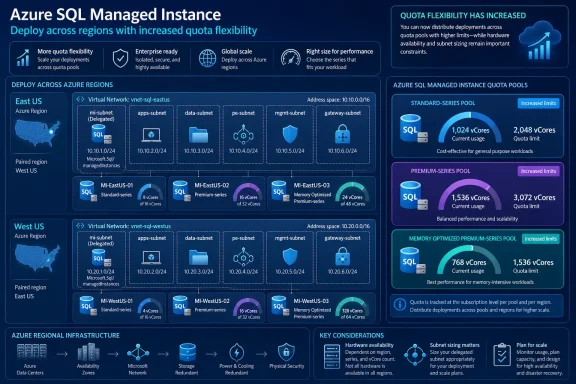
Microsoft’s updated quota guidance says there is now no limit on the number of subnets in which a subscription can deploy Azure SQL Managed Instance. The old SQL Managed Instance-specific regional subnet count has been retired; Microsoft’s resource-limits documentation says the change took effect in August 2026.
That removes a surprisingly awkward hurdle for enterprises that separate production environments, business units, network zones, or disaster-recovery infrastructure into distinct virtual networks. Under the old model, a deployment could have adequate address space, valid delegated subnets, and funding approval yet still require a support request because the subscription had reached its Managed Instance subnet entitlement in that Azure region.
Administrators should not read the announcement as permission to treat Managed Instance networking casually. Each instance still requires a dedicated, delegated subnet in an Azure virtual network. That subnet cannot host ordinary virtual machines or gateway resources, must be delegated to Microsoft.Sql/managedInstances, and needs the network configuration required for Microsoft’s service management traffic.
The capacity of a subnet also remains a practical ceiling. Microsoft’s networking documentation says that a Managed Instance deployment needs at least 32 IP addresses, and that sizing must account for the number of instances, service tiers, hardware configurations, maintenance configurations, and management operations. The subnet range cannot simply be resized after Managed Instance resources are deployed inside it.
In other words, Microsoft removed a subscription-level counting quota, not the networking architecture behind the service. Teams can create and use more Managed Instance subnets without asking Azure support for a service-specific limit increase, but they still need to reserve address space correctly before deployment. A poorly sized /27 does not become expandable because the regional subnet quota has vanished.
Microsoft has split a shared vCore quota into three pools
The vCore change deserves closer attention than the subnet change. Previously, Azure SQL Managed Instance used one regional vCore unit limit across supported hardware generations. A deployment on Standard-series consumed from the same regional allowance as one on Premium-series or Memory Optimized Premium-series.
Microsoft now scopes the allowance separately to each hardware generation:
- Standard-series, previously identified as Gen5 hardware, has its own regional quota.
- Premium-series has a distinct regional quota.
- Memory Optimized Premium-series has a distinct regional quota.
This aligns quota management with a real purchasing and deployment choice. Premium and memory-optimized hardware are not universally available in every Azure region where SQL Managed Instance exists, while Standard-series is broadly available. Customers planning a migration around a higher-memory SKU may now request the capacity they need for that hardware family without changing the quota attached to their Standard-series estate.
The distinction is also important because Azure measures this limit in vCore units, not always in the vCore number displayed when provisioning an instance. Microsoft says one General Purpose vCore consumes one unit, but one Business Critical vCore consumes four units. A 16-vCore Business Critical instance therefore draws 64 vCore units from the applicable regional hardware-generation pool.
That multiplier has long made Managed Instance quota planning prone to surprises. A team might interpret a regional allowance as enough for several Business Critical instances by adding their advertised vCore counts, then discover that the quota calculation is four times higher. The new model does not alter that formula; it applies the same formula separately within each hardware generation.
Microsoft’s published defaults also remain subscription-dependent. Enterprise Agreement and Cloud Solution Provider subscriptions normally receive 960 vCore units per region, rising to 1,440 units in selected regions. Pay-as-you-go subscriptions normally begin at 320 units, while some Visual Studio and sponsored offers have lower defaults. Those figures are now evaluated per hardware generation, rather than as one combined regional amount.
The automatic conversion is more generous than the announcement suggests
Microsoft says existing regional vCore limits will be automatically converted, with no action required from customers. Its quota-request documentation adds the detail missing from the initial announcement: an existing regional quota increase is carried forward as the same amount for Standard-series, Premium-series, and Memory Optimized Premium-series in that region.
For example, if an organization previously had its Managed Instance regional limit raised to 960 vCore units, Microsoft says that allowance becomes 960 units for Standard-series, 960 for Premium-series, and 960 for Memory Optimized Premium-series. The new structure can therefore create a much larger aggregate quota envelope than the customer had under the single shared pool.
That does not mean an organization can instantly deploy three times as much database compute in every region. Microsoft’s resource-limit page calls these subscription limits default settings rather than technical limits, and its regional availability documentation separately warns that limited hardware capacity can temporarily block new instances or changes to existing instances. A quota approval determines what the subscription is permitted to request; it does not turn unavailable infrastructure into available capacity.
This is especially relevant for Premium-series and Memory Optimized Premium-series plans. Microsoft lists both as available only in particular regions, and its regional documentation specifically warns that some configurations can be temporarily blocked by regional capacity constraints. An administrator who sees a healthy new quota in the Azure portal may still need to change hardware generation, select another compliant region, or wait for capacity to return.
Still, the conversion has a real effect on planning. A company that previously avoided a Premium-series test or migration because it would consume room needed by its Standard-series production estate can now assess each hardware pool independently. The capability creates room for more deliberate workload placement: Standard-series for broadly compatible deployments, Premium-series for workloads that benefit from the newer platform, and memory-optimized hardware where RAM-per-vCore is the governing factor.
The portal is now the control point—and runbooks need updating
Microsoft says administrators can view and manage the new hardware-specific limits in the Azure portal. The support workflow remains familiar: create a support request under service and subscription limits, select SQL Database Managed Instance as the problem type, choose the region, and enter the desired capacity. What changes is the request target: capacity is now identified by hardware generation rather than a single combined regional vCore limit.
Infrastructure teams should update internal quota runbooks, deployment pipelines, and preflight checklists accordingly. Any automation or documentation that asks, “Do we have enough SQL Managed Instance vCores in this region?” is now incomplete. The question needs a hardware qualifier, and for Business Critical workloads it must translate requested vCores into the four-to-one vCore-unit consumption Microsoft uses for the regional limit.
A practical review should include:
- Audit current Managed Instance deployments by region, hardware generation, service tier, and vCore-unit consumption.
- Record the converted portal quota for all three hardware generations instead of relying on historical regional quota records.
- Recalculate Business Critical expansion plans using four vCore units for every provisioned vCore.
- Check the target region’s hardware availability before treating a quota increase as a deployment commitment.
- Preserve subnet sizing and delegated-subnet validation in deployment gates, even though the service-specific subnet quota check can be removed.
Microsoft’s documentation now reflects the August change, though organizations should expect older internal guides, cached portal screenshots, and third-party deployment playbooks to retain the obsolete subnet-quota language for some time. The important correction is straightforward: no separate SQL Managed Instance subnet entitlement remains to manage.
The remaining constraint is more concrete. Azure SQL Managed Instance capacity is now governed by the right combination of factors—valid network design, region and hardware availability, service-tier consumption, and a hardware-specific vCore quota—rather than a legacy regional limit on how many dedicated subnets a customer may use.
