
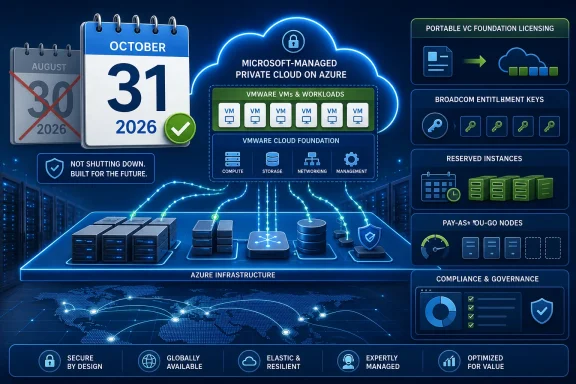
That difference is more than calendar housekeeping. An AVS shutdown would force customers into a hurried platform migration, potentially to native Azure infrastructure, another VMware host, or an alternative hypervisor. Microsoft’s published guidance instead describes a licensing transition: customers that continue running affected pay-as-you-go AVS nodes after October 31 must register portable VMware Cloud Foundation, or VCF, subscriptions purchased from Broadcom.
SDxCentral correctly identifies the larger trend: Broadcom has pushed hyperscalers away from selling VMware software as part of their own managed-cloud SKUs and toward a bring-your-own-license model. But the article conflates the retirement of Microsoft-supplied VCF licensing for some AVS consumption with retirement of Azure VMware Solution itself. Microsoft has explicitly said the AVS service remains a Microsoft-managed VCF private-cloud offering on Azure.
For Windows and infrastructure teams, the immediate job is not to evacuate AVS by August 30. It is to identify which AVS hosts are covered by reserved instances, which remain on license-included pay-as-you-go billing, and which new capacity already requires a Broadcom VCF entitlement.
 Microsoft ended new bundled VCF sales in 2025
Microsoft first laid out the AVS licensing change in September 2025, after Broadcom announced that hyperscaler customers would need portable VCF subscriptions. Microsoft stopped selling new Azure VMware Solution nodes with a VCF subscription included after October 15, 2025. From October 16, 2025 onward, customers buying new AVS nodes had to supply a VCF subscription purchased directly from Broadcom or an authorized Broadcom partner.
The crucial point is that this was a change in who supplies the VMware license, not a withdrawal of AVS. Microsoft continues to provide the Azure infrastructure, dedicated hosts, service operations, platform patching, and host-level VMware software management. The customer’s new responsibility is obtaining, tracking, renewing, and registering the VCF entitlement that Broadcom now requires.
Microsoft’s latest AVS portability guidance is unusually explicit on this distinction. It says VCF subscriptions are no longer included with new AVS node purchases, while also describing how customers can deploy and manage AVS private clouds with portable VCF. The portal even permits VCF portability to be applied per AVS private cloud rather than requiring a single all-or-nothing change across an Azure subscription.
That per-private-cloud flexibility matters for organizations that built AVS estates across regions, business units, or separate Azure subscriptions. A team can move a new or expanding private cloud to BYOL while keeping an older private cloud under an existing license-included commitment, where eligible. This is a billing and compliance split that administrators will have to track deliberately; it is not a platform migration.
The October 31 deadline applies to pay-as-you-go nodes
Microsoft says license-included AVS pay-as-you-go deployments can keep operating without licensing or product changes through October 31, 2026. Beginning November 1, those deployments must use the VCF BYOL model to remain compliant with Broadcom’s terms.
Existing reserved instances are treated differently. If an organization bought an AVS reserved instance with VCF included on or before October 15, 2025, Microsoft says the customer can continue using those covered nodes with the included licensing until the reserved-instance term expires. A three-year reservation is therefore not cut short simply because the market has moved to BYOL.
This is the most important correction to the implication in SDxCentral that every license-included reserved-instance customer must convert immediately or face disruption at the end of August. Microsoft’s guidance says those reservations are honored through their original terms. The organization may choose to exchange an eligible license-included AVS reservation for the equivalent VCF BYOL reservation, but it is a transition option, not an across-the-board August 30 service termination.
The deadline does have teeth for pay-as-you-go customers. Microsoft’s documentation warns that after October 31, 2026, license-included pay-as-you-go AVS deployments will no longer comply with Broadcom licensing requirements. It also reserves the right to suspend a private cloud that is out of compliance. That is a licensing-enforcement risk, but it should not be mistaken for a Microsoft decision to sunset AVS.
Administrators should also separate the licensing deadline from an unrelated set of Azure hardware and VM-series retirements. Azure routinely retires individual VM families and AVS node configurations. Those product-specific retirements can require host migration or replacement, but they are distinct from the VCF portability policy.
A VCF license is now part of AVS capacity planning
Under the portable VCF model, an AVS administrator needs more than an approved Azure quota and a reserved host SKU. Microsoft’s portal requires the VCF subscription key, Broadcom site ID, serial number, license expiration date, and the number of VCF cores allocated to the private cloud. The registered core total must match the number of deployed BYOL cores.
That creates a new operational dependency between Azure capacity management and Broadcom contract management. A cloud team may have enough AVS host quota in a target Azure region but still be unable to expand compliantly if its VCF entitlement does not cover the additional cores. Conversely, a procurement team may own a sufficient VCF commitment but need to allocate it accurately across multiple private clouds.
Microsoft supports mixed environments in limited, practical ways. An AVS private cloud can retain existing hosts covered by a license-included reserved instance while new hosts use portable VCF. The same Azure subscription can also contain different AVS private clouds using different licensing arrangements. This provides a phased path for capacity expansion, but it also makes asset inventory more important than before.
Teams using VMware vDefend Firewall need a separate check. Microsoft says some customers with active VCF-included reservations and firewall enabled before October 16, 2025 can retain eligible firewall-core use until the reservation expires. New firewall use beyond those eligible cores, or use after the reservation term, requires a Broadcom-supplied VCF vDefend add-on entitlement. Treating the base VCF conversion as complete without reviewing firewall licensing can leave an AVS estate out of compliance.
A sound near-term review should include the following:
- Identify every AVS private cloud and classify each host as VCF BYOL, license-included reserved instance, or license-included pay-as-you-go.
- Confirm the expiration date and host coverage of every AVS reserved instance, rather than assuming all license-included capacity reaches the same deadline.
- For pay-as-you-go capacity still using bundled VCF, acquire and register Broadcom portable VCF entitlement before October 31, 2026.
- Match purchased VCF core capacity to deployed BYOL host cores, including planned scale-out and disaster-recovery capacity.
- Review vDefend Firewall and other VMware add-ons separately, because their eligibility and entitlement requirements can differ from the base AVS hosts.
Oracle and AWS show the broader cloud-market shift
The core premise of SDxCentral’s reporting is still valid: Broadcom’s subscription policy is changing the commercial structure of VMware services across public clouds. Oracle Cloud VMware Solution began its BYOL transition earlier this year. Oracle’s published schedule ended new long-term license-included OCVS SKUs on March 22, 2026, and required BYOL for all new capacity after May 20, while allowing existing committed deployments to continue through their existing terms.
Amazon has taken a different product route after the end of VMware Cloud on AWS. Amazon Elastic VMware Service, generally available since August 2025, runs VMware Cloud Foundation directly inside an Amazon Virtual Private Cloud on supported EC2 bare-metal instances. AWS describes the offering as built around VCF license portability, leaving the customer with VMware licensing control rather than bundling the stack into the older VMware Cloud on AWS commercial model.
Azure, Oracle, and AWS therefore differ in service design and transition dates, but the commercial pattern is consistent: Broadcom wants the VCF subscription relationship to sit directly with the enterprise customer. Hyperscalers can still provide infrastructure and managed service layers, but the familiar model in which VMware licensing quietly arrived as part of a cloud bill is disappearing.
That model changes budgeting as well as administration. An AVS bill may fall when a customer moves from a license-included SKU to a BYOL SKU, but the VMware software cost does not vanish; it moves to a separate Broadcom purchase and subscription-renewal process. Comparing only Azure consumption before and after the change can produce a misleading cost picture.
Broadcom’s VCF savings case needs a narrower reading
Broadcom is promoting VMware Cloud Foundation as a platform that can improve consolidation, workload placement, storage efficiency, and operational consistency. The Forrester Consulting study cited by SDxCentral projects three-year benefits of $20 million to $36.1 million and a 31% to 137% return on investment for composite large-enterprise VCF users.
Those figures should be read as vendor-sponsored scenario analysis, not a price list or an independently observed outcome for AVS customers. The study itself acknowledges that VCF subscriptions can cost more than legacy licensing approaches. Its projected return depends on broader operational savings from standardization, infrastructure consolidation, automation, and integrated networking and security capabilities.
For an AVS customer, the relevant question is more concrete: does maintaining VCF compatibility in Azure avoid enough migration work, refactoring risk, hardware operations, and application disruption to justify the separate Broadcom subscription? The answer will vary sharply by estate. A heavily customized VMware environment with strict recovery objectives may value continuity highly; an organization already moving workloads toward Azure-native services may see the licensing change as an opportunity to accelerate that plan.
Microsoft has not announced an end date for Azure VMware Solution. The deadline AVS customers should put on their operational calendars is October 31, 2026, for license-included pay-as-you-go nodes. Reserved-instance customers should plan around their own commitment expiration dates, while every organization adding new AVS capacity should assume it needs portable VCF entitlement from Broadcom.