
Bangladesh has opened the National Semiconductor Symposium & BEAR Summit 2026 in Dhaka, putting talent development, deep-tech startups and international partnerships at the center of its push to build a domestic chip industry.
The two-day event began July 25 at the Novotheatre, according to The Daily Star. Prime Minister Tarique Rahman inaugurated both the summit and the accompanying BEAR Innovation Expo 2026, where students, startups and technology companies presented semiconductor and deep-tech projects.
Organised by the Bangladesh Semiconductor Industry Association, BEAR and Silicon River Bangladesh, the summit is framed around “Building Bangladesh’s Semiconductor Future through Global Partnership.” That wording is important: Bangladesh is not announcing a near-term leading-edge fabrication plant. Its immediate task is creating the people, research capacity, design capability and supplier relationships needed to participate in a capital-intensive global industry.
Texas Instruments CTO Ahmed Bahai delivered a keynote during the opening programme, followed by panels on semiconductor skills, ecosystem development and global industry cooperation. Participants included GlobalFoundries, NXP Semiconductors, Ulkasemi, Prime Silicon, Neural Semiconductor, BUET, Arizona State University and the University of Saskatchewan.
For Windows developers and IT professionals, this reflects where emerging semiconductor ecosystems can make practical progress first: chip design, embedded software, validation, firmware, engineering services and specialized tooling. Those activities demand far less fixed investment than wafer fabrication while still creating pathways into global supply chains.
Bangladesh already has a large pool of software and engineering talent, but semiconductors require a different level of sustained coordination. Companies need experienced circuit designers, verification engineers, packaging specialists and embedded developers; universities need laboratories and industry-linked research; startups need customers beyond demonstration projects.
The BEAR Innovation Expo offers a visible starting point, but the harder work begins after the exhibition stalls close. Bangladesh’s semiconductor ambition will be judged by whether the roadmaps create repeatable routes from student projects and research labs to commercially viable design, engineering and deep-tech businesses.
The two-day event began July 25 at the Novotheatre, according to The Daily Star. Prime Minister Tarique Rahman inaugurated both the summit and the accompanying BEAR Innovation Expo 2026, where students, startups and technology companies presented semiconductor and deep-tech projects.
Organised by the Bangladesh Semiconductor Industry Association, BEAR and Silicon River Bangladesh, the summit is framed around “Building Bangladesh’s Semiconductor Future through Global Partnership.” That wording is important: Bangladesh is not announcing a near-term leading-edge fabrication plant. Its immediate task is creating the people, research capacity, design capability and supplier relationships needed to participate in a capital-intensive global industry.
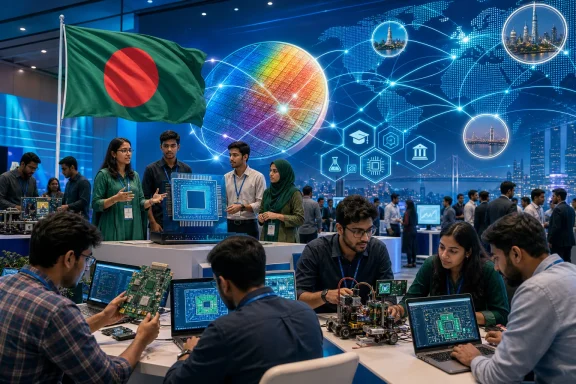 The Near-Term Bet Is Talent and Design
Texas Instruments CTO Ahmed Bahai delivered a keynote during the opening programme, followed by panels on semiconductor skills, ecosystem development and global industry cooperation. Participants included GlobalFoundries, NXP Semiconductors, Ulkasemi, Prime Silicon, Neural Semiconductor, BUET, Arizona State University and the University of Saskatchewan.For Windows developers and IT professionals, this reflects where emerging semiconductor ecosystems can make practical progress first: chip design, embedded software, validation, firmware, engineering services and specialized tooling. Those activities demand far less fixed investment than wafer fabrication while still creating pathways into global supply chains.
Eight Roadmaps Will Be the First Test
The summit’s closing session is expected to unveil eight strategic national frameworks and roadmaps for Bangladesh’s semiconductor ecosystem. The value of those plans will depend on whether they attach measurable commitments to university curricula, workforce training, intellectual-property policy, export support, power reliability and access to electronic-design-automation tools.Bangladesh already has a large pool of software and engineering talent, but semiconductors require a different level of sustained coordination. Companies need experienced circuit designers, verification engineers, packaging specialists and embedded developers; universities need laboratories and industry-linked research; startups need customers beyond demonstration projects.
The BEAR Innovation Expo offers a visible starting point, but the harder work begins after the exhibition stalls close. Bangladesh’s semiconductor ambition will be judged by whether the roadmaps create repeatable routes from student projects and research labs to commercially viable design, engineering and deep-tech businesses.
References
- Primary source: thedailystar.net
Loading…
www.thedailystar.net