
TechPowerUp first highlighted the launch, while Universal Blue’s Bazzite team describes it as the largest rework yet of its Deck images. The headline package upgrades are substantial: Bazzite 44 moves stable users from kernel 6.17.7 to the Open Gaming Collective’s 7.2.0 kernel, advances Mesa from 26.0.4 to 26.2.1, and updates KDE Plasma, GNOME, firmware, Gamescope, and NVIDIA driver branches in the same deployment. But the meaningful change for handheld users is the replacement of the software layer that previously made non-Valve portable PCs feel coherent.
Bazzite is also ending its one-time split between desktop and handheld image update schedules. Universal Blue says all images will now update together, removing the period in which handheld users remained on an older Fedora base while Bazzite desktop images had already advanced. That should reduce the lag in kernel, Mesa, and security updates for handheld installations, although it also means gaming-mode changes will arrive in the same broad cadence as desktop platform updates.
 Handheld Daemon is out; SteamOS-aligned tooling is in
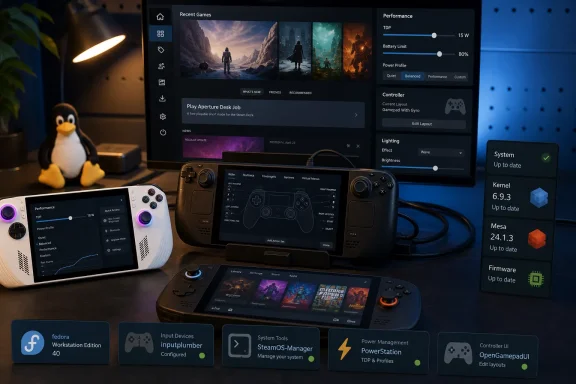
Bazzite 44 retires Handheld Daemon, or HHD, as the central layer for handheld controls. HHD had handled controller emulation, button behavior, power settings, RGB lighting, fan settings, and assorted device-specific functions. Its replacement is a four-part stack made up of InputPlumber, SteamOS-Manager, PowerStation, and OpenGamepadUI.
InputPlumber is now responsible for controller handling, emulation, and remapping. SteamOS-Manager takes on tasks including session switching and Steam-facing power controls. PowerStation remains available for devices whose power features cannot be exposed directly through SteamOS-Manager. OpenGamepadUI supplies an overlay for settings that Steam’s own interface does not currently offer.
This is more than a renamed utility. Bazzite is deliberately moving closer to the control model used by SteamOS and several other Linux gaming distributions. Universal Blue announced the direction in January when it joined the Open Gaming Collective, a collaboration intended to consolidate Linux gaming kernel patches, controller support, and essential packages rather than leave each distribution carrying its own divergent hardware stack.
For Windows handheld owners considering a Linux installation, that consolidation is the real significance of Bazzite 44. Windows remains the manufacturer-supported option for firmware tooling and vendor utilities on many devices, but every portable PC vendor also ships a different control center with different quality, update habits, and driver dependencies. Bazzite’s pitch is that it can present a Steam Deck-like interface across that uneven hardware field. Version 44 is the project’s attempt to replace a Bazzite-specific compatibility layer with components shared across more of the Linux gaming world.
TDP control has moved into Steam’s interface
The practical adjustment users will notice first is power control. In Bazzite 44, TDP control is intended to live in Steam’s Quick Access Menu rather than a separate HHD panel. OpenGamepadUI exposes additional controls, including Boost settings where supported, while PowerStation handles power features on machines that SteamOS-Manager does not yet fully support.
That architecture is cleaner on paper, but it is also a migration. A handheld configured around HHD’s controls may not present the same menu locations, defaults, or options immediately after updating. Universal Blue specifically warns that Steam can hide the TDP slider on some hardware unless the user selects the performance option under performance profiles. That is a support detail that matters: an absent slider does not automatically mean that Bazzite has lost power-control support.
The launch announcement says the OpenGamepadUI overlay is enabled by default only on non-Valve handhelds. It can be toggled with Bazzite’s configuration tooling. Valve hardware already has SteamOS-native expectations; machines such as the ROG Ally and Legion Go need the overlay to surface the functions Valve’s standard Steam interface does not expose.
Users who rely on a handheld as a docked desktop should treat the HHD removal as a configuration change, not a routine driver refresh. Controller disable behavior, external-controller priorities, RGB controls, fan curves, gyro mapping, and mouse-mode shortcuts can all be tied to the retired stack. Before installing the update, document any custom HHD configuration and take note of which controls matter for your device. The update is designed to preserve the operating-system deployment, but it cannot preserve an interface that no longer exists.
The release fixes the stale-handheld problem, but it is a broad platform jump
The official GitHub release record shows that Bazzite stable had previously been on 43.20260420, released in April. The move to 44.20260820 therefore combines roughly four months of accumulated platform changes with the handheld-control rewrite. This is exactly the kind of release where a clean-looking version number can understate operational risk.
Alongside the handheld stack, Bazzite 44 brings kernel 7.2.0-ogc4.1, firmware dated August 10, Mesa 26.2.1, Gamescope, InputPlumber 0.78.0, OpenGamepadUI 0.46.0, PowerStation 0.8.1, SteamOS-Manager, KDE Plasma 6.7.4, GNOME 50.4, and updated NVIDIA driver branches. The stable image also enables bpftune by default, a BPF-based tuning service. These changes may improve hardware support and performance behavior, but they expand the number of variables involved when troubleshooting display, sleep, controller, network, or dock issues.
The release record also shows new and adjusted tooling around HDMI 2.1, AMD variable-refresh-rate configuration, HDMI-CEC behavior, switchable graphics, SSH management, and boot-time service behavior. Those are useful improvements for living-room PCs and docked handhelds, but they also explain why this should not be handled as a zero-risk “update for more FPS” release.
Early user reports on Bazzite’s Reddit community reflect that mixed reality. Some users report smooth upgrades and working VRR. Others describe lost controller mappings, absent TDP controls, RGB issues, docked-controller problems, Wi-Fi credentials needing to be entered again, and third-party Decky plugins crashing after the platform change. These reports are not proof of a universal defect, and no broad hardware failure has been established. They do show that device-specific validation remains necessary, particularly for non-Valve handhelds that depended heavily on HHD.
Bazzite’s rollback model is useful, but it does not make experimentation consequence-free
Bazzite is an image-based, immutable distribution built on Fedora Atomic Desktop technology. In normal use, operating-system updates are prepared as a new deployment and activated after a restart; an older deployment remains available for rollback. That design is one reason Bazzite is attractive to users moving from Windows or conventional Linux distributions: a bad system update does not necessarily require repairing a partially modified root filesystem by hand.
However, “immutable” does not mean every command, script, Flatpak, game prefix, BIOS flash, controller firmware update, or home-directory change is safe to run blindly. Rollback primarily protects the managed operating-system image. It does not guarantee recovery of changed game data, altered Steam controller profiles, custom configuration in a user’s home directory, or peripheral firmware. It also does not turn speculative commands from an AI assistant into good operational advice.
For Bazzite 44, the safe approach is straightforward:
- Confirm the current deployment and retain the previous Bazzite 43 deployment until the new handheld controls have been tested.
- Test Gaming Mode, Desktop Mode, sleep and wake, physical controls, TDP adjustment, audio, Wi-Fi, Bluetooth, external displays, and any dock before removing the prior deployment.
- Verify controller behavior both handheld and docked, especially if a game or emulator depends on disabling the built-in controller.
- Avoid assuming that a missing menu item means a feature has vanished; Steam performance-profile settings and OpenGamepadUI may now expose the relevant control.
- Expect Decky plugins and other software that hooks into Steam’s interface to require updates after this release.
Bazzite’s own documentation continues to position Bazzite-Deck as an image that boots directly into Steam Gaming Mode while retaining a Desktop Mode session. That makes it a credible alternative interface for a Windows handheld, rather than a general-purpose Linux desktop awkwardly placed on a seven-inch screen. But the Bazzite 44 launch makes clear that “SteamOS-like” depends on an active hardware enablement layer, and that layer has changed wholesale.
The first post-launch fixes are already in testing
There is an important timing detail for anyone upgrading immediately. Bazzite’s stable release landed on August 20, while testing images published on August 21 already included fixes for persistent SteamOS login-mode behavior and another pass at the HDMI 2.1 toggle. A separate testing build also added a potential fix for some NVIDIA Gamescope problems.
Those fixes are evidence that the project is actively responding after the launch, but they are not yet a reason for stable users to assume the issues are resolved on their installed image. The current stable release remains 44.20260820. Users with a working Bazzite 43 handheld setup, especially those relying on a nonstandard dock, controller arrangement, NVIDIA graphics, or niche portable hardware, have a reasonable case for waiting until the first stable follow-up lands.
For everyone else, Bazzite 44 is worth viewing as the point where the project stopped maintaining a separate, delayed handheld branch and committed its Deck images to a SteamOS-aligned control stack. The immediate consequence is more current kernels, Mesa drivers, and handheld support; the cost is that users must revalidate the controls that make their particular handheld usable.